
NVBA NEWS BLOG
Welcome to the blog for Northern Virginia Bird Alliance, a wealth of resources about northern Virginia birds, wildlife, habitat conservation and restoration, native plants, wildlife-friendly gardening, advocacy and more.

Our Hog Island Scholarship Winner
NVBA is pleased to announce that Deborah Hammer is the 2025 winner of our scholarship to attend "Sharing Nature: An Educator's Week" at Hog Island Audubon Camp in Maine this coming August.
Photo: Hog Island coastline, Kirk Treakle
Bill Burton
NVBA is pleased to announce that Deborah Hammer is the 2025 winner of our scholarship to attend "Sharing Nature: An Educator's Week" at Hog Island Audubon Camp in Maine this coming August. NVBA awards this scholarship, covering tuition, room, board, and transportation, every year to a northern Virginia classroom teacher, specialist, or school administrator. Hog Island has offered environmental education programs for adults, teens, families, and conservation leaders since 1936. The camp takes a multidisciplinary approach to helping instructors develop effective techniques for teaching children and adults about nature.

Ms. Hammer is an Autism and Low Incidence Specialist with Arlington County Schools and coaches hundreds of teachers, paraprofessionals, and other staff across the district who work with over 1,200 students. She plans to use her experience to find nature-focused strategies that will help the teachers make academic content fun and engaging for their students who struggle to learn. We look forward to hearing about Ms. Hammer's experiences at Hog Island and how she plans to incorporate them into her teaching.

Early Spring Blooms for the Garden
Our woodlands and meadows are about to awaken and burst into a vibrant display of spring ephemerals, the transient native beauties we love to see, especially after the cold and snowy days of winter.
Photo: Spring Beauty, Margaret Fisher
Plant NOVA Natives
Our woodlands and meadows are about to awaken and burst into a vibrant display of spring ephemerals, the transient native beauties we love to see, especially after the cold and snowy days of winter. They are among the first spring plants to emerge and are indeed ephemeral. They don’t last long, completing their life cycle in a matter of weeks to take advantage of the sunlight that filters through the canopy before the trees leaf out.
Spring Beauty, Margaret Fisher
Virginia Bluebells are a well-known and popular example of a spring ephemeral, celebrated during bluebell festivals around the region in April. But the show starts earlier, with Spring Beauty sprinkling the ground starting in late March, followed by a whole array of fascinating species including Trout Lilies and Dutchman’s Breeches. We can bring their splendor and interest to our homes by planting them in our landscapes and gardens. They are the native equivalent of crocuses and daffodils, a difference being that they are transplanted in pots rather than planted as bulbs.
The blooms of spring ephemerals are small and delicate, almost fairy-like in appearance, and yet they are an important early source of pollen for newly emerging bees. Our gardens can serve as a haven for these small but mighty plants that directly support the biodiversity of the region. Spring ephemerals will emerge before many of us begin active gardening, so successful cultivation requires some advance thought and planning. They need sun in late winter and early spring but require shade later on as the sun intensifies and temperatures rise. They will be at home in most woody settings on your property, so plant them under trees, shrubs, and other large perennials where the soil is moist. They are particularly charming along paths and walkways where you can enjoy them every day as you pass by. You can read about them on the Plant NOVA Natives website.
Some growers advise that early fall is the best time to plant spring ephemerals, but the plants are harder to find for sale then since they would just look like empty pots. Planting them in the spring is just fine, but you may not see blooms in the first season. Most commercial nurseries these days sell the more popular species of spring ephemerals such as Virginia Bluebell, but a wider selection of species can be found in the native plant nurseries and at the local spring native plant sales.
Please remember this important rule when considering spring ephemerals for your property. You should always buy them from a grower and never take them from the wild. They are slow to propagate and will likely die if you disturb them. They may be small and short-lived, but they are crucial to the native ecosystems and a testament to the renewal of spring. Let’s enjoy them in the wild where they have decided to plant themselves.
Before this year’s spring ephemerals come and go, it’s worth the effort to get out to see them sprinkled across wetlands and woodland floors in parks and other undisturbed preserves across northern Virginia. They are a sight for sore eyes after the drab gray of winter. Open your plant identification apps, grab your native plant guidebook, or go on one of the spring ephemeral walks such as the ones hosted by the Virginia Native Plant Society. Watch your step and stay on the paths as you take in the wonderful display. Get to know them, fall under their spell, and you will no doubt be inspired to purchase and plant several of these magical beauties for your own garden viewing pleasure.

A Closer Look: Nature All Around Us, April 2025
Judy Gallagher is an NVBA board member and a regular surveyor of local wildlife who also captures photos of what she sees, in particular the less common species.
Photo: Humped Beewolf, Judy Gallagher
Judy Gallagher
April 2025
While researching something recently, I read that bees were descended from Crabronid or Square-headed Wasps, and I thought that the wasps would be an interesting topic for this column.
As you might have guessed, Square-headed Wasps are named for their large and square heads. They are solitary hunting wasps, and their prey includes aphids, bees, beetles, butterflies and moths, cicadas, cockroaches, crickets, flies, grasshoppers, hoppers, mantids, and spiders. Several species are kleptoparasitic, stealing prey captured by other wasps. The prey serves as live food for the wasp's larvae, and the adults mostly feed on nectar. There are more than 60 Square-headed Wasp species found in Virginia.

Eastern Cicada Killer with Cicada, Judy Gallagher
With a length of almost 2 inches, the Eastern Cicada Killer is one of our largest local wasps. As the name suggests, the female Cicada Killer catches cicadas, usually in flight, and stings them to keep them immobile. She digs a nest in the ground with 9 or 10 chambers, and provisions each chamber with one or more paralyzed cicadas. She then lays an egg on the cicadas. Male eggs get one cicada, but female eggs require two or more. Several females may use the same burrow, but they will each provision their own cells.
Velvet Ants or Mutillid Wasp females sometimes lay eggs in Cicada Killer nests. The Cicada Killer larva eats its cicada and grows and when it pupates, the Velvet Ant larva eats the Cicada Killer pupa.

Horse Guard Wasp, Judy Gallagher
The Horse Guard Wasp is slightly smaller than the Eastern Cicada Killer, but it's still a big wasp. Its prey is horseflies. Female wasps fly around horses, often flying up and down the horses' legs, or even flying backward in front of the horse looking for horse flies. When she finds one, she stings it to paralyze it and puts it into burrows for her larvae. She actively hunts while the larva is growing, feeding it new horse flies as necessary, and resealing the nest between visits so that no parasites can enter the nest. The Horse Guard Wasp is an important biological control of horse flies, so if you're riding a horse and see something that looks like a hornet, please leave it alone and let the Horse Guard Wasp do its job.

Organ-pipe Mud Dauber nest, Judy Gallagher
The Organ-pipe Mud Dauber is known for its mud nests that look like organ pipes. The female picks a nest site near a supply of mud. She picks up the mud with her mouthparts, rolls it into a ball, and then flies back to her nest site. She mixes the mud with her saliva, and then smears the mud mixture in long strips as you see above.

Organ-pipe Mud Dauber with spider, Judy Gallagher
She then captures an orbweaving spider, stings it to paralyze it, and fills the nest with between five and twenty spiders. She mates at the nest, lays an egg on the spiders, then seals the nest with mud. While the female is hunting for spiders, the male sometimes guards the nest to prevent the spiders from being stolen or used by other parasitic wasps or flies
Humped Beewolf, Judy Gallagher
The Humped Beewolf preys on bees and wasps, with the most common prey being Sweat Bees. The adult female smears her nest with Streptomyces bacteria from glands in her antennae. The wasp larva uses the bacteria in its cocoon, and that protects it from fungi and bacteria in the soil. When a female wasp emerges from its cocoon, she picks up the bacteria from the cocoon, and the bacteria colonize her antennal glands, starting the cycle anew.

Bicolored Mole Cricket Hunter, Judy Gallagher
The Bicolored Mole Cricket Hunter doesn't build a nest. The female stings a Mole Cricket to temporarily immobilize it, and lays an egg on the Mole Cricket on the thorax between its legs. The wasp first checks to ensure that there aren't any other wasp eggs there, and, if there are, she chews it off before laying her egg. When the wasp larva hatches, it slowly eats the Mole Cricket, even as the Mole Cricket continues to go about its business.

One-toothed Sand Wasp, Judy Gallagher
The One-toothed Sand Wasp feeds its larva scavenged, dead and stolen prey. The only time that prey is alive is if it is stolen.
It is intriguing that vegetarian Bees are a sister group to these magnificent predators. We should be grateful that we have so many Square-headed Wasps to keep other insect lines under control!
View more of Judy’s articles on A Closer Look: Nature All Around Us (formerly Observations from Meadowood).

Beyond the Spray: Creating Safer, Biodiverse Habitats Without Mosquito Pesticides
A recent presentation highlighted how conventional mosquito spraying is jeopardizing efforts to create thriving wildlife habitats and offered effective alternatives that protect both people and pollinators.
Photo: Ebony Jewelwing, Judy Gallagher
Liz Train
At the March 8, 2025 NVBA Wildlife Sanctuary Ambassador Brunch, I delivered a presentation titled “Beyond the Spray: Protecting Wildlife and Biodiversity with Safer Mosquito Control Solutions.” The session highlighted how conventional mosquito spraying is jeopardizing efforts to create thriving wildlife habitats and offered effective alternatives that protect both people and pollinators.
To qualify as a wildlife sanctuary, a residential yard must support native species throughout their lifecycles. However, one of the most critical barriers to sanctuary certification is the use of broad-spectrum mosquito sprays. These pesticides don’t just target mosquitoes—they kill every insect they contact, including essential pollinators like bees, butterflies, and beneficial predatory insects.
Ebony Jewelwing, Judy Gallagher
Scientific studies underscore this alarming impact. Research has shown that malathion, a common organic mosquito fogging pesticide, reduces nesting activity in cavity-nesting bees by 60%, while pyrethroids can reduce larval survival rates in mason bees by 40%. Additional findings reveal that pesticide exposure results in abnormal larval development, delayed emergence, and up to a 70% reduction in butterfly populations. These declines aren’t just environmental tragedies—they threaten entire ecosystems, agricultural productivity, and the future of biodiversity.
Pollinators are vital for sustaining life: 90% of flowering plants depend on them for seed production. With many species already declining due to habitat loss and pollution, widespread spraying adds another serious stressor. Even when used according to label instructions, mosquito sprays kill beneficial insects and reduce food for birds by contaminating foliage, nesting sites, and water bodies, spreading toxins throughout the food web. Native bees—often smaller and more sensitive than honeybees—are especially vulnerable, receiving disproportionately high doses of toxins that their physiology can't withstand.
The presentation emphasized that mosquito fogging is not only ecologically harmful but also ineffective. These sprays kill adult mosquitoes only after they are already biting and fail to address breeding. In contrast, Integrated Pest Management (IPM) offers a science-based, non-toxic approach that effectively reduces mosquito populations without harming other species, by targeting them at their source.
IPM strategies include eliminating standing water (source reduction), using safe larvicides like Bacillus thuringiensis (Bt), (biological control), deploying ovitraps, using outdoor fans to deter mosquitoes, and encouraging community education. These methods target mosquitoes at key points in their lifecycle and avoid the significant environmental damage caused by chemical fogging.
Spring is arriving, and now is the time to take steps to control mosquito populations that will begin emerging in the next few months. The NVBA urges homeowners to “Say No to the Spray” and consider the long-term health of their yards, ecosystems, and communities. The organization’s Wildlife Sanctuary Program promotes healthy, pesticide-free habitats that nurture biodiversity from the soil up.
For those interested in learning more or seeking sanctuary certification, visit our website. You can also find more information on mosquito pesticides and read our policy on spraying.
The choice is clear: protecting pollinators is protecting our future. By moving “Beyond the Spray,” we can build safer sanctuaries, increase biodiversity, and protect our local watershed—one yard at a time.
Catch up on past Wildlife Sanctuary Almanac articles here.

Weekly Bird Word: March 31, 2025
Our new feature, the Weekly Bird Word, introduces a new bird-related vocabulary word each week.
Photo: Mallard, Alan D. Wilson, Wikimedia
This week’s Bird Word is:
Bounding
According to the Cornell Lab Bird Academy, bounding is a flight pattern in which a bird alternates flapping (during which it rises slightly) with glides on closed wings (during which it descends slightly). House Finches like the one shown below are known to fly in this manner.
House Finch, Jeff O’Keeffe/Audubon Photography Awards
Each week, we introduce a new Bird Word along with a briefing on the latest news and events from NVBA. If you’d like to receive this email, make sure you sign up for our mailing list!
The Chimney Swift
Did you know that until the mid-19th century the Chimney Swift (Chaetura pelagica) was called the American Swift?
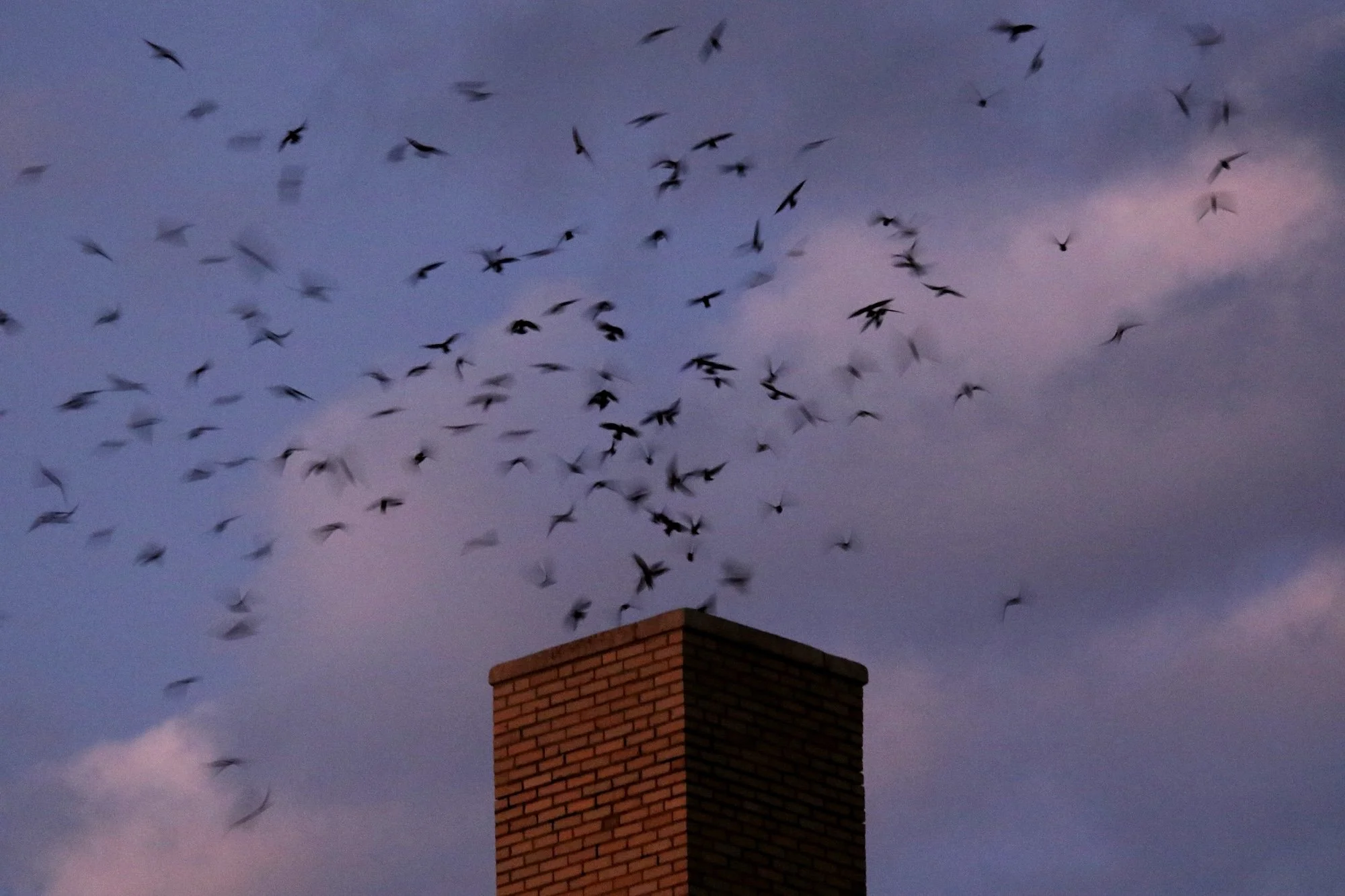
Photo: Chimney Swifts, Ben Cvengros/Audubon Photography Awards
Evelyn Novins
Did you know that until the mid-19th century the Chimney Swift (Chaetura pelagica) was called the American Swift? In the past the Chimney Swift commonly built its nest in abandoned woodpecker holes. As settlers moved west in the Americas they destroyed many trees but built chimneys, and the birds easily transitioned into these upright structures.
They are having a harder time adapting in our urbanizing areas. The Chimney Swift is one of the five birds that breeds in northern Virginia that the North American Bird Conservation Initiative defines as at the tipping point for survival. This means that the bird has lost two-thirds of its population in the past 50 years and is on track to lose another 50% in the next 50 years. The Virginia Department of Wildlife Resources lists it as a bird of greatest conservation need as well.
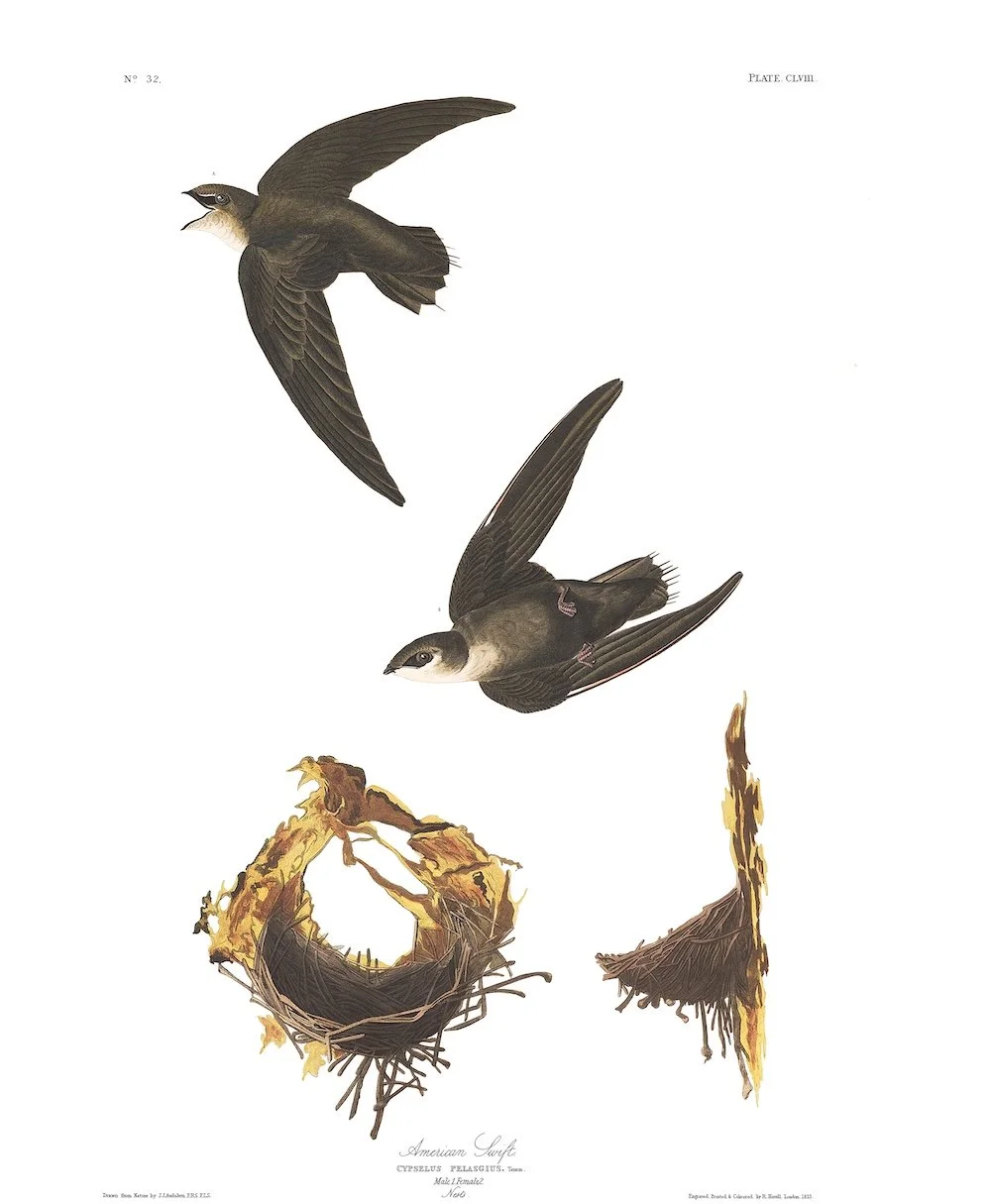
American Swift, John James Audubon
The chimney swift has a tiny slender body (5 inches) with long, narrow, curved wings (12-inch span). The head is round with a short neck, and the bird’s bill is so short that it is difficult to spot. The tail is short as well and squared off. Birders often say it looks like a flying cigar, and it often looks totally black against the sky despite its gray/brown color and a paler chest. For this reason, it is most easily recognized against the sky from its silhouette: its wings look like a boomerang. Check out its snappy wingbeats in a video on Cornell’s All About Birds site.
The Chimney Swift spends its day flying and capturing insects, not perching. Actually, the chimney swift cannot perch horizontally like most songbirds, only vertically as with all swifts. Its long forward-facing claws act like grappling hooks, clinging to the walls of chimneys and other vertical surfaces.
Both the male and the female make the nest. It is made of small twigs and branches that they break from trees with their feet as they are flying. Securing the twigs in their mouth, they return to the nest site. The twigs are loosely woven together and stuck with saliva to the vertical wall of an abandoned woodpecker hole, chimney or man-made tower. The completed nest measures 2–3 inches from front to back, 4 inches wide, and 1 inch deep. The clutch size is generally from 3-5 eggs and they can have two clutches per season.
The chimney swift’s diet consists of airborne insects. Its food includes wasps, bees, flies, mayflies, stoneflies, beetles, fleas, craneflies, and more. The little ones go right down the throat as it is flying. It grabs larger insects first in its short bill. They can get insects from branch tips and have been reported to flush out prey from ground foliage. They can be seen foraging over urban and residential areas as well as fields, shrublands, forests and marshes. They are considered diurnal foragers; however, they sometimes hunt for insects around lights at night. Chimney Swifts are incredible aerial insectivores, spending most of their lives in the air, even drinking and bathing by skimming over the water.
As a migratory species, the Chimney Swifts are in North America during the spring and summer to breed. In the fall, they flock and migrate, wintering in eastern Peru and elsewhere in the Amazon Basin of South America.
The Migratory Bird Treaty Act prevents you from removing a Chimney Swift nest from your chimney without a permit until breeding season is over and the birds have abandoned the nest completely. But that protection is not enough to prevent its current decline in population, the causes of which are largely unclear and manyfold. Contemporary chimney designs with covered, narrow or metal flues interfere with nesting and roosting opportunities. Widespread pesticide use decreases the population of insects, the bird’s dietary staple. In addition, death from window collisions is not uncommon, including cases of mass fatalities. The birds cannot see glass or they mistake reflections for open air. The effects of climate change also affect Chimney Swifts. The severity of hurricanes over their migratory route reportedly has caused mass fatalities.
Conservation efforts need to focus on educating the public about the devastating effects of overuse of pesticides, such as broadcast spraying for mosquitoes, preventing destruction of nesting and roosting sites, installing and monitoring new nesting and roosting structures, and encouraging bird-safe building design. Cape Henry Audubon has an active project to conserve Chimney Swifts, and NVBA works in our area to encourage bird-friendly building design and lighting through Bird Safe NOVA.
Chimney Swifts arrive in our area during spring migration in March/April. They select nest sites, often returning to previous sites. Mating pairs will allow non-mating swifts to roost in their nesting areas and they often help with raising the young. Chimney Swift towers are helpful in providing nest and roosting sites. Plans for towers are available on the Chimney Swift Conservation Association’s website.
David Lawlor, ecologist from Fairfax County, reports that there are Chimney Swift towers at Runnymeade Park in Herndon and Cub Run Rec Center in Chantilly. The Northern Virginia Bird Club holds a Chimney Swift Watch event each fall at a local roost site. The spectacle of the birds returning to their roost site after spending the day bulking up on insects to fuel their fall migration is mesmerizing. Watch for the announcement of a walk this fall in the bird club’s newsletter, The Siskin, typically in its August issue. The bird club’s walks also are available from a link on the NVBA website.

The 2025 Virginia General Assembly Session So Far
The Virginia General Assembly adjourned sine die on February 22. It is scheduled to reconvene April 2 to address actions the governor may take on legislation sent to him.
Photo: Virginia State Capitol Building, Wikimedia user Skip Plitt via CC BY-SA 3.0
The Virginia General Assembly adjourned sine die on February 22. It is scheduled to reconvene April 2 to address actions the governor may take on legislation sent to him. The governor can sign the bill if he approves it, and the bill becomes law; he can veto it by returning the bill with his objections to the house in which the bill originated; or he can return it to the house in which the bill originated with specific recommended amendments. The legislators can override the governor’s veto and object to or adopt recommended amendments. The available options are outlined in Virginia Constitution.
There are several bills that we hope will become law:
Budget Bill Item 367, Nesting area for seabirds: The governor included $4.4 million to create a permanent nesting area for 25,000 seabirds that had moved to a temporary location due to construction on the Hampton Roads Bridge Tunnel Project. None of the House or Senate budget amendments modified this provision, so it appears likely to be included in the final budget.
HB 1941 and SB 1166, Invasive plant signage for retail sales: Both the House and Senate bills require retail establishments selling certain invasive plants to post conspicuous signs identifying the plants as invasive, educating consumers regarding invasive plant species, and encouraging consumers to ask about alternatives. The bills would require that the signs be posted as of January 1, 2027. It remains to be seen whether the Governor will veto the bills as he did last year.
HB 2630 and SB 2638, Tree canopy fund: Both bills passed without amendment in both houses. They allow local governments to set requirements for the replacement of trees that are cut down during development. They also allow local governments to establish a tree canopy fund to collect, maintain, and distribute fees collected from developers that cannot provide for full tree canopy requirements where the development project is situated. The governor may sign, amend, or veto the bills.
There are several bills we had hopes for that failed, including HB 2059, the Great American Outdoors Act, which would have funneled money to parks.
To learn more, visit the Virginia Conservation Network, and the Chesapeake Bay Foundation.
Stay tuned!

Clean Water and Native Plants
If your property contains a stream, pond, or any sort of wetland, whether its flow is permanent or intermittent in nature, this article is especially for you!
Image: James River Consortium
Plant NOVA Natives
If your property contains a stream, pond, or any sort of wetland, whether its flow is permanent or intermittent in nature, this article is especially for you! Anyone can directly enhance water quality, and in turn benefit the health of the animal, plant, and human communities that depend upon it, by using native plants to fill the “riparian buffer” adjacent to a water feature. The word “riparian” comes from a Latin word meaning “bank.” A riparian buffer protects the wetland from runoff from developed areas, including turfgrass lawns.
If the riparian buffer already contains natural vegetation, you should first control any invasive plants found there. You also should avoid adding any new species, native or otherwise, that will disturb the existing plant community. You may need a waiver from your local governmental authority to remove existing vegetation and to plant new plants within 100 feet of a stream, shore, or wetland. Maps of these “Resource Protection Areas” can be found here. If the area is currently landscaped or mowed, you may be able to add native plants without a waiver, but you should still check with your county or municipal government.
To figure out if the plants that are present are native or invasive, you can use a free app such as iNaturalist or a subscription-based app such as PictureThis to help you with the identification. You also can invite a volunteer from NVBA's Wildlife Sanctuary Program to walk the site with you.
Healthy riparian buffers with native plants are beautiful to see and fun to explore. They support a wide diversity of life and create peaceful and inviting landscapes that draw us in to enjoy and connect with the nature they support.
Riparian buffer graphic from James River Consortium
Riparian buffers are also the natural defenders of stream banks. They help stabilize the soil and control soil erosion. This is due to their capacity to slow down and absorb stormwater runoff that would otherwise erode the banks of streams and rivers and fill the Chesapeake Bay with excessive silt. Due to riparian buffer degradation and excessive runoff across northern Virginia, a massive quantity of silt from our streams and rivers now reaches the Chesapeake where it clogs the gills of wildlife, smothers eggs, buries aquatic insect habitats, and interferes with the production of oxygen by aquatic plants. Anything we do that successfully holds soil will benefit the Bay. Riparian buffers also act as filters that trap pollutants. This protects aquatic life from harmful contaminants and keeps them out of our water supply. Native trees provide the leaves that feed aquatic insects, and their shade lowers the water temperatures, making the environment more hospitable for life. As the earth warms, planting and protecting native plants on riparian borders will become increasingly urgent.
Ideally a riparian buffer should be at least 100 feet wide, but don’t let that discourage you, as a buffer of any size is helpful. Try to pick combinations of native plants that would naturally occur along waterways in your region. This will increase the odds of creating a balanced, healthy habitat that continues to grow and thrive. Please refer to the resources on the Plant NOVA Natives website to help you select your plants.
Riparian buffers formed naturally on undisturbed land, holding soil, cooling water, filtering pollutants, and supporting life. It is humans who have disturbed them. Our work now is to take a moment to pause and wonder at the interdependence of land, water, native plants, and animals. Regardless of the other forces at work to degrade our environment, we still have the power to rebuild essential habitats on the lands we control.

Get Ready for Birdathon 2025
As spring arrives in northern Virginia, we’re looking forward to Birdathon 2025, our annual event where teams collect pledges from friends and family and then record how many species they can identify during any 24-hour period between April 19 and May 18.
Photo: Birders, Camila Cerea
As spring arrives in northern Virginia, we’re looking forward to Birdathon 2025, our annual event where teams collect pledges from friends and family and then record how many species they can identify during any 24-hour period between April 19 and May 18. In addition to being just plain fun, Birdathon helps NVBA to support outdoor education, citizen science, habitat conservation, and programs to encourage people to plant native plants and protect native wildlife. Birdathon also helps ornithologists better understand spring migration by reporting sightings through eBird, an online database of bird observations run by the Cornell Lab of Ornithology.
More information is available on our Birdathon 2025 webpage. You can plan a big day route around northern Virginia, or you can even participate from your own backyard. So, gather your birding buddies and register your team today. If you have already registered a team, or just want more information on Birdathon, make sure you join us on Sunday, March 23 from 2:30 - 4:30 PM for our Alliance Afternoon. Matt Felperin will be giving us a warbler bootcamp to get us all ready for Birdathon. You also can watch a free webinar about competitive birding and Birdathon with ornithologist Greg Butcher. If you’re planning to gather your team in your backyard, join us March 20 for a free webinar on backyard bird identification.

A Closer Look: Nature All Around Us, March 2025
Judy Gallagher is an NVBA board member and a regular surveyor of local wildlife who also captures photos of what she sees, in particular the less common species.
Photo: Aplos simplex nymph, Judy Gallagher
Judy Gallagher
March 2025
Have you ever seen a small insect with a fiber-optic-like tail? If so, you've probably seen a planthopper nymph.
Aplos simplex nymph (family Issidae), Judy Gallagher
Planthoppers are True Bugs, members of insect order Hemiptera. There are twenty Planthopper families world-wide, with twelve families in North America north of Mexico, so it's quite a diverse group of insects. There are over 900 species reported in the U.S. and Canada. They range in size from 0.08 inches to 4 1/2 inches, but most of our local planthoppers are on the smaller end of the range.

Delphacid Planthopper (family Delphacidae) showing the bulbous antenna projection (the little circle under its eye), Judy Gallagher
There are other kinds of hoppers: leafhoppers; froghoppers and treehoppers. Planthoppers can be distinguished from those by their wing venation and their antennae, which are below the eye and have a bulbous projection. Unlike other hoppers, planthoppers have two face segments that separate their simple eyes or ocelli. Some planthopper species have both full-winged and short-winged adults. The short-winged adults can't fly, but the full-winged adults can, and they often occur in the same population. But they often hop rather than fly, and both adults and nymphs can hop up to 100 times their body length.
Most local planthoppers have between one and three generations a year, but some tropical species can have up to 12 generations in a year. Adults feed on plant juices, but some nymphs feed on fungus or mosses. Some species are host-specific, feeding on one plant or several related plants, while others can feed on many different plants.

Spotted Lanternfly (family Fulgoridae), seen here on an NVBA field trip to Cape May, on board member Tom Wood's shoe, Judy Gallagher
Most local planthoppers don't cause much damage to plants. There are a few crop-damaging planthoppers found outside our area, like the Brown Planthopper, a significant pest of rice. The invasive Spotted Lanternfly is a problem for both fruit and forest industries in our area. It's bigger than most of our local species. It sucks out plant juices, wounding the plant, and excretes a sugary fluid that causes sooty mold, which can further damage the plant. The Spotted Lanternfly is a member of family Fulgoridae. Species in this family have elongated snouts, and folklore has it that these snouts illuminate at night, hence the name Lanternfly.
Some plant-damaging planthoppers can help control invasive plants. The Waterhyacinth Planthopper has been released in Florida to help control Water Hyacinth, which tends to clog waterways.

Big Bluet damselfly eating a Northern Flatid Planthopper (family Flatidae), Judy Gallagher
Planthoppers are a significant source of food for anything higher up on the food chain.

Aplos simplex (family Issidae) nymph (The black thing near the tail is a Pincer Wasp parasitoid), Judy Gallagher
And they are also preyed upon by parasitoids. Pincer Wasps (family Dryinidae) are parasitoids of planthopper and other hopper nymphs, with rates of parasitism of 20% or more, and they are an important biological control of planthoppers.

Aplos elliptica or bullata (family Issidae) parasitized by Planthopper Parasite Moth (the white thing protruding from the rear end of the planthopper), Judy Gallagher
One of the more bizarre parasitoids is a Moth. The Planthopper Parasite Moth is the only local member of a Moth family, Epipyropidae, whose caterpillars are all carnivorous. The adult moth lays its eggs on plants, and the caterpillars find an adult planthopper, attach themselves to it, and feed on the planthopper's bodily fluids.

Two-striped Planthopper nymph (family Acanaloniidae) showing off its waxy tail, Judy Gallagher
You might have been wondering why planthopper nymphs have those fiber-optic tails. The tails are made of wax secreted from abdominal glands, and some tropical planthopper nymphs have tails that are several inches long. The tails can deter predators by either camouflaging the planthopper or acting as a physical barrier against predators and parasites. Planthoppers secrete sugary waste called honeydew that is prone to fungal attacks, and the tails may also help protect the nymphs from the fungus. But a recent study proved another benefit of the tails. As I mentioned before, wingless planthopper nymphs can jump long distances. If the nymph lands in an unfavorable body position, it is susceptible to predation. The tails serve an aerodynamic self-righting function, allowing the nymphs to have a stable, controlled descent. Planthopper nymphs with waxy tails land in a good position 98.5% of the time, while tail-less planthopper nymphs only land in a good position 35.5% of the time.
I hope you find some cool planthoppers this season, but no Spotted Lanternflies!
View more of Judy’s Closer Look (formerly Observations from Meadowood) articles here.

Wildlife Sanctuary Almanac: Wildlife-Friendly Spring Garden Cleanup
If you followed the advice to forgo an annual autumn garden cleanup and instead left fallen leaves and dead plant stems in place to provide winter habitat for wildlife, your yard helped lots of local bugs and birds survive the winter and prepare for spring.
Photo: Common Eastern Bumblebee, Judy Gallagher
Alda Krinsman
Another winter will soon be behind us--almost! If you followed the advice to forgo an annual autumn garden cleanup and instead left fallen leaves and dead plant stems in place to provide winter habitat for wildlife, your yard helped lots of local bugs and birds survive the winter and prepare for spring.
With spring approaching you may be tempted to do a spring cleanup of all that dead plant material. However, early spring temperatures can be erratic. The wildlife you were protecting in autumn is still sheltering in the dead plant stems, under leaf litter, or in brush piles. Resist the temptation to do a wholesale garden cleanup until days and nights are reliably above the 50-degree range. Before you grab your garden tools, spend some time outside observing whether any early flowers such as violets, spring beauties, or red maples are blooming, and whether any native bees have emerged. If you are still unsure about when it is safe to begin your cleanup, you can find additional guidance from Xerces Society here.
Even in spring, dead plant material from the prior growing year is still providing habitat for wildlife, especially native bees and other insects. Pithy, hollow stems from last year’s growth provide nesting places for the current generation of native bees and beneficial insects. Don’t remove or cut all these stems down to the ground. Instead, cut back stems to 8”-24.” This spring’s bees will use those cut stems as places to lay and provision their eggs, which will emerge as a new generation of bees next year. And don’t chop up the stems that you cut back. Leave them on the ground near the plant or in a brush pile to protect any insects that are late to emerge. For your own use, or to pass along to interested neighbors, see the open source brochure from Xerces Society on creating habitat for stem-nesting bees.
Common Eastern Bumblebee, Judy Gallagher
Nor should you be in a hurry to remove last autumn’s leaf litter. Queen bumblebees and other wildlife depend on those leaves for protection from late-season frosts or freezes. The leaves also feed the soil as they decompose, and provide habitat for valuable soil-occupying fungi and bacteria, as well as insects such as fireflies. Most new plant growth is strong enough to break through leaf litter. If any leaves appear to be smothering new plant growth, you can lightly brush them off the plant’s crown.
If you have aesthetic concerns about leaving plant debris in your garden, you might consider using excess leaf litter or plant debris to create a brush pile in an out-of-the-way area, thus creating more habitat. Emerging new plant growth will hide any cut-back stems, and, if you adopt the practice of using dense plantings of native plants to create “green mulch,” most plant debris will be unobtrusive once the growing season is under way.
By then, most stem-dwelling bees and other beneficial insects will have emerged from their protected winter shelters and will be buzzing around, filling your garden with life.
Catch up on past Wildlife Sanctuary Almanac articles here.

Monday Mystery - February 24, 2025
Monday Nature Mystery continues! Read on to learn who correctly identified our last mystery.
Photo: Spotted Salamander (Ambystoma maculatum). Photo: USFWSmidwest, Public domain, via Wikimedia Commons
We are pleased to announce the winner of our most recent Monday Nature Mystery, Blair Lear!
Congratulations to Blair for identifying this Spotted Salamander (Ambystoma maculatum).
Spotted Salamander (Ambystoma maculatum). Photo: USFWSmidwest, Public domain, via Wikimedia Commons
According to the Virginia Department of Wildlife Resources, the spotted salamander, also known as the yellow-spotted salamander, is a member of the mole salamander family which are endemic to North America. These salamanders get their family name from their burrowing behaviors, as they spend the majority of their life underground. You will only see them in the water are during their juvenile stage and when they return to breed.
Monday, March 3 will be our last Monday Nature Mystery, so if you’ve never played, now is your chance! We started Monday Nature Mystery back in 2020 during the pandemic, and we hope you enjoyed playing along and learning about our local wildlife and plants as much as we did. Thanks to all who participated!
Here is this week’s mystery:
Who is this?
Be sure to post your guess on our Facebook page under the latest Monday Nature Mystery post, and make sure you receive our emails to find out the winner and mystery answer each week. Good Luck!
Please check our guidelines here.

Monday Nature Mystery: Who is this? Photo: Judy Gallagher

A Closer Look: Nature All Around Us
This month we have renamed Judy Gallagher’s monthly feature article, which provides her stunningly detailed photos of insects, along with fascinating information about their lives.
Photo: Ocala Skipper with pollen on its face, Judy Gallagher
This month we have renamed Judy Gallagher’s monthly feature article, which provides her stunningly detailed photos of insects, along with fascinating information about their lives.
Find Judy’s latest article here.

The Birds Are Coming – Will the Lights Be Out?
Migration season is approaching fast. Between March 15 and May 31, 100 million birds will pass through northern Virginia, most of them flying at night.
Photo: Baltimore Orioles, Eric Nie/Audubon Photography Awards
Migration season is approaching fast. Between March 15 and May 31, 100 million birds will pass through northern Virginia, most of them flying at night. The birds can be disoriented by bright lights from tall buildings and sky glow from light pollution. Some crash into the buildings and are injured or die. Other birds fly around the lights, exhausting themselves. It’s critical that we take steps to help protect them.
There are three ways you can help protect migrating birds.
Help us talk to building managers. NVBA and other members of the Bird Safe NOVA partnership will be contacting building managers in the Tysons and Reston areas to tell them how important it is to turn lights out between 11 PM and 6 AM during migration season. How effective we’ll be will depend on how many people are willing to help. If you’d like to work with us on this project, please email advocacy@nvbirdalliance.org.
Search for birds injured or killed by window collisions. We will work with the Wildlife Rescue League to train volunteers who will walk around tall buildings early in the morning during migration season to document bird deaths from window collisions. Data on bird deaths can be used to help convince building managers to turn their lights out at night. We’ll provide training on where to go and what to do and provide business cards with contact information so people can let us know when they find dead birds. Of course, if the bird needs help, call the Wildlife Rescue League at 703-440-0800.
Help build a database of bird collisions. Jeremy Andre, an alumnus of George Mason University, has developed the One Stone Bird Map, a geographic information system (GIS) visualization project designed to track and analyze avian mortality across the DC, Maryland, and Virginia (DMV) area. The project’s objective is to shed light on the under-reported issue of bird deaths in urban areas, particularly from window collisions and outdoor cats. You can learn more about the project here.

You can also report bird deaths on iNaturalist’s Bird-Window Collisions website. The project will help quantify mortality of birds due to window collisions, identify hotspots of mortality, and propose mitigation measures.
We’re joining efforts around the country to protect birds from window collisions.
Northern Virginia is far behind other areas of the country in working to protect birds from window collisions. The District of Columbia has a well-established Lights Out DC campaign run by City Wildlife. The Cape Henry Audubon Society has spearheaded a very effective Lights Out Hampton Roads campaign. They have established teams that walk key areas of Norfolk to find and report birds killed by window collisions and have convinced building managers to turn out or dim their lights during migration. Lights Out campaigns are operating throughout the country. National Audubon Society’s Lights Out Program map documents more than twenty cities with program to reduce outdoor lighting during migration season, including Philadelphia, New York City, and Chicago.
It’s time for Northern Virginia to do its part to protect birds. If you’d like to help, contact us at advocacy@nvbirdalliance.org.


We’re Recruiting
NVBA relies heavily on its members to execute its mission, and we’re currently looking for members interested in serving on our Board of Directors.
Photo: Eastern Bluebirds, Danny Brown/Audubon Photography Awards
NVBA relies heavily on its members to execute its mission, and we’re currently looking for members interested in serving on our Board of Directors. Your interest in and commitment to the birds and what they need are the primary qualifications, but we are also hoping to recruit new board members with strengths in the following areas:
Finance and Accounting, to help with investments as well as month-to-month financial matters
Conservation, especially to help with Stretch Our Parks
Communications, including writers and editors, especially those with social media expertise
Diversity and Inclusion, to increase our reach and impact across all northern Virginia Communities
Adult Education, to help with bird- and conservation-related programming
If you are interested in getting involved, or if you have any questions, please contact Libby Lyons at president@nvbirdalliance.org.
Please join us!
Results of the 2024 Manassas-Bull Run Christmas Bird Count
The results of the 43rd annual Manassas-Bull Run Christmas Bird Count are in! Over seventy birders counted 17,591 birds of 79 species in this 15-mile diameter circle on December 15, 2024.
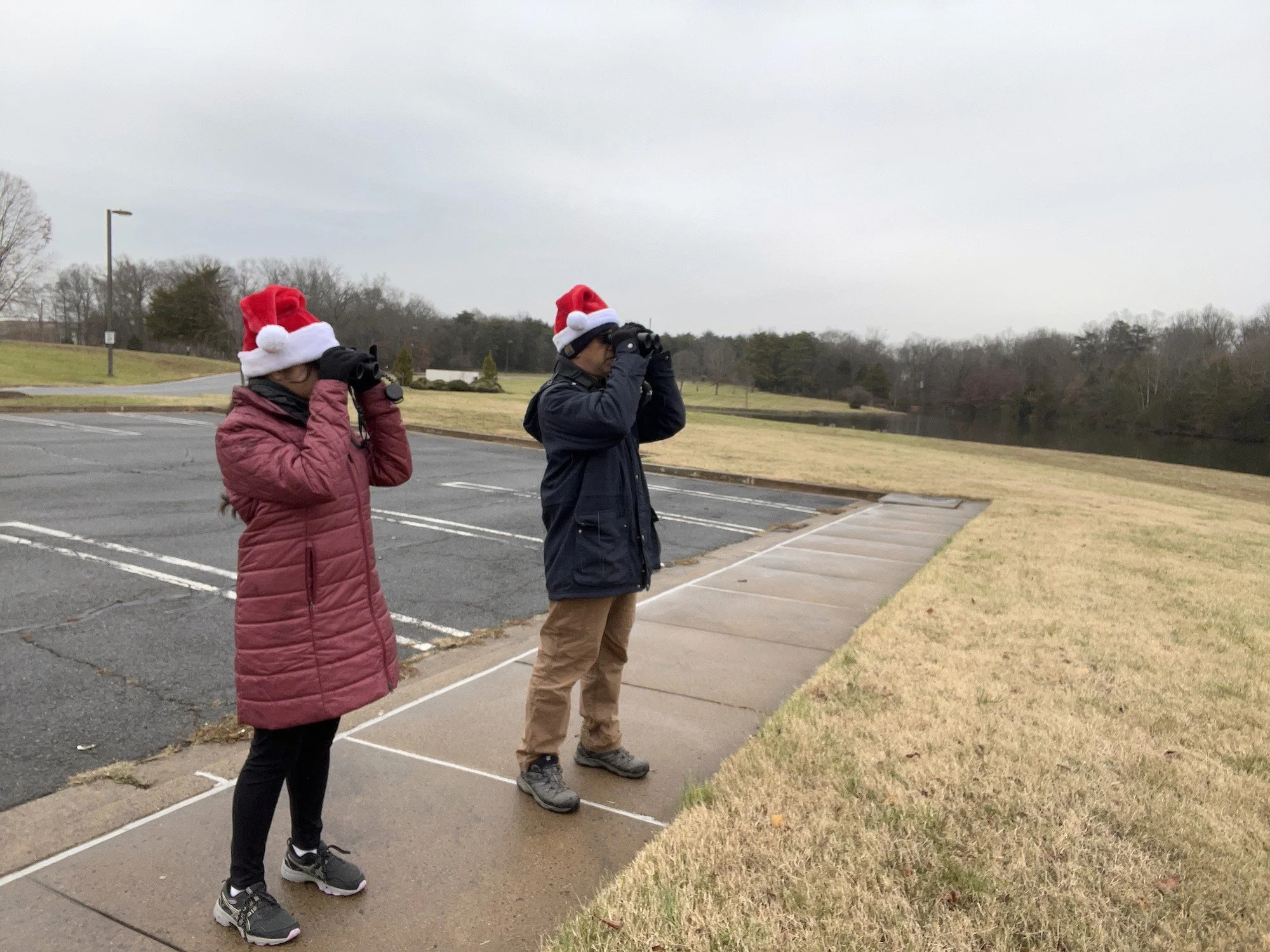
Photo: CBC participants Mehika and Deapesh Misra at Upper Occoquan polishing pond
Phil Silas, Compiler
The results of the 43rd annual Manassas-Bull Run Christmas Bird Count are in! Over seventy birders counted 17,591 birds of 79 species in this 15-mile diameter circle on December 15, 2024. There were 35 parties of field observers. They were led by experts but included birders of all skill levels. The day was cool and overcast with some drizzle toward mid-day.

Swamp Sparrow, Chuck Wood/Audubon Photography Awards
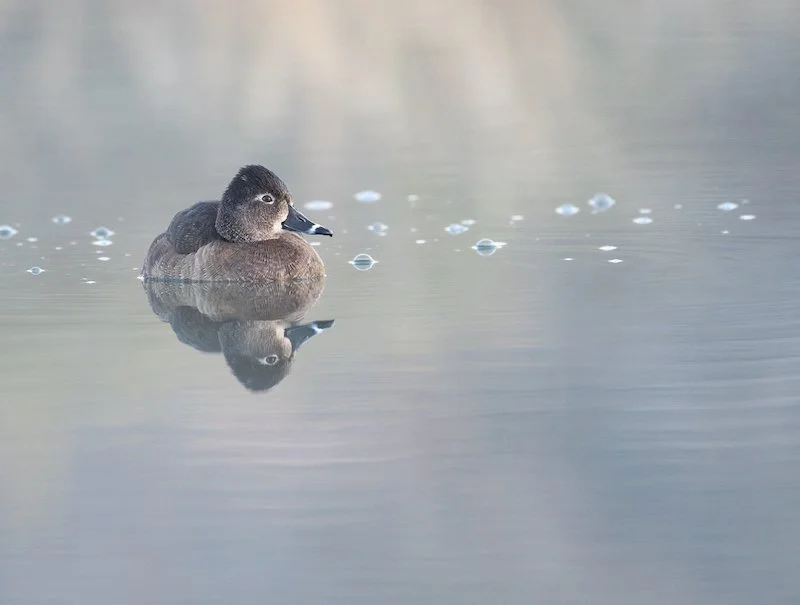
Ring-necked Duck, Mike Wood/Audubon Photography Awards
Ruby-crowned Kinglets numbered 36, and Winter Wrens numbered 26, which passed the respective high counts of 32 and 22 from all our previous counts.
The waterfowl had a few notable records as 83 Ring-necked Ducks were observed, which is 40 more than our previous high count. A single American Wigeon showed on a previous year’s count; this year’s count recorded two. Gadwall approached the record high of 50 with a count of 47.
Sparrows were a delight with Swamp Sparrows surpassing last year’s record of 40 by 1. White-throated Sparrows and Dark-eyed Juncos had strong numbers of 1,624 and 1,359, respectively. We don’t see the American Tree Sparrow and Fox Sparrow every year, so it was nice to record six and seven sightings, respectively. Northern Cardinals were just 11 off the record 877 observed just last year. Notably absent was the Common Grackle that had been super abundant on this count just two years ago.
Each of the six sectors observed at least one species unique to the count. Sector 1 had Eastern Phoebe; Sector 2 had Sharp-shinned Hawk; Sector 3 had Common Merganser, American Herring Gull, and Red-breasted Nuthatch; Sector 4 had Bufflehead; Sector 5 had Wild Turkey and Brown-headed Cowbird; and Sector 6 had Northern Shoveler, American Wigeon, Lesser Scaup, and American Tree Sparrow.
Thanks to all who participated, especially my fellow sector leaders -- Robin Duska Huff, Greg Butcher, Toby Hardwick, and Robert Mocko. Mark your calendars for the 44th count December 14, 2025. The spreadsheet with all the data by sector is linked here.

Calling All Photographers: 2025 Audubon Photography Awards
The National Audubon Society’s annual photography competition is now open for submissions.
Photo: Green-winged Teals, James Fatemi/Audubon Photography Awards
The National Audubon Society’s annual photography competition is now open for submissions. You can submit photos or videos until Wednesday, March 5 at 12 p.m. (noon) ET. Let’s see if northern Virginians can bring home more prizes. Remember that local teens Amiel Hopkins and James Fatemi won the Youth Honorable Mention Award in the 2022 and 2023 competitions, respectively.

Greater Prairie Chicken, Amiel Hopkins/Audubon Photography Awards
Recognizing that many species migrate between the northern and southern hemispheres, Audubon is opening the competition this year to submissions from Chile and Colombia in addition to the submissions from the United States and Canada. So, there will be cash prizes for entrants from the United States and Canada, and for entrants from Chile and Colombia. Winning photos also are featured in Audubon’s magazine.
Keep reading here for the contest rules, prizes and some tips on how to capture that picture-perfect moment.

Community Associations and Environmental Leadership
Community associations are positioned to play a transformative role in ecosystem rejuvenation and health, acting on their common land and inspiring residents to do the same on theirs.
Photo: Community entrance sign with native planting, Gretchen Spencer
Plant NOVA Natives
Community associations are familiar local institutions. They serve residents by enacting and enforcing community rules, managing any common areas, and enhancing the neighborhood’s quality of life. In addition, in recent years, a number of community associations in northern Virginia have chosen to expand stewardship of their lands to the native flora and fauna inhabiting them. Those organizations who have reached this pivot point came to realize that the two seemingly unrelated goals of supporting ecosystem health and maintaining property values are in fact mutually reinforcing.
Community entrance sign with native plantings, Gretchen Spencer
This is good news, as community associations are positioned to play a transformative role in ecosystem rejuvenation and health, acting on their common land and inspiring residents to do the same on theirs. Some local homeowner associations (HOAs) own very large swaths of natural spaces, including environmentally sensitive riparian borders along streams and rivers across our region. They therefore have the necessary control to make both small and big decisions that can determine the future of the birds and butterflies of northern Virginia. As an example of a project that can make a big difference, seven HOAs participated last year in a mini-grant program for invasive plant removal, supplementing professional services with volunteer help to rescue their trees.
Whether your community association manages acres of common land or none at all, there are a number of ways to lead in the environmental stewardship space. The following ideas reflect what is actually being done in various community associations across northern Virginia. Many of these projects require little or no budget.
Develop a natural landscaping policy for your common land.
Set voluntary standards for landscaping on residential properties and provide residents with resources to choose native plants -- Approximately 300 species of Virginia native plants are available for sale, which provide plenty of choices, whether you are looking for a natural look or a conventional landscaping plan.
Use your newsletter or NextDoor.com to raise awareness.
Host presentations at community meetings on the benefits of invasive plant removals and native plant landscaping.
Develop a plan to control invasive plants on your own property.
To keep invasive plants from spreading back from adjacent land, encourage residents to remove invasives on their own properties and to volunteer to control invasives in their local park. Adopt the roadside right of way to combat invasives there. VDOT has a relatively straightforward permitting process for this.
Organize native tree plantings – See organizing tips and program examples here.
Join an alliance for political action. Loudoun communities can engage with the Loudoun Invasive Removal Alliance that currently represents 50 community associations and 210,000 residents in that county. Fairfax communities can engage with the Fairfax Invasive Removal Alliance that currently represents 40 community associations and 150,000 residents there.
For details about these ideas as well as many others, see the community association page on the Plant NOVA Natives website.
Community associations are reinventing themselves as we write this. As stand-alone organizations, their members can help draft and implement stewardship plans and monitor results. As alliance members, they can use their significant political clout to advocate for sustainable development and ecosystem protection. As trusted partners in the greater community, they can help reinstate the biodiversity of our region. As always, we thrive together.

The Short-eared Owl, Another Winter Visitor
Some observant DC-area birders were fortunate to catch sight of Short-eared Owl in the DC-northern Virginia urban core late in December and early in January.
Photo: Short-eared Owl, Duke Coonrad/Audubon Photography Awards

Short-eared Owls, Diana Whiting/Audubon Photography Awards
Some observant DC-area birders were fortunate to catch sight of Short-eared Owl in the DC-northern Virginia urban core late in December and early in January. Sightings were reported from Reagan National Airport, the Washington Sailing Marina, Gravelly Point Park, East Potomac Park, and Hains Point, but it’s a relatively uncommon visitor. In northern Virginia, it’s a winter visitor, but it’s a little more likely you’ll see one in the more rural areas of northern Virginia, such Loudoun and Fauquier Counties, primarily because it’s an open-country hunter, foraging in fields and grasslands.
Like another occasional winter visitor, the Snowy Owl, the Short-eared Owl is a diurnal hunter and so is often visible during the daytime. The birds fly low over grasslands, especially at dawn and dusk. You often see them where you also see Northern Harriers, and they sometimes get in conflict over prey with the harriers and each other. They hunt small mammals and birds.

Short-eared Owl, Terri Shaddick/Audubon Photography Awards
They have short ear tufts, distinguishing them from Long-eared Owls, but the tufts are rarely visible. To identify them, look instead for a medium-sized owl, pale below with dense, vertical streaks on the breast. Its back is mottled brown and buff, and it has black-rimmed yellow eyes and a pale facial disk.
Short-eared Owls nest on the ground and you may see them flying up from the ground, but in winter they also may roost in trees. Because they are ground-breeders and migratory, they are particularly sensitive to habitat fragmentation and loss. They require relatively large grassland tracts for foraging. Conversion of open habitat to development is a driver in northern Virginia, reducing roosting and foraging areas for these winter visitors.
When we can, let’s all support conservation of important grassland habitat in northern Virginia and around North America to help this captivating predator.




A Closer Look: Nature All Around Us, February 2025
Judy Gallagher is an NVBA board member and a regular surveyor of local wildlife who also captures photos of what she sees, in particular the less common species.
Photo: Juniper Hairstreak on Fleabane, Judy Gallagher
Judy Gallagher
February 2025
I'm looking out my window at freshly fallen snow, trying to appreciate the season. But my thoughts keep wandering to spring, and right now I'm dreaming of butterflies fluttering erratically from flower to flower.
Ocola Skipper with pollen on its face, Judy Gallagher
When a butterfly lands on a flower to drink nectar, pollen sometimes rubs off on the butterfly. The pollen may be transferred as it visits other flowers. We usually think of bees as our key pollinators. But although they lack specialized structures for collecting pollen, butterflies and their moth cousins are also pollinators.
Juniper Hairstreak on Fleabane, with pollen on its abdomen and proboscis, Judy Gallagher
Butterflies like flowers with a landing platform, perhaps a daisy or fleabane, and they gather pollen as they wander around the flower clusters. They may not be as efficient pollinators as bees, but they visit an amazing number of flowers each day. Scientific studies have shown that butterflies like nectar with lots of amino acids, which appears to help them lay more eggs. They like brightly colored flowers, and unlike most bees, butterflies can see red. Many sense odors through chemoreceptors in their antennae, and so can smell sweet floral scents from a distance. Butterflies tend to fly farther than bees, and can potentially pollinate a larger area than bees.

Common Buckeye with Milkweed pollinia stuck to its foot, Judy Gallagher
Milkweed flowers are unusual in that their pollination structures and pollen are hidden inside the flower. The only way an insect can get to the pollen is to accidentally get its foot stuck inside the flower. When it extracts its foot, a mass of pollen grains called a pollinia may be attached, shown here (above and below) on a Common Buckeye.

Common Buckeye with pollinia detail , Judy Gallagher
Here's a closer look, above, at the Common Buckeye's feet. The pollinia are the yellow, elongated structures. Pollination occurs if the butterfly gets its foot with attached pollinia stuck in a different milkweed flower.

Great Spangled Fritillary on Flame Azalea with pollen on its wings, Judy Gallagher
Butterflies are the most important pollinator of Flame Azaleas. The anthers and stigmas of flame azalea flowers are widely separated, and large butterflies like Great Spangled Fritillaries and Eastern Tiger Swallowtails have wings that brush against the flowers, thereby collecting or depositing pollen. Scientists designed experiments to see how effective the butterflies were as Flame Azalea pollinators. When all pollinators were prevented from pollinating, or all pollinators except butterflies were allowed to pollinate, pollination rates were very low. When the butterflies were allowed in, pollination rates were ten times higher.

Eastern Tiger Swallowtail on Tiger Lily, Judy Gallagher
Butterfly wings can also pollinate Tiger Lilies, as this Eastern Tiger Swallowtail is demonstrating above.
Butterflies pollinate some commercial crops. They are the primary pollinators of Macadamia Nut trees in Brazil. They also can pollinate cotton. In a recent study, scientists catalogued the insects that visited cotton flowers. There were 40 bee species, 16 fly species and 18 butterfly species. Bees tended to visit the inner flowers, and flies and butterflies landed on outer flowers. This meant that 50% more flowers were visited than if bees were the only pollinators, and flies and butterflies were responsible for about one third of the pollination.

Butterfly with pollen on its face and eyes, Judy Gallagher
Here's an extreme close-up of a butterfly's head. Note the pollen grains scattered through its scales, and there are even a couple of grains on its eye. Do you know what popular butterfly this is?
I thought about not giving you the answer until next month's column, but leaving you in suspense would be cruel. Plus, I might forget by next month that I had promised to give you the answer. This pollinator is a Monarch.
Spring will be here before long. I hope you can spend quality time appreciating our butterfly pollinators.
View more of Judy’s Closer Look (formerly Observations from Meadowood) articles here.