NVBA NEWS BLOG

Welcome to the blog for Northern Virginia Bird Alliance, a wealth of resources about northern Virginia birds, wildlife, habitat conservation and restoration, native plants, wildlife-friendly gardening, advocacy and more.
News Jess Michetti News Jess Michetti

Invasive Plant Legislation Moves Forward in the Virginia Legislature

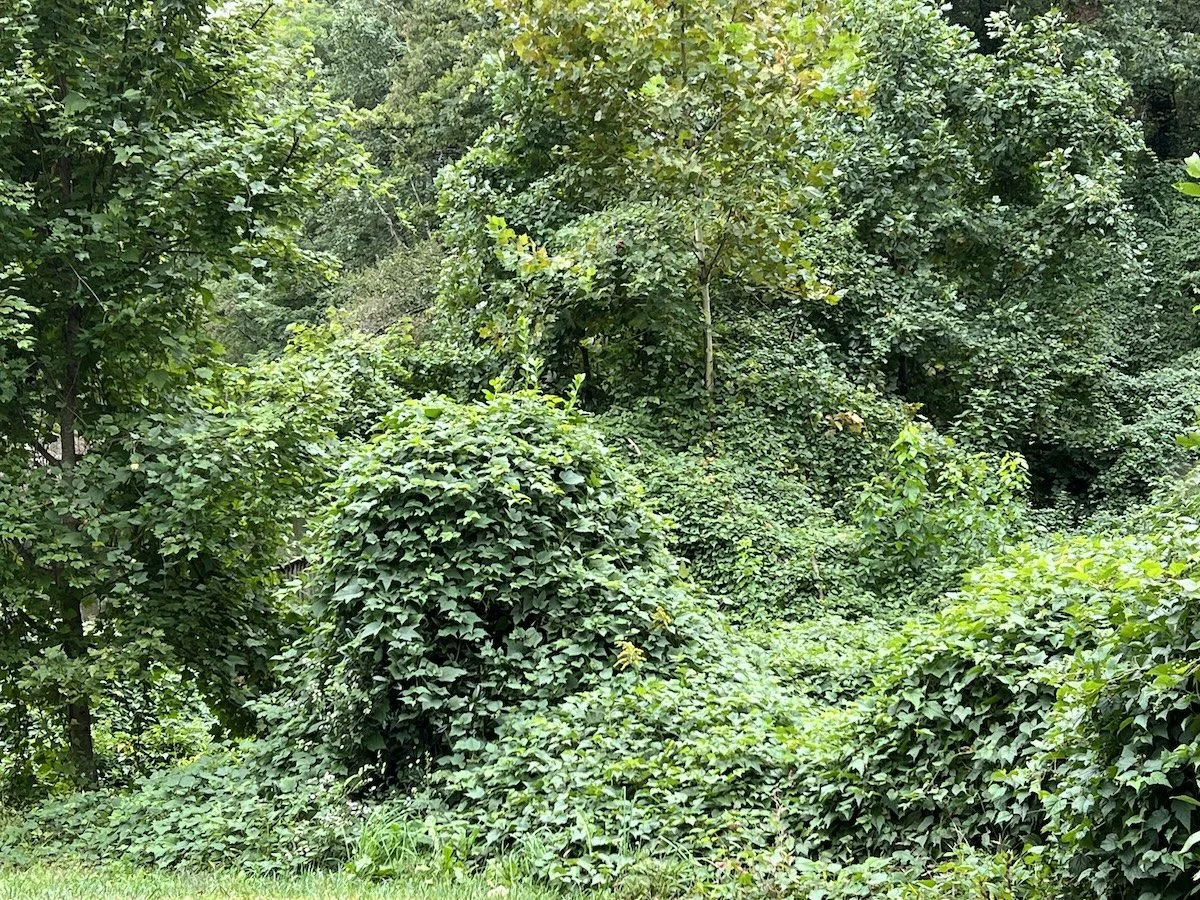
The Virginia legislature appears to be intent on taking steps to slow the environmental and economic harm that invasive plants are causing. State legislators introduced seven bills relating to invasive plants in the 2026 legislative session, and all of them are proceeding through the legislative process. 

Photo: Invasive vines, Valerie Morgan

Tom Blackburn

Anyone who walks in local parks or drives the highways can see invasive plants overwhelming trees, shrubs and meadows. Invasive plants are estimated to cost the state $1 billion per year. I am pleased to report that the Virginia legislature appears to be intent on taking steps to slow the environmental and economic harm that invasive plants are causing. State legislators introduced seven bills relating to invasive plants in the 2026 legislative session, and all of them are proceeding through the legislative process. 

Invasive vines smothering a tree. Photo: Valerie Morgan

Local government control of invasive plants: House Bill 388 and Senate Bill 89 are essentially identical bills that would permit local governments that have established service districts to use tax revenues to control the spread of plants on the state’s list of invasive plants. The House and Senate each has passed its bill by unanimous vote, meaning that it is virtually certain that the bills will be consolidated and sent to the Governor for signature. Congratulations to the Fairfax Invasive Removal Alliance, which first championed this bill and convinced other environmental organizations to support it. 

Ban on selling state-designated noxious weeds: Current law allows retailers to sell plants included on the state list of noxious weeds, even though they are the most destructive of the invasive plants, if they are commercially viable. As introduced, House Bill 109 would have banned the sale of noxious weeds outright. However, the House passed the bill by a vote of 96 to 2 with an amendment that phases in the ban over two years for grasses, forbs, and vines; four years for shrubs; and seven years for trees. The Senate Agriculture, Chesapeake and Natural Resources Committee reported the bill to the Senate, where it is awaiting final action. 

Ban on invasive plants along state highways: House Bill 88 would prohibit the Commonwealth Transportation Board and Commissioner of Highways from planting any plant on the state list of invasive plants along any state right-of-way. As introduced, the bill would have required the state to establish a plan for the removal of all invasive plants from the right-of-way, but that provision was removed from the bill before the House passed it by a unanimous vote. Two Senate committees have reported the bill unanimously, and it is now pending before the full Senate.

Civil fines for failing to notify landowners before planting invasive plants: House Bill 710 and Senate Bill 383 are essentially identical bills that establish civil penalties for tradespeople who propose or install plants listed on the state’s invasive plant list without first notifying the property owner in writing. The House bill passed with only two dissenting votes and the Senate bill passed unanimously. It is virtually certain that a consolidated bill will be sent to the Governor for signature.

Volunteers’ using herbicides on state property: In the last session of the General Assembly, the legislature passed and the Governor signed legislation permitting volunteers under supervision of a certified applicator to use herbicides on property owned by local governments. Senate Bill 163 would expand that law by making it applicable to state-owned property. The bill passed the Senate by unanimous vote and the House Agriculture, Conservation and Natural Resources Committee has voted unanimously to send the bill to the full House for a vote. 

Next steps: House Bills 88 and 109 must be passed by the Senate and Senate Bill 163 must be passed by the House before they can be sent to the Governor for signature. 

A big thank you to the 28 members of NVBA’s Advocacy Committee and other NVBA members who have agreed to write to their delegates and senators to support environmental legislation. We will continue to write to our legislators about these three bills and other bills that preserve and enhance our environment.

This story was updated on Wednesday afternoon, February 25. For further developments on the bills, go to the Virginia Legislative Information System and type the bill number into the search box identifying the chamber (HB or SB) and the bill number.

Read More
News Jess Michetti News Jess Michetti

NVBA’s Advocacy Committee and the Busy Season Ahead

There’s always something the NVBA Advocacy committee needs help with. With the 2026 Virginia General Assembly about to convene on January 14 for a fast-moving two-month session, the committee needs many volunteers to make sure its voice is heard. 

Photo: Virginia State Capitol Building, Wikimedia user Skip Plitt via CC BY-SA 3.0

Connie Ericson

I have been active in NVBA’s advocacy committee since 2018 when I joined the board. I had just retired and had not been active in any of the organization’s many projects. But when a board member asked for a volunteer to draft a letter to the National Park Service about a planned activity along the GW Memorial Parkway that could potentially disturb Bald Eagles, my hand shot up. Over the years my participation has waxed and waned, but there’s always something the committee needs help with. With the 2026 Virginia General Assembly about to convene on January 14 for a fast-moving two-month session, the committee needs many volunteers to make sure its voice is heard. 

There’s more information below on how you can help, but first, here’s a little perspective on the scope of the committee’s activities. 

Much of the work of the committee naturally focuses on local issues within NVBA’s geographical area, such as urging local officials to (i) take conservation into account when proposing and developing bike paths, (ii) support more preservation and restoration of land, (iii) encourage responsible dark sky lighting practices, (iv) prevent encroachment of development on nature reserves like Occoquan Bay NWR, (v) negotiate with Dominion Energy for streetlights that minimize light pollution, and much more. Whenever possible, NVBA will join with other organizations to increase the potential impact of our efforts.

Sometimes the committee will take a stand on issues relevant to the larger area, particularly when there’s a troubling environmental or conservation impact. A current example is helping reverse the serious decline in Ospreys in the Chesapeake Bay and addressing the menhaden reduction fishery operations in Virginia.

The committee will also comment on some federal regulatory and legislative issues, such as recent proposals to reduce the effectiveness of the Endangered Species Act and the Clean Water Act. In those efforts NVBA often partners with National Audubon, the National Parks Conservation Association, and the Southern Environmental Law Center.

Focus on the 2026 General Assembly

And, there are state-level actions, which affect northern Virginia and the rest of the Commonwealth. In the regulatory arena, NVBA is promoting building code amendments to require bird-safe windows. The committee has already been taking action in advance of the upcoming session of the General Assembly. The committee cosponsored a workshop on the menhaden/Osprey problem and hosted a free online seminar with Delegate Kathy Tran, who spoke on how to be an effective advocate. You can view the recorded seminar here

Because the General Assembly session is only two months long, bills move quickly, and we have to act fast when bills we support or oppose are scheduled for action. We would love to have your help. We anticipate advancing positions on invasive plants, menhaden fishing, data centers, much-needed funding for state parks and other protected lands and waters, retaining the Clean Economy Act, tree preservation and more. To learn more about anticipated bills and their need, visit The Virginia Conservation Network's "Our Common Agenda.”

If you can help, send an email to advocacy@nvbirdalliance.org with your name, email address and telephone number, and we will send you an email with some suggested talking points when action on an issue is required. Because time will be short, make sure you know in advance who your Delegate and Senator are and how to contact them. You can get that information from the Virginia General Assembly website on the Who's My Legislator page. Also, many state legislators have town meetings at home during the session and that is a great, nearby opportunity to advocate for sound conservation policies.

Let’s all do what we can in 2026 to help birds, other wildlife and the environment!

Read More
News Jess Michetti News Jess Michetti

Expanded Polystyrene Foam Now Banned in Takeout Containers in Virginia

If you have ever participated in a trash cleanup along a shoreline, creek or road, you’ll undoubtedly have come across pieces of expanded polystyrene foam (EPS), popularly known by one of its brand names, Styrofoam.

Photo: Scavenging gull, Chris Downer / Mallaig

Tom Blackburn

If you have ever participated in a trash cleanup along a shoreline, creek or road, you’ll undoubtedly have come across pieces of expanded polystyrene foam (EPS), popularly known by one of its brand names, Styrofoam. There is good news on the environmental front: as of July 1, 2025, Virginia implemented a ban on the use of EPS in takeout and beverage containers for vendors with more than 20 locations in Virginia, including grocery stores, restaurants, food trucks and caterers. On July 1, 2026, the ban goes into effect for all vendors.

Scavenging gull, Chris Downer / Mallaig

EPS is extremely harmful to the environment. It is fragile, and quickly breaks into smaller pieces, making it difficult to clean up. And because it is very lightweight, it often blows far from where it was initially deposited, making it even harder to collect for proper disposal. Like all plastics, EPS biodegrades very slowly. Scientists estimate that plastics may take at least five hundred years to biodegrade. If Captain John Smith had tossed a piece of EPS over the side of his ship as he traveled up the Potomac River in 1608, tiny pieces of it would still be in the water, where fish, birds and other wildlife could eat them. 

EPS and all other plastics break down into microplastics and nanoplastics before they biodegrade and can have severe health impacts. A recent article, “Seabirds in crisis: Plastic ingestion induces proteomic signatures of multi-organ failure and neurodegeneration,” in the journal Science Advances, reports that the stomachs, livers and kidneys of 90-day-old seabirds that had eaten plastics were not functioning normally, and the birds also showed symptoms of Alzheimer’s-like brain deterioration. While no studies have demonstrated adverse health effects in humans yet, an article, “Bioaccumulation of microplastics in decedent human brains,” in the journal Nature Medicine, reports that nanoplastics have breached the blood-brain barrier and are accumulating in human brains. 

Virginia State Representative Betsy Carr introduced HB 533 in the 2020 Virginia General Assembly to prohibit the use of EPS in carryout food service containers. It passed, but with an amendment requiring reenactment in 2021 before it could take effect. Rep. Carr’s reenactment bill, HB 1902, passed in 2021, but Governor Youngkin inserted language in the 2022 budget bill delaying implementation of the ban. He attempted to do the same thing earlier this year, but the legislature overturned the delay, allowing the initial ban to take effect this year. 

The Virginia Department of Environmental Quality has implemented a Foam Free Virginia campaign, providing information on its website about the ban, alternatives to EPS containers and filing a complaint about vendors violating the law. 

Read More
News Jess Michetti News Jess Michetti

It’s Official: The Bald Eagle Is Our National Bird

On December 24 President Joe Biden signed S. 4610, making it official that the Bald Eagle is the national bird of the United States.

Photo: Bald Eagle, Cynthia Hansen/Audubon Photography Awards

On December 24 President Joe Biden signed S. 4610, making it official that the Bald Eagle is the national bird of the United States. Many did not know that it was not already our national bird, because it is a pervasive symbol throughout our government, as the bill’s findings make clear. 

Since 1782 it has been the Coat of Arms for the United States Great Seal; it’s the leading insignia for all branches of the military; its image is on thousands of government branches, department and agencies; it’s integral to the spiritual lives and sacred belief systems of most Indigenous peoples and Tribal communities; and it’s on hundreds of stamps and many coins and currencies. 

For those of us working actively to conserve threatened bird species, it’s also a symbol of how focused efforts can return an endangered bird from near extinction.

Read More
News Jess Michetti News Jess Michetti

ASNV Co-Hosts an Advocacy Forum

ASNV’s Advocacy Committee co-hosted an Advocacy Forum with the Loudoun Wildlife Conservancy and the Faith Alliance for Climate Solutions on October 21, an event that attracted close to 50 people.

Photo: Virginia State Capitol Building, Wikimedia user Skip Plitt via CC BY-SA 3.0

The Honorable Kenneth (“Ken”) Plum, Member Virginia House of Delegates, District 36. Photo: Trinity Mills

ASNV’s Advocacy Committee co-hosted an Advocacy Forum with the Loudoun Wildlife Conservancy and the Faith Alliance for Climate Solutions on October 21, an event that attracted close to 50 people. Delegate Ken Plum was the keynote speaker and urged all to help influence conservation policies at all levels of government. Other presenters included: 

  • Mary Cortina, Fairfax County Planning Commissioner, and Kate Feingold, City of Fairfax Councilmember, on how a governing board makes policy; 

  • Chris Miller, Piedmont Environmental Council, and Trinity Mills, Loudoun Wildlife Conservancy, on how to be an effective advocate; 

  • Scott Peterson, Faith Alliance for Climate Solutions, Katy Johnson, Fairfax City Environmental Forum, and Michael Myers, Loudoun Wildlife Conservancy, on what we can learn from successful and unsuccessful advocacy efforts; and 

  • Mary Rafferty, Executive Director of Virginia Conservation Network, on what’s ahead in the Virginia General Assembly. 

Mary Rafferty, Executive Director, Virginia Conservation Network. Photo: Trinity Mills

Representatives of all of the sponsoring organizations were encouraged by the number of attendees who signed up to work on advocacy with their organizations. All left the sessions with a new appreciation for the importance of grass roots advocacy.

Read More
News Jess Michetti News Jess Michetti

Vote for Conservation This Month

All elections are important but Virginians will elect the entire Virginia General Assembly on November 7.

Photo: Wikimedia Commons

Wikimedia Commons

All elections are important but Virginians will elect the entire Virginia General Assembly on November 7. To learn how your state legislators voted on conservation issues, visit the conservation scorecard posted by the Virginia League of Conservation Voters. 

Local officials in our area, including Fairfax and Arlington counties, also will be on the November 7 ballot.

You can find examples of issues of concern to Virginia’s conservation voters on the website of the Virginia Conservation Network, one of ASNV’s partners.

The League of Conservation Voters posts a scorecard for federal elected officials. You can consult it at https://scorecard.lcv.org/.  

Read More
News Jess Michetti News Jess Michetti

Virginia General Assembly Passes Two Bills to Deter Invasive Plants

The Virginia House of Delegates and Senate have approved two bills that can help deter the spread of invasive plants in Virginia and encourage use of native plants.

Photo: Porcelain Berry vine, Wikimedia Commons

Elizabeth Martin

English Ivy, Wikimedia Commons

The Virginia House of Delegates and Senate have approved two bills that can help deter the spread of invasive plants in Virginia and encourage use of native plants. The next step is to send the bills to the Governor for approval. The success of the bills so far is due to tireless efforts of two northern Virginia legislators, Delegate David Bulova (37th District) and Delegate Paul Krizek (44th District) and advocacy by conservation organizations and voters throughout Virginia. Thank you from ASNV and its members! Please take a few minutes to write each of them a personal thank you.

The Two Bills

Delegate Bulova’s HB 2096 requires the state agriculture board to develop a list of invasive plant species, and includes provisions to discourage their use. The bill directs the board to develop regulations requiring commercial designers and installers to notify property owners of proposed use of any plants on the state’s invasive plants list. Because plant retailers and customers often do not know which plants are invasives, the requirement to provide information allows customers to make better choices. The bill also prohibits state agencies from planting, selling, or propagating the plants except for scientific or educational purposes. It also authorizes the board to adopt regulations for permits to move, transport, deliver, ship, offer for shipment, sell, or offer for sale any invasive plant.

Delegate Krizek’s HB1998 directs state agencies to prioritize native plant species and to take steps to identify state properties for native plantings and prepare guidance to rehabilitate state properties degraded by invasive species. Because the state owns many large properties, such as universities and prisons, the bill would expand native plant habitat. It also provides the state the opportunity to set an example for responsible environmental stewardship by enhancing its properties’ habitats with native plants that serve Virginia wildlife.

So Why Is This Important?

Non-native plants were introduced into the United States intentionally or accidentally by people sometime after Europeans first arrived in North America. Many are important food crops or ornamental plants that do no harm. But many are harmful invasives, non-native plants that can spread out of control and overwhelm and displace native vegetation. They can spread dangerously because they have no natural predators in our ecosystem. Even if an invasive plant appears to be “under control” in a private yard, its seeds can spread and invade nearby parks and wildlife areas. Native plants co-evolved with local wildlife and provide the best food value to them. An area overrun with non-native invasives is a food desert for native wildlife that depends on native plants to survive.

Chickadees provide a good example of that dependence. Research shows that unless a yard is at least 70 percent native plant material, it cannot support even one family of chickadees. Chickadee nestlings depend on caterpillars to survive, and caterpillars eat very specialized native plant species. No native plants (or trees) means no caterpillars, and that means no birds. Our native wildlife is losing habitat not only to development but also to encroachment by invasive plants, and habitat loss is the largest cause of the decline of North American birds.

The annual cost of invasive plant species in the U.S. is estimated to be $35 billion. (Swearingen and Fulton, Plant Invaders of Mid-Atlantic Natural Areas, 2022, p. 10). Current Virginia law identifies only 14 plants on the state’s “noxious weeds list,” but the list of invasives recognized by the Department of Conservation and Recreation is much longer. Common invasive plants in Northern Virginia include English ivy, running bamboo, Bradford pear trees, tree-of-heaven, oriental bittersweet, privet, porcelain berry and stilt grass. Virginia law allows the sale of most of them, and they have invaded our parks and reserves. Change, like that called for in the Bulova and Krizek bills, is sorely needed.

What You Can Do

Here are the links to track the further progress of Delegate Krizek’s HB 1998 and Delegate Bullova’s HB 2096. If you’re interested in learning more about how to advocate for legislation to improve wildlife habitat and halt the decline in bird populations, contact the ASNV Advocacy Committee using this link]

There’s more information available about invasive species, the harm they do, and what you can do about them here. And if you’d like to tackle invasives in your own yard, request a visit here from an Audubon at Home Ambassador who can help you identify them, tell you how to remove them, and advise on native plants that will enhance the habitat value of your property.

Read More
News Jess Michetti News Jess Michetti

Help Us Promote Stronger Conservation Policies in Fairfax County

We’re looking for volunteers to help ASNV contact members of the Fairfax County Board of Supervisors from time to time. Depending on the issue, we may ask you to call, email, or request a meeting with your district’s supervisor. Can you help?

Photo: Huntley Meadows fog, Dixie Sommers

We’re looking for volunteers to help ASNV contact members of the Fairfax County Board of Supervisors from time to time. Depending on the issue, we may ask you to call, email, or request a meeting with your district’s supervisor. We will help research the issue and develop key points to make.

Local elected officials make many decisions affecting how and where we live, work, and recreate. At times, issues arise that affect individual districts, such as planned changes to parks. Some issues affect the entire county, such as the county’s budget. These decisions can have a substantial effect on the natural resources that ASNVers care about, such as wildlife, habitat, tree preservation, clean air, and water quality. Elected officials need to hear from their constituents and are often responsive to constituents’ concerns.

If you are uncertain who your supervisor is, you can find out by entering your address in the box at the top of the map here.

Please let us know today if you can help by providing your name and the name of your Fairfax County Supervisor. Contact our advocacy committee via our website here. We hope to hear from you soon.

Read More
Jess Michetti Jess Michetti

Op/Ed by Tom Blackburn, President of the Audubon Society of Northern Virginia

Nearly 70 species of birds that call Virginia home are at serious risk of extinction from climate change and related threats like sea-level rise, forest fires and false springs, according to the National Audubon Society’s recent climate report, Survival by Degrees. And nationally, that number grows to two-thirds of North American bird species.

Photo: Neabsco Creek Creek, Sheryl Pollock

When most folks talk about the signs of climate change, they point to things they can see. We see destruction from fires, droughts, or sea rise around the country and the world – and right here in Virginia, we can see it in increased flooding along our coastlines. But for me and other Audubon members, we see it in the changes in the birds in our own backyards.  

Nearly 70 species of birds that call Virginia home are at serious risk of extinction from climate change and related threats like sea-level rise, forest fires and false springs, according to the National Audubon Society’s recent climate report, Survival by Degrees. And nationally, that number grows to two-thirds of North American bird species. 

Cerulean Warbler, DJ McNeil/USDA

Cerulean Warbler, DJ McNeil/USDA

That statistic should alarm everyone, not just birders like me. As indicator species, birds tell us about the health our environment. Birders all over Northern Virginia are commenting on the small number of water birds that have shown up this winter as a result of the unusually warm winter. While one winter’s average temperature does not itself demonstrate climate change, it is a component of the rising average temperatures that are projected to reach dangerous levels in just a few years. The same threats that endanger our birds’ futures also endanger our homes and communities in Virginia and ultimately the lives of our children and grandchildren.  

It’s disheartening living so close to Washington and seeing so many of our nation’s leaders either failing to act or, even more dangerously, undoing the positive steps our government has taken to combat climate change. Fortunately, that’s not the story in Richmond, where the General Assembly is working to pass a series of bills to fight climate change in the Commonwealth.

One bill in particular stands out from the rest – the Virginia Clean Economy Act. This bill would make Virginia a national leader in transitioning our energy economy from fossil fuels to clean sources like wind and solar, and in eliminating pollution from our energy utilities. Under this bill, by 2050 the electricity generated by Virginia’s public utilities will come from clean sources and they will be completely emissions-free. With proper siting and management practices to avoid harm to birds, eliminating carbon pollution by switching to clean sources of energy like wind and solar will go a long way toward preserving Virginia’s beautiful habitat for birds and people alike for decades to come. 

The Virginia Clean Economy Act isn’t perfect, but it’s the best piece of energy legislation we’ve seen come out of Richmond in a long time. Passing this bill and signing it into law will mark a historic first step in the fight against climate change. Our birds are telling us we have to act on climate change. If we don’t heed their warning, they won’t be the only ones facing extinction. I hope all legislators in the General Assembly will do the right thing when the time comes to vote and support the Virginia Clean Economy Act.

Read More