
NVBA NEWS BLOG
Welcome to the blog for Northern Virginia Bird Alliance, a wealth of resources about northern Virginia birds, wildlife, habitat conservation and restoration, native plants, wildlife-friendly gardening, advocacy and more.

Ospreys and the Menhaden Question
It’s always a joy when Osprey return to northern Virginia in the spring to breed after their winters in the Southern Hemisphere, but reports of increased nest failure are cause for concern.
Photo: Osprey, Lewis Scharpf/Audubon Photography Awards
Evelyn Novins
It’s always a joy when Osprey return to northern Virginia in the spring to breed after their winters in the Southern Hemisphere. Like the Bald Eagle, the bird is a prime example of successful population recovery following the ban of DDT, increasing in Chesapeake Bay from 1,450 pairs in the 1970s to 10,000 nesting pairs today, about ¼ of the population in the United States. So, it’s disheartening to learn of an increase in nest failure in areas of the Chesapeake Bay, reported by both Greg Kearns, senior naturalist for the Patuxent River Park, and Dr. Brian Watts, from the Center for Conservation Biology at William and Mary University.
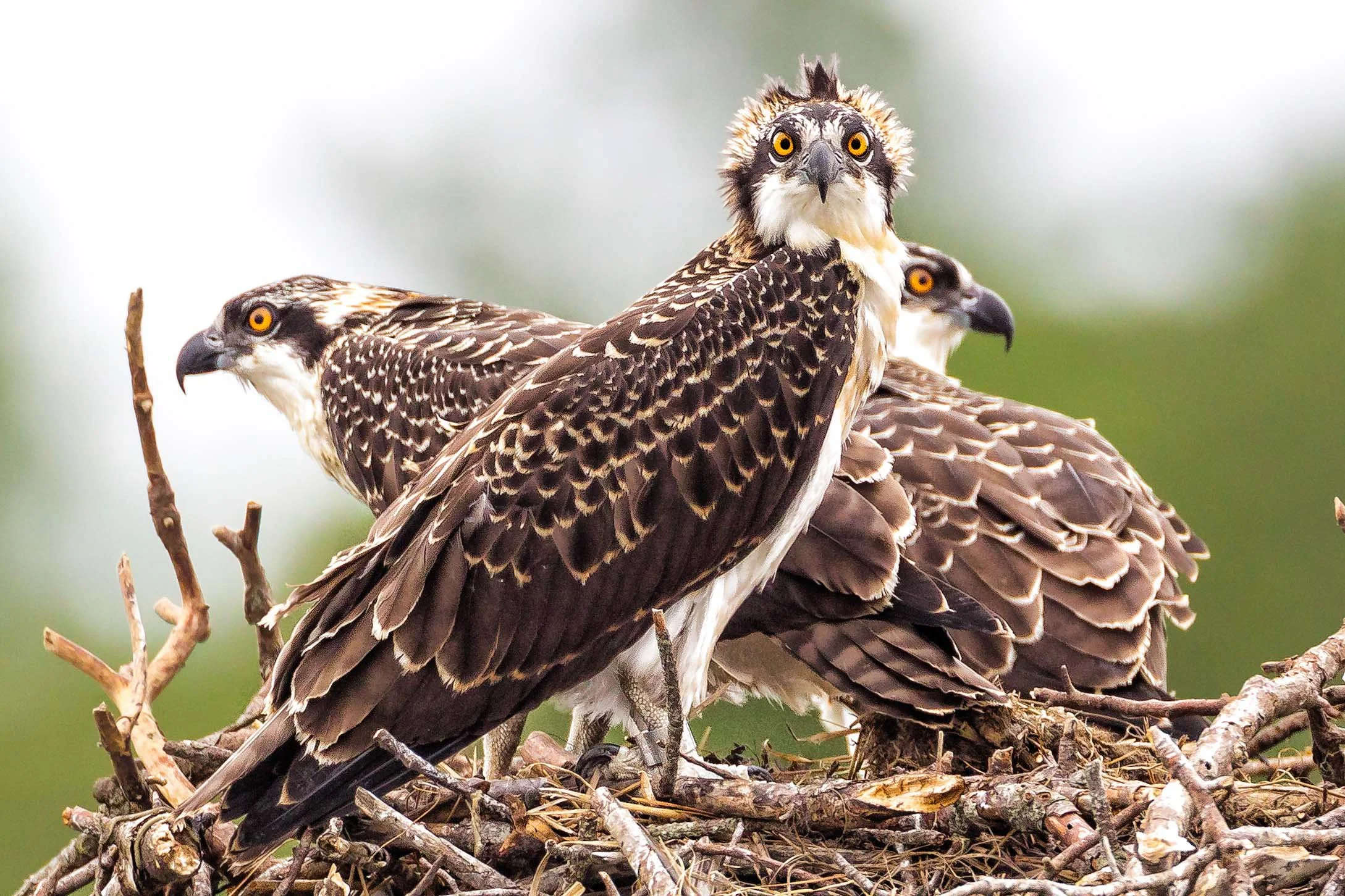
Osprey, Kurt Wecker/Audubon Photography Awards
But before we dig into that discussion, let’s review a little information about the Osprey, Pandion haliaetus, sometimes called the fish hawk, seahawk, or fish eagle. It’s a diurnal bird of prey which hovers over water before making spectacular dives for fish. It spots the fish from as far as 150 feet up and begins a forward dive to the water, but it enters with its feet first to grab the prey. Its nostrils close to keep out the water, and a nictitating membrane protects its eyes. The Osprey’s talons have a 6- to 8-inch spread and are equipped with spicules (spiky spines) to grasp its catch securely. Holding the fish head forward as it flies back to the nest, it usually stops along the way to eat the head first, killing the fish and stopping its struggle. It appears that 1 in every 3 or 4 dives is successful.
Osprey traditionally build their nests at the top of tall trees. However, they have become accustomed to and look for man-made platforms which suit them well. They seem to know that their primary predator, racoons, find these structures difficult to raid. However, the great horned owl and the eagle still have access. Ospreys exhibit nest fidelity, returning to the same nest site year after year, especially if they have been successful in raising chicks. First year Osprey often remain on wintering grounds for an extra year before heading north to breed in the area where they were born.
Back to reports of nest failure at high levels in certain areas of the Chesapeake Bay. First, note that a nest productivity rate of 1.15 or greater is required to sustain a population. Greg Kearns, who has been monitoring Osprey along the Patuxent River for 40 years, reports a drop in nest productivity from 1.8 in 2013 to 0.86 in 2024, or 6.57% nest failure in 2013 to 45.07% in 2024. Even higher levels of nest failure were reported in some intervening years: 58.95% in 2017, 60.41% in 2020, and 56.67% in 2023, productivity rates of 0.73, 0.67, and 0.61, respectively. Kearns’ March 18 talk, Ospreys on the Patuxent, a Smithsonian Environmental Research Center presentation and the source of those figures, is still available online free of charge following registration.
Dr. Watts’s research of Ospreys in the Chesapeake Bay indicates that Osprey feeding in lower salinity areas in the rivers appear to be doing better than those Osprey near the middle of the Bay, the main stem of the Chesapeake with its brackish waters. The diet of river Ospreys consists of gizzard shad and catfish while the diet of Ospreys in the main stem of the Chesapeake is 75% menhaden.
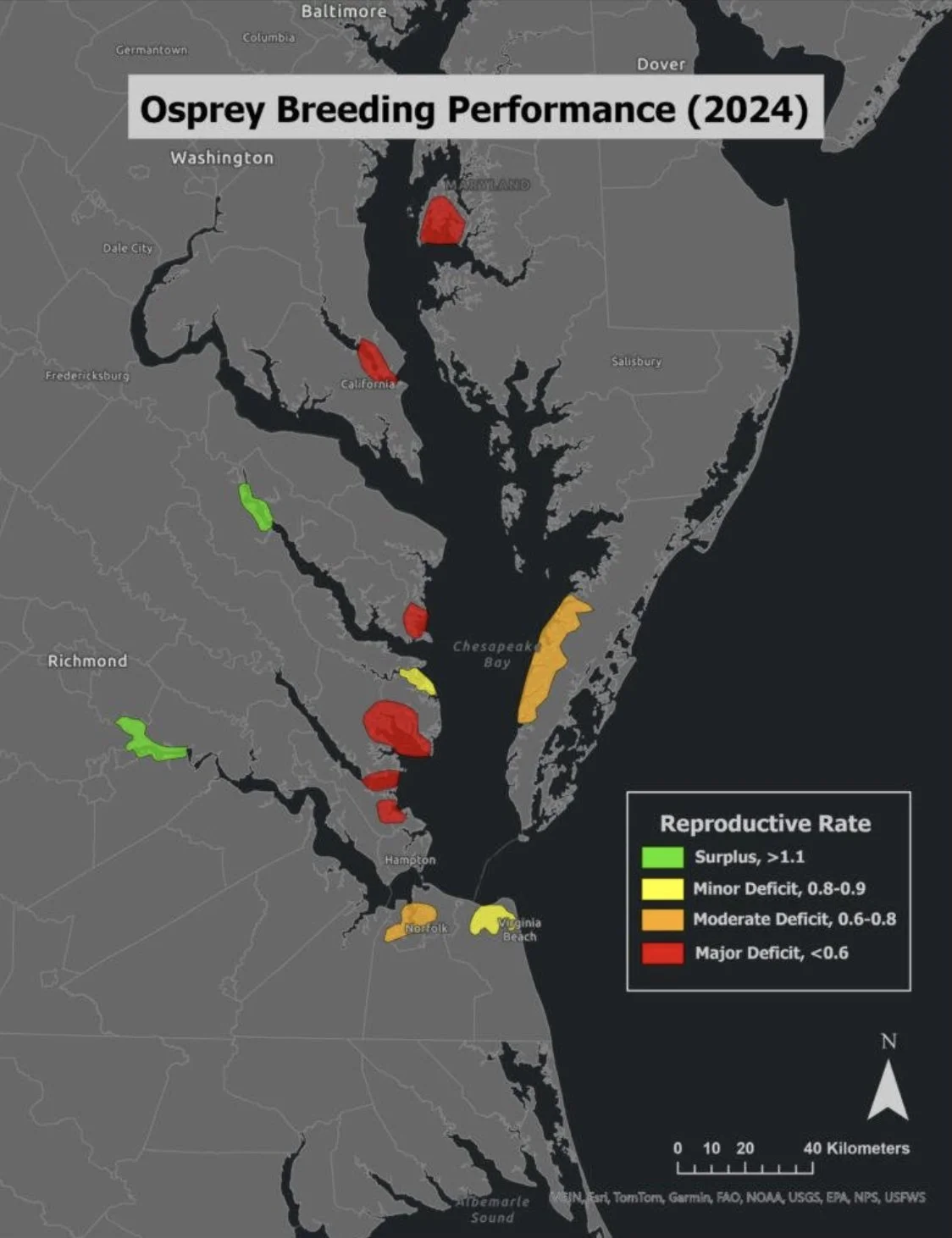
An Osprey breeding performance map from an article by Dr. Brian Watts shows areas of steep decline.
He reports that mean breeding performance for Osprey pairs nesting within the main stem of the Bay did not meet the productivity rate required for population maintenance. The reproductive rate in this area was 0.51 young/pair in 2024. The cause of nest failure, documented through webcams, nest inspections and necropsies of dead chicks, is starvation. Dr. Watts’s article on poor breeding performance of Chesapeake Bay Osprey is available here. A graphic from his article shows areas reporting steep declines.
Conservation groups have urged protections to prevent overfishing of menhaden in the Bay, and the fisheries industry has pushed back. Regulation of the industry in this area is by the Virginia Marine Resources Commission in Virginia’s waters, and the Atlantic States Marine Fisheries Commission, which monitors stock assessment. Menhaden spawn in the Atlantic and swim into the mouth of the Bay, with the Bay becoming a menhaden nursery, where they live for several years before returning to the Atlantic to spawn.
Menhaden is a nutrient-rich fish containing a very high concentration of protein and omega-3 fatty acids. It is also the primary food source for Chesapeake Bay Osprey and striped bass (rockfish), an iconic Chesapeake Bay fish, which is in decline. Humans don’t consume menhaden, but it is a target of the reduction fishery, which reduces it to a protein-rich fish meal, a commodity used in salad dressing, pet food, omega-3 supplements, oils, makeup, pellet food, and other products.
Conservation and sport fishing organizations argue that the area is being overfished, disrupting its ecological balance and causing the increasing rate of Osprey nest failures and decline in striped bass. The menhaden industry is an important one in Virginia, and it has pushed back.
In 2024 the Chesapeake Legal Alliance, with the Southern Maryland Recreational Fishing Organization and other organizations, submitted a petition for rulemaking to the Virginia Marine Fisheries Commission urging regulation of menhaden fishing in Chesapeake Bay and the reduction fishery. After receiving 1,325 comments, the Commission decided to take no action.
Two bills to authorize a three-year study of the ecology, fishery impacts, and economic importance of the Atlantic menhaden population in Virginia’s waters failed in the 2025 General Assembly, HB19, a proposal introduced by Delegate Lee Ware in 2023, and HB2713, introduced by Delegate Paul Milde in 2025. It’s likely that the issue will return in the 2026 session, in January 2026. We all need to support collection of the necessary scientific information to determine how best to balance the needs of conservation and industry. It’s not too early to send a letter to your representative in the General Assembly urging support for a similar bill in 2026.

Bird Banding at Occoquan Bay National Wildlife Refuge
During spring migration’s height, in April and May, from 6 a.m. to noon, volunteers catch and band birds in the Occoquan Bay National Wildlife Refuge near Marumsco Creek three mornings a week, a project undertaken there every spring since 2001, except 2020, the “covid year.”
Photo: Female Northern Cardinal with a bander, Glenda Booth
Glenda C. Booth, originally published in the Connection Newspapers
The 1.4-ounce female Northern Cardinal was squawking and squirming between Brian Rademacher’s fingers and then bit his hand, leaving a red mark, as he prepared to release her after putting a tiny metal band on her leg.
Brian Rademacher uses the bander’s grip to hold this female northern cardinal. Photo: Glenda Booth
“The bite was like a severe pinch,” Rademacher said calmly. The agitated bird was what he called a “recapture.” She had been caught and banded there three weeks ago.
During spring migration’s height, in April and May, from 6 a.m. to noon, volunteers catch and band birds in the Occoquan Bay National Wildlife Refuge near Marumsco Creek three mornings a week, a project undertaken there every spring since 2001, except 2020, the “covid year.”
They typically catch on average 20 to 30 birds in mist nets per six-hour stint, 500 per season. Their most commonly-banded bird is the White-throated Sparrow.
Birdcast.info shows that by April 27, 45 million birds had crossed the region since early March. Birds migrate to find food and favorable climates, and to breed.
Factors like weather, wind, human disturbances and habitat, including conditions in their wintering grounds, can affect the numbers. “A calm, cold night without rain or a big headwind is ideal for migration,” said Suzanne Miller, the project’s leader. “Songbirds migrate at night, up high. Hawks migrate on thermals.”
Next Steps: Recording Data
The team follows Monitoring Avian Productivity and Survivorship protocols. They do not use seeds or audio lures. They check the black, very fine, barely visible nets every 30 minutes and, if a bird is snared, carefully extract it. “It comes out of the side it went in on,” explained Miller, “to prevent breaking a wing or leg.
Once in hand, they put the bird in a cloth bag and take it to the banding station where they measure the wings and tail length, weigh it and determine age and sex. The goal is to process the bird in around five minutes to minimize stress on the bird.

Banders blow on birds’ bellies to study their anatomy. Photo: Glenda Booth
One step is to blow on the bird’s breast and belly to check three things, Paul Napier explained: (1) the brood patch where naked skin indicates the stage of the egg incubation cycle; (2) a cloacal protuberance that indicates breeding condition; and (3) fat, a sign of energy reserves.
The cloaca is the rear orifice or vent for the digestive, reproduction and urinary tracts. In male birds, if it is bulging like a pimple, the bird is in breeding condition. If a female has a protuberance, she likely has eggs. Minimal fat in birds could mean they spent a lot of energy traveling. Fat accumulation could indicate a healthy habitat, abundant in insects, grubs and inchworms, for example.
Among other data, volunteers record recaptures. Miller said that, since 2001, out of 652 cardinals, they have recaptured 74 or 11.3 percent. Cardinals are non-migratory, resident birds in northern Virginia.
“They don’t go far from where they hatched,” Miller said. The recapture statistics can help determine a bird’s age. All data go to the U.S. Geological Survey Bird Banding Laboratory. Scientists use data to analyze bird behavior, population, distribution, survival rates and other factors.
Napier, a Falls Church resident, heads the Cape May (New Jersey) Raptor Banding Project and says that every time he bands a bird he learns something new. He has banded raptors since 1988 and songbirds since 2005.
Beverly Arnold drives up from Fredericksburg to band. “It’s a labor of love. I’m contributing to citizen science,” she said.
Janet Martin from Springfield said, “It’s so cool.”

The banding station. Photo: Glenda Booth
Banding is controlled by federal and state laws that require permits because it involves capturing and handling birds. All of this team’s banding, marking and sampling is conducted under a federally-authorized bird banding permit issued by the U.S. Geological Survey. The refuge also has a Virginia and U.S. Fish and Wildlife Service permit.
The one-square-mile Occoquan Bay National Wildlife Refuge at the mouth of the Occoquan River on Belmont Bay has tidal marshes, grassland and forest, and four miles of trails. Observers have documented over 650 plant and 200 bird species.
The banding station is open to the public from 7 a.m. to 12 noon until Memorial Day weekend. Groups larger than 10 people need a permit. Visit https://www.fws.gov/refuge/occoquan-bay/about-us.
To learn how many birds migrated through an area last night, visit https://birdcast.info/.

Attracting hummingbirds (and convincing them to stay a while)
With forethought and some planning, you can have a clear and frequent view of these 3.5-ounce, dive-bombing, backward-flying, shimmering, drama-obsessed, and Ferrari-engine-powered birds. If that sounds like fun, here are some tips to attract them now and get them to linger for the season.
Photo: Ruby-throated Hummingbird with Scarlet Beebalm, Sarah Holtz
Plant NOVA Natives
Hummingbirds may be the tiniest birds on the planet, but they are among the easiest and most delightful to observe. Ruby-throated Hummingbirds are especially common in northern Virginia during the spring migration months of April and May and are the only species of hummingbirds who breed here. Most Ruby-throated Hummingbirds we spot through mid-May are flying through to other destinations. But some will choose to stay for weeks if the landscape offers them what they need.
With forethought and some planning, you can have a clear and frequent view of these 3.5-ounce, dive-bombing, backward-flying, shimmering, drama-obsessed, and Ferrari-engine-powered birds. If that sounds like fun, here are some tips to attract them now and get them to linger for the season.
Feed them nectar
Hummingbirds have extreme metabolisms. A Ruby-throated Hummingbird’s heart beats up to 1,200 times per minute and its wings beat 53 times per second. They must consume very specific foods to survive, and they eat almost constantly.
At least 20 percent of a hummingbird’s diet is nectar. They can’t taste “sweet,” but the nectar is a source of high-quality carbohydrates for their energy needs. They are therefore attracted to areas with nectar-producing native plants, many of which you can purchase, plant and grow. Before you make your plant selections, however, consider this. Ruby-throated Hummingbirds need to find and consume nectar through spring, summer, and fall. You should therefore select nectar-producing plants that flower at different times during the growing season.
Ruby-throated Hummingbird with Scarlet Beebalm, Sarah Holtz
Cardinal Flower, Eastern Red Columbine, and Coral Honeysuckle are considered the “big three” wildflower nectar sources for hummingbirds. Their flowers are all red, which signals the presence of carbohydrates to hummingbirds but not to bees who can’t see the color. They have also developed long tubular flowers with a pendulous and perch-less form, making them ideal sources of nectar for hovering, long-billed hummingbirds.
Of these three, Coral Honeysuckle is probably the number one recommended native plant for attracting hummingbirds. It blooms continuously through the growing season, timing its first bloom in northern Virginia close to the arrival of migrating Ruby-throated Hummingbirds in April. Eastern Red Columbine blooms in the spring and provides an early source of nectar, while Cardinal Flower begins blooming in July and lasts approximately 6-8 weeks. Planting all three around your property ensures a steady flow of nectar for many months.
You can also supplement your nectar-producing plants with hummingbird feeders filled with sugar water that mimics the carbohydrate content of nectar. Feeders can be purchased at any wild-bird center and hung near your window for close up views of the birds. Make sure you select a feeder that is easy to open and clean. Bacteria and fungi grow quickly in them, especially if placed in the sun. Once a week, or more frequently in warm weather, disassemble and clean your feeder thoroughly in hot water with mild dish soap. Scrub the pieces with a clean brush, rinse in cold water, and air-dry before refilling.
The Cornell Lab of Ornithology provides a recipe for making your own hummingbird feeder solution. Use ¼ cup of granulated cane sugar per cup of unsoftened, hot, and non-distilled water. In cold rainy weather you can make it a bit stronger if you like with up to 1/3 cup of sugar per cup of water. While some people boil their sugar water solution, that is not necessary if your drinking water is safe and your feeder is kept clean. Never use food coloring in the solution.
Feed them protein and fat
Although we tend to think of hummingbirds as mostly nectar eaters, that isn’t close to the truth. According to Doug Tallamy, an entomologist at the University of Delaware and national proponent of incorporating native plants in residential landscapes, only 20 percent of a hummingbird’s diet is nectar while 80 percent is composed of insects and spiders. Cornell’s “Birds of the World” reports that rough estimates from fecal samples indicate a large percentage of insects in the birds’ diet, perhaps as high as 50-60 percent. Whatever figure further study indicates, it’s clear that only biologically diverse ecosystems that have incorporated a range of native plants and native trees can produce enough insects and spiders to feed any species of birds consistently and well. This is because native plants and trees co-evolved with specific insects, so they are entirely interdependent upon one another.
An adequate supply of insects, particularly caterpillars that birds use to feed their young, is simply necessary to attract and keep hummingbirds. Spiders, flies, aphids, caterpillars, and gnats are all common sources of protein and fat in a ruby-throated hummingbird’s diet. Dr. Tallamy believes that hummingbirds are actually insectivores who happen to eat nectar. If your yard is bereft of native plants and trees, hummingbirds can’t stay there, especially when you consider that they build their nests using spider silk to bind and hold the construction materials together. Such a landscape can neither feed them nor help them to successfully breed. It also follows that you must not spray your yard with insecticides, since chemicals intended to kill ticks or adult mosquitoes will kill all the other insects as well.
Know when to expect them next year
If you are able to attract hummingbirds this year, remember to put out your clean feeder once again in mid-April to welcome them back. There is evidence that they have strong “site fidelity,” meaning they tend to return to their favorite feeding and breeding sites year after year, a remarkable feat for such small and graceful creatures.
For more details, see the Plant NOVA Natives website, the Wildlife Sanctuary Program's website, and Cornell’s All About Birds.

New Study Documents Trends Using eBird Data
It’s difficult to be optimistic about the future of North American birds in the face of a relentless avalanche of news about national policy changes that can challenge conservation efforts.
Photo: Eastern Meadowlark, Sheri Douse/Audubon Photography Awards
It’s difficult to be optimistic about the future of North American birds in the face of a relentless avalanche of news about national policy changes that can challenge conservation efforts:
Massive cuts in staffing for national parks, refuges, and forests
A proposed budget with unprecedented spending cuts to agencies in charge of managing public lands and to other environmental and conservation programs
Endangered Species Act proposed rule changes that mean only an intentional take of an endangered bird (rather than an incidental or indirect harm through habitat loss) would be illegal, a change already in place for the Migratory Bird Treaty Act through guidance
Promotion of fossil fuel energy production and withdrawal of funds for clean energy projects, potentially exacerbating climate change
Recent studies also provide challenging news. The State of the Birds 2025 confirms that North American birds continue to decline, and a new trend in decline in duck populations dims a bright spot in earlier reports. And a May 2025 article in Science (Johnston et al., Vol. 388, Issue 6747, pp. 532-537) reports that declines in North American bird populations are greatest where species are most abundant.
On the hopeful side of the ledger, it’s clear that we have more, and more focused, information on bird populations that can direct conservation efforts. Recall that a little over 2.5 years ago we highlighted the Bird Migration Explorer, a joint project of multiple organizations that mapped migration patterns of more than 450 species using data from eBird at the Cornell Lab, BirdLife International, and National Audubon, making clear the need for healthy habitat across continents. And the latest report on North American birds documents changes in abundance of 495 species breeding in North and Central America and the Caribbean based on 14 years of eBird data. In other words, Cornell’s large citizen science initiative continues to produce results.
Although the study’s conclusions are grim in many respects, the writers offer some positive conclusions. The detailed range information provided by eBird can (i) detect localized declines that may not be evident from broader studies; (ii) help identify causes of declines, and (iii) inform management, which is typically implemented in local landscapes. In addition, although 75% of species were declining, with significant declines for 65%, 97% of species showed separate areas of significantly increasing and decreasing populations, possibly highlighting areas for focused conservation efforts.
Of course, we all have a lot of work to do to respond to political challenges, climate change, and habitat loss from land use changes. As the study makes clear, many of those challenges must be addressed at the local level. So, let’s all continue to talk to our elected representatives at the national, state and local levels, protect and enhance healthy habitat for wildlife, and participate in citizen science.

A Closer Look: Nature All Around Us, June 2025
Judy Gallagher is an NVBA board member and a regular surveyor of local wildlife who also captures photos of what she sees, in particular the less common species.
Photo: Green Mantidfly, Judy Gallagher
Judy Gallagher
June 2025
I went to North Carolina recently, searching for early season dragonflies. We searched for dragonflies by day, but at night we set up a black light to see what other insects we could attract. The highlight was a Pleasing Lacewing, an insect I had only seen once before, and it is the inspiration for this month's column.
Pleasing Lacewings are a family in order Neuroptera, or nerve wings. This is the oldest insect order that undergoes complete metamorphosis. Other members of the order include Antlions, Owlflies, Mantidflies and additional families of Lacewings. Adults in this order have four membranous wings with many veins, and chewing mouthparts. Most Neuropteran larvae are voracious predators. Some adults are also predators, but many feed on nectar or don't feed at all as adults.

Pleasing Lacewing - Nallachius americanus, Judy Gallagher
There are about 70 species in the Pleasing Lacewing family, only one of which occurs in our area. Pleasing Lacewing larvae prey upon beetle larvae that are under bark, and scientists aren't sure what the adults eat.

Golden-eyed Lacewing - Chrysopa oculata (member of Green Lacewing family), Judy Gallagher
There are several other Lacewing families, including Green Lacewings, Brown Lacewings, and Beaded Lacewings. There are at least 1,300 Green Lacewing species in the world, and they are the ones we see most commonly in our area. Male Green Lacewing adults vibrate their abdomens and send a signal out on the plant they are resting on, and females can feel these vibrations and respond. Each Green Lacewing species song is unique. Adult lacewings in subfamily Chrysopinae can detect the sound of bats with auditory organs in the large veins of their front wings. Some species are called Stink Flies because they release a stinky odor when threatened.
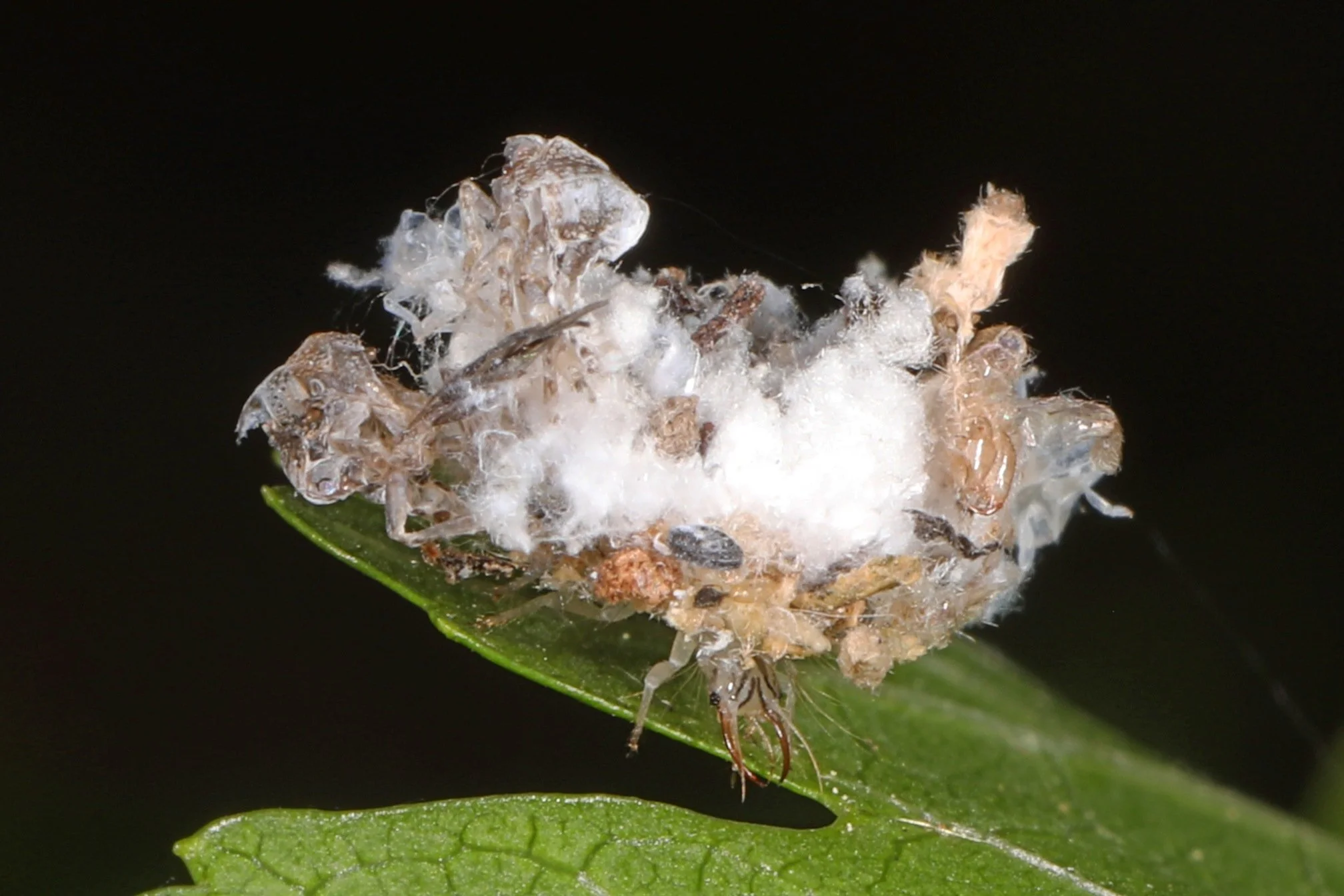
Green Lacewing larva with discarded body parts of its prey, Judy Gallagher
I mentioned before that Neuropteran larvae are predators. Some Green Lacewing larvae use discarded body parts of their prey to disguise themselves. Some decorate themselves with lichen, also as a disguise, but other larvae don't bother concealing themselves from predators. Green Lacewing larvae are particularly effective predators of aphids, and are used as a biological control. They're sometimes referred to as Aphid Lions or Aphid Wolves.

Lacewing larva preying on aphids, Judy Gallagher
Brown Lacewing larvae and adults also eat aphids. Confusingly, not all adults of the Brown Lacewing family are brown. Some are green, and some adult Green Lacewings are brown. This presents a challenge when I try to identify lacewings to species.

Antlion - Brachynemurus abdominalis, Judy Gallagher
Antlion larvae are, as the name suggests, predators of ants. But they're not too picky about prey and will eat almost anything. Some species build funnel-shaped pit traps in the ground. The Antlion larva, also known as a Doodlebug, settles at the bottom of the trap with its jaws projecting upwards. Prey that slips into the trap goes right into the Doodlebug's mouth. The arrival of food is unpredictable, and Antlion larvae have slow metabolisms so that they can survive when prey is unavailable. Adult Antlions are nocturnal, and they don't live very long.
Green Mantidfly - Zeugomantispa minuta, Judy Gallagher
My favorite members of order Neuroptera are the Mantidflies, which look like a cross between a Lacewing and a Praying Mantis. Despite their resemblance to Praying Mantises, they aren't closely related. The larva of many Mantidfly species are specialized predators of spider eggs. They find and either penetrate egg sacs, or hitch a ride on an adult spider. Adults prey on small moths and other insects. Green Mantidfly larvae penetrate spider egg sacs, chewing through the silk casing with their specialized jaws.

Say's Mantidfly - Dicromantispa sayi, Judy Gallagher
Mantidfly species that can't chew their way inside spider egg sacs climb onto a female spider and wait until she lays her eggs. The larva gets wrapped up with the eggs in the egg sac. If the Mantidfly larva climbs onto a male spider, it switches to the female while they are mating, or, even better, when the male spider is being eaten by the female spider. There also are some Mantidfly species larvae that prey on beetle larvae, bee or wasp larvae and caterpillars.
I am fascinated by the way species interact with their environment. I hope you get to see some Neuropterans interacting this summer.
View more of Judy’s articles on A Closer Look: Nature All Around Us (formerly Observations from Meadowood).

Wildlife Sanctuary Almanac: Pollinators
Pollinators are important to our daily lives. Without insects, around 80 percent of flowering plants would not be pollinated.
Photo: Sweat Bee with pollen, Judy Gallagher
Judy Gallagher
Pollinators are important to our daily lives. Without insects, around 80 percent of flowering plants would not be pollinated. Depending on the country, flowering plants make up 50 to 90 percent of people’s diets. Without food from flowering plants, many humans would likely starve. Obviously, we should support pollinators however we can.
Sweat Bee with pollen, Judy Gallagher
What does it take to provide a positive environment for insect pollinators? If you want to attract a specific insect, it's important to know its natural history. Is the insect attracted to flowers of a particular color or shape? Does the larval stage require a specific plant? For instance, Monarch butterflies require Milkweed for their larvae, but they can get nectar from many other flowers including Joe-Pye Weed, Black-eyed Susan, Narrow-leaved Mountain Mint, New York Ironweed and shrubs like Buttonbush. And while they're dining on nectar, they may be picking up pollen that will be transferred to another flower. Long tubular flowers attract insects with long tongues or proboscises, like Sphinx Moths. Native plants attract native insects.
Flowering plants can grow in both shady and sunny locations, but what kind of environment does your pollinator want? Some, like butterflies, like to bask in the sun and some of their favorite wildflowers grow best in full or partial sun with some protection from the wind.
The insect's first concern is finding a food supply. Having different flower sizes, shapes and colors, and varying plant heights and growth habits helps support a great number and diversity of pollinators. You'll have a larger pollinator population if you have a lot of flowers. And pollinators like to eat throughout the season, so you should try to have flowers that bloom at different times so that you have nectar and pollen from spring through fall.
Insect pollinators also need shelter and a place to nest. Insects that overwinter stay in protected places under soil, inside rotting logs, inside plant galls, in leaf litter and under rocks. Having leaf litter, woody debris and dead flower stems and stalks in your habitat helps them survive during cold weather.
Nesting requirements vary by species. Many ground nesting bees like bare, undisturbed patches of soil, preferably close to food plants. Some bees partition their nests with mud, so it helps to have a water source in or near your habitat. Other pollinators lay eggs on plants, in rotten wood, in crevices, or in hollow stems. If your habitat is diverse, you'll support more species.
Our Wildlife Sanctuary program can help you create a vibrant natural environment. More information is available here. You can request a visit by a Wildlife Sanctuary Ambassador, who will advise you on habitat.
Many pesticides, especially insecticides, but also fungicides and herbicides, are harmful to pollinators. Sometimes the pollinators are killed by pesticides, but even sub-lethal doses can affect their ability to navigate, and can compound the effects of other environmental threats. It is important that you don't buy plants that have been treated with pesticides.
Finally, we all need to spread the word about protecting pollinators. Our voices are necessary in discussions on agricultural policy, land use and conservation.
Catch up on past Wildlife Sanctuary Almanac articles here.

Weekly Bird Word: May 26, 2025
Our new feature, the Weekly Bird Word, introduces a new bird-related vocabulary word each week.
Photo: Chipping Sparrow, Troy Bynum
This week’s Bird Word is:
Eyline
According to the Cornell Lab Bird Academy, an eyeline is a distinctively colored line that passes through the eye, as seen below in the Chipping Sparrow.
Chipping Sparrow, Troy Bynum
Each week, we introduce a new Bird Word along with a briefing on the latest news and events from NVBA. If you’d like to receive this email, make sure you sign up for our mailing list!

Birdathon Stories: The Board Birders
The Board Birders started their Birdathon at 6:00 AM at Dyke Marsh Wildlife Preserve. Read about their Birdathon adventure and find out how many species they saw!
The Board Birders -- Dixie Sommers, Libby Lyons and Tom Blackburn -- began our Birdathon at 6:00 AM at Dyke Marsh Wildlife Preserve.

The Board Birders pose for a selfie at the start of their Birdathon.
It’s always great to start a Birdathon --- spotting the birds is exciting, and every species you see adds to your total. We got off to a good start – 45 species in 90 minutes. The highlight was a Lesser Scaup that evidently hadn’t gotten the Migration Memo, which we spotted thanks to Ed Eder, who apparently knows every bird at Dyke Marsh personally. We also found 7 warbler species, Orchard Orioles, Baltimore Orioles and 8 Bald Eagles.
Our next stop was Jones Point Park, under the Woodrow Wilson Bridge. We went there to find a bird that eluded us last year, the Rock Dove (pigeon). We bird in natural areas, where pigeons are in short supply, and last year we realized as it got dark that we hadn’t seen even one. We made sure that didn’t happen this year.
The highlights at Four Mile Run were 4 Wood Ducks and the hard-to-find Willow Flycatcher. At the parking lot for Theodore Roosevelt Island, we found Cliff Swallows under the bridge, and by using a scope we spotted Purple Martins at a martin house across the river in Georgetown. Our Birdathon rules require us to stay in Northern Virginia, but we can count any bird we see, regardless of where it is. We were also pleased to see a Black-crowned Night Heron. Monticello Park lived up to its reputation as a warbler haven: we got 10 warblers there as well as other birds. We made a brief stop at Jackson Abbott Wetlands Refuge, and were rewarded by finding Pine Warblers, which are reliably found in the pines along the water, and Yellow-throated Warblers, which we’ve logged there in other years.
As the day wore on, it became increasingly difficult to find new species. We arrived at Meadowood Special Recreation Area at 7:00 PM, hoping to find one or two new birds as it got dark. We were delighted to find Chipping Sparrows, Savannah Sparrows, a Yellow-throated Vireo, a Summer Tanager and Blue Grosbeaks, all new birds for the day. At our final stop at the Elizabeth Hartwell Mason Neck National Wildlife Refuge, we logged our last bird of the day, the beautiful song of a Wood Thrush, but we couldn’t see it -- at 7:45 PM it was too dark to see anything.
In our 14 hours of birding (including a 20 minute lunch stop) and nearly 10 miles of walking, we birded 14 locations and found 93 species of birds, including 16 warbler species. We beat last year’s total of 84 birds and went home tired but satisfied.
Thank you very much to everyone who donated to NVBA to support our Birdathon Team!

New Law Requires Signs: Some Plants Are Invasive
Thanks to NVBA advocates’ and many others’ efforts, Virginia has a new law that requires, by January 1, 2027, retailers to conspicuously post “in proximity to each invasive plant display” signs indicating that a plant is invasive and “encouraging consumers to ask about alternatives.”
Photo: English Ivy, Chris Light, CC BY-SA 4.0, via Wikimedia Commons
Glenda C. Booth
Most plant shoppers are baffled by the array of choices awaiting purchase at garden shops, especially at big box stores, and may choose a plant for its color, distinctive shape or “curb appeal.” Whether it is suitable for a planned site, native or not native, can be a big guess.
Thanks to NVBA advocates’ and many others’ efforts, Virginia has a new law that requires, by January 1, 2027, retailers to conspicuously post “in proximity to each invasive plant display” signs indicating that a plant is invasive and “encouraging consumers to ask about alternatives.”
Governor Glenn Youngkin signed the bill into law on March 24. Delegate Holly Seibold and Senator Saddam Salam introduced and shepherded identical bills through the 2025 state legislature.
The law lists 39 specific plants by their scientific name, plants like English ivy, heavenly bamboo, periwinkle and Japanese wisteria. You can read the final bills and the full list of plants on the Virginia Legislative Information System site at HB1941 and SB1166.
The 39 listed plants were negotiated with stakeholders and settled on because they are commonly sold and are on the Virginia Invasive Plant Species List managed by the Department of Conservation and Recreation (DCR), a list that has 103 species on it.
Informed Consumers
Advocates argued that invasive plants degrade habitat and agricultural land and displace more valuable native plants that support native wildlife with which they co-evolved and are interdependent. The new law benefits native plants and animals, especially insects and birds.
Supporters maintained that economic losses in Virginia due to invasive species may be as high as $1 billion annually, costs that the new law can help reduce.
The bill’s supporters also argued that many people who buy plants may not know that some are invasive and cause environmental harm. Many sales employees are not knowledgeable about native and invasive plants and can only provide limited guidance to consumers. Having information at the point of sale is critical to educating consumers, encouraging the purchase of native plants and avoiding invasive plants.
Senator Salim told NVBA, "As a volunteer on neighborhood cleanups, I have seen firsthand the harm that invasive species are causing to Virginia's natural environment. Invasive plants displace native flora, threatening wildlife and pollinators in ways that disrupt our parks, agricultural lands and even habitats for endangered species.
“I'm proud to have championed legislation in my first term in the Virginia Senate that gives the power to consumers by educating them at the point of sale about alternative, native plant options. Together, we're taking meaningful steps to preserve the beauty, balance and biodiversity of our Commonwealth for generations to come."
Delegate Seibold told NVBA, “In April 2023, fresh off my very first session in Richmond, I met with a group of local women in a small coffee shop in Vienna who had been spending their weekends removing invasive species for years. The data was startling and the damage was breathtaking. I knew right there and then that we must do something to prevent the further spread. As a former teacher, the first bill I wanted to carry on this topic was one that would educate the consumer about the harmful effects of invasive plants at the point of sale.
“The bill received bi-partisan support and garnered lots of support from the community and advocates in the 2024 Session and passed the General Assembly; however, it was vetoed by the Governor. But we didn’t give up! We returned to the 2025 Session with an updated bill and lots of community members, advocates and stakeholders ready to work together to make this dream into a reality! "
Next Steps
The new law charges the head of the Virginia Department of Agriculture and Consumers Services, in consultation with the Virginia Invasive Species Working Group, with determining the format, size and content of the signs by October 1, 2025.
The Virginia Invasive Plant Coalition, which consists of 83 organizations including NVBA, will monitor the working group’s efforts and continue to advocate for more legislation in the coming years to curtail the sale and use of invasive plants. NVBA will continue to work with the coalition. Additional information is available from the coalition’s website and from Plant NOVA Natives.

The People Birding to Make a Difference: Stories of Birdathon
It’s that time of year again: the days are longer, you have dirt under your fingernails from planting natives, and all across the region teams of people are birding for a good cause.
Tina Dudley
It’s that time of year again: the days are longer, you have dirt under your fingernails from planting natives, and all across the region teams of people are birding for a good cause.
The Birdathon is a fundraiser that has been taking place for over 10 years. When it started out, it was quite small. Joanne Bauer, team captain for The Bowerbirds, recalls that when she first started participating there were fewer teams, but the spirit was just as enthusiastic.
Over the years, more and more people have been inspired to get involved. Birdathon is a great opportunity to spend time with friends and family, to be out in the nature, and to raise funds for a good cause. The event has shifted a bit - becoming more inclusive and welcoming to newer birders. You don’t need to be a lister or even leave your house to participate - you can compete in the Backyard Birdathon category and report the species that visit your yard.
This year, our goal for Birdathon is to raise $20,000. This is a big goal in a hard year, but there are dozens of birders all across our region working together to make it happen.
Modeled after a traditional walk-a-thon, Birdathon relies on team members to seek out pledges and donations from friends and family. But you don’t need to know anyone on a team to make a gift to that team if you feel inspired by their story. Let’s all pitch in to make Birdathon a success!
You can still sign up to have a Birdathon team if you feel inspired. The last day you can do a Birdathon this year is Sunday, May 18. Also new this year, you can do Birdathon solo! It’s more fun with friends, but if birding by yourself is your jam, you can still participate. Register your team and join the magic, the movement, the moment because the birds need us now. Let’s show up for them!
Continue reading to learn about some of this year’s teams.
Some of our 2025 Birdathon teams
Three Little Towhees
This team is close to our hearts because its captain, Louise Edsall, has been our trusty Program Assistant since October 1, 2017. She is the person who processes all of the checks that come in at the end of the year. Louise is the secret glue that keeps NVBA running.
In 2023, she wrote about her team’s experience as part of a Birdathon Story. Her team birded only at the Neabsco Creek Boardwalk and Trails because Louise’s husband Bart, a paraplegic, could only go to wheelchair-accessible places. Bart’s wheelchair put him at the height of the handrails, which limited his view a bit, but he was the first to spot the Osprey which had caught a fish just in front of the “No Fishing” sign. He also was an avid birder by ear. Sadly, Bart passed away September 16, 2024. He is deeply missed, and the Louise’s Birdathon team this year is participating in his memory. You can read Bart’s obituary here.
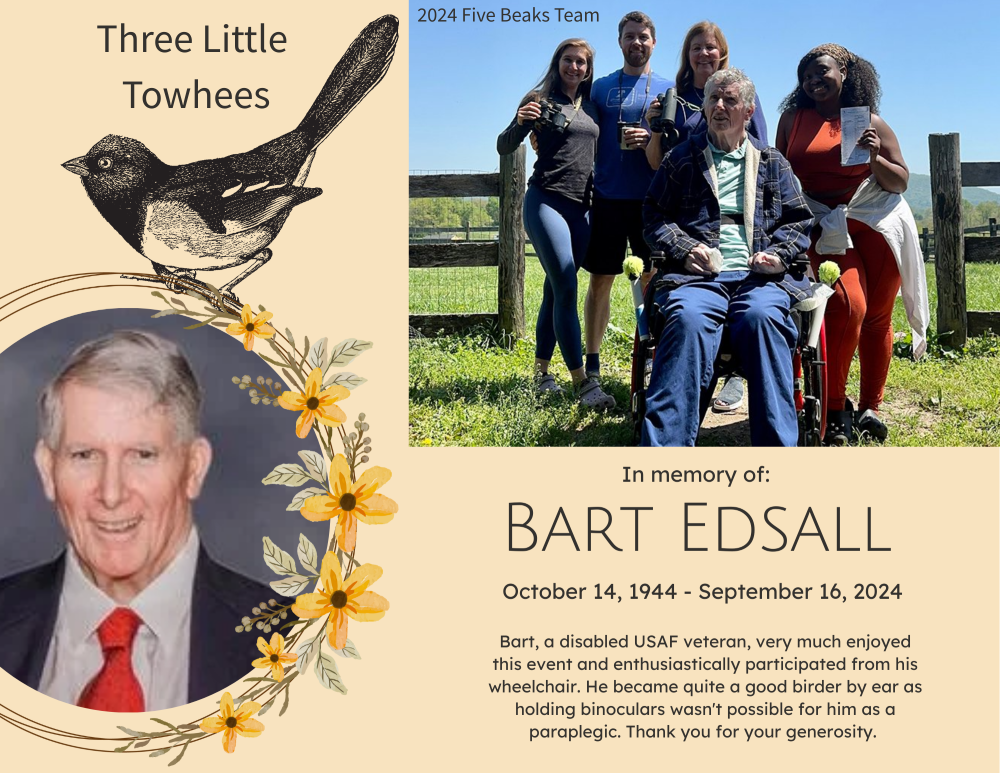
The name of Louise’s team this year comes from her childhood memory of being asked by her mother, “What is that pretty bird scratching in the leaves," to which 10-year-old Louise promptly responded, "Oh, that's a Rufous-sided Towhee." After that the towhee became “their bird” and showed up on birthday cards and in gifts. Louise and her mother both loved the Eastern Towhee’s "Drink Drink Your Tea" song. It remains one of Louise's favorite birds and a fond reminder of her mother's enthusiastic support of her hobby.
Nesting Since ‘98

Jade Abuzaid has been birding since she was 10, when being sick and stuck inside for a month made her curious about the birds singing outside her window. Now she’s studying environmental science and doing bird surveys in college, discovering new species every time she goes outside. Her goals for participating in Birdathon are to teach her parents about all the cool birds that come out in the spring and maybe get some awesome photos. She knows about 60 species so far but would like to double that through Birdathon.
The Avian Avengers
The Avian Avengers team was organized by Ajani Simmons, an Arlington Regional Master Naturalist (ARMN), and includes three fellow ARMN graduates of the spring 2025 class. Although new to birding, Ajani brings a photographer’s eye to the field, using the camera to observe and connect more deeply with nature. She told NVBA, “Birding has become a grounding and joyful experience—and we’re excited to share that journey together during Birdathon 2025.” One of this team’s goals is to raise awareness for Black Birders Week, May 25-May 31 this year. Ajani is working to plan an NVBA event for this year’s Black Birders Week. More information is coming soon on this event.
The Bowerbirds

Led by former board member, Joanne Bauer, this team is celebrating its 10th anniversary doing Birdathon. Wow! They plan to celebrate this milestone by finding more birds than they ever have. Their record, which they hope to exceed, is 88 species in one 24-hour birding marathon.
Plus 12 more teams!
We hope you will be moved to make a gift in honor of one or more of our participating teams and can share this article on your social media to spread the word.
And there are many other ways you can help our feathered friends this spring. Why not become an NVBA volunteer and pitch in to pull invasive plants, educate the community about conservation, or serve on one of our committees. We thank you and the birds thank you!

Huntley Meadows Park Celebrates 50 Years!
Some history and background on a favorite birdwatching locale for many northern Virginians as Huntley Meadows celebrates its 50th year.
Photo: Hooded Merganser, Parameswaran Ponnudurai/Audubon Photography Awards
Huntley Meadows Park, a favorite birdwatching locale for many northern Virginians, is celebrating 50 years. The park’s walking trails and boardwalk provide a good view of waterbirds, shorebirds, and songbirds throughout the year. The boardwalk and woods also attract a steady stream of photographers, many of them winning awards in the annual Audubon Photography Awards competition. The Friends of Huntley Meadows Park invite birders to join them every Monday morning for an informal birdwalk (there’s no leader), which attracts experienced and new birders alike. Make sure you check out the series of interviews with walk participants posted to the Friends’ website.

Great Blue Heron, Kimberly Sharp/Audubon Photography Awards
So, a little history of this 1,500-acre+ natural reserve in the middle of an area of intense urban development: the parkland has been farmland and a dairy, and an entrepreneur in the 1920s dreamed of making the area’s dairy farms a dirigible base. That didn’t work out, and the federal government acquired the land. In the 1940s the Bureau of Public Roads tested asphalt road surfaces at the site, and in the 1950s the Virginia National Guard’s Battery D, 125th Gun Battalion, used the land to protect the nation’s capital from air assault. Then the U.S. Navy conducted classified radio communication research.
Fairfax County started exploring possible uses of the property in the 1960s, while local residents used the area to walk, explore and ride motorcycles. There even was a popular racetrack in the southern part of the property. In 1971 the Navy and the Fairfax County Park Authority (FCPA) signed an agreement allowing citizens to use 400 acres of the property for recreation.
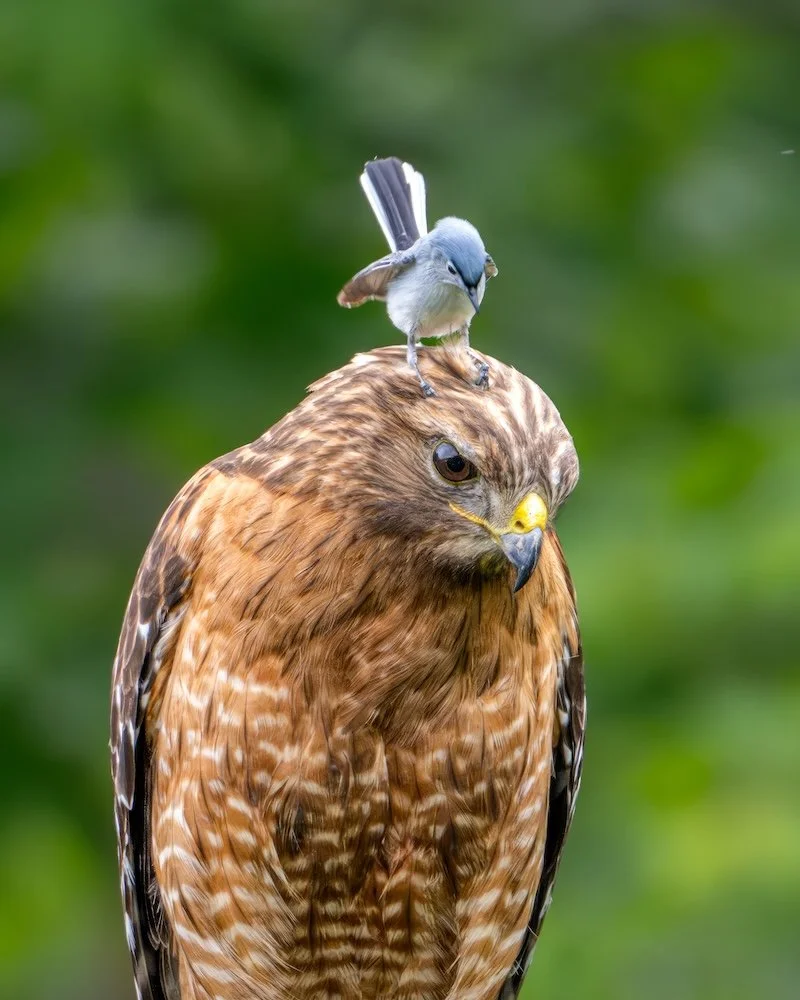
Red-shouldered Hawk and Blue-gray Gnatcatcher, Dale Ward/Audubon Photography Awards
In 1971, President Nixon initiated the Legacy of Parks Program that allowed the federal government to transfer surplus land to state and local governments for natural, cultural, and recreational use. Fairfax County acquired the property in 1975. In 1992, FCPA acquired an additional 165 acres of adjacent wetland and upland with the assistance of Ducks Unlimited.
Work to make the park the natural reserve it is today took many years. Even in the 1970s, the meanders of the Potomac River and industrious beavers started to transform a portion of the property from meadow to wetlands. There was open water by 1981. Work in the 1980s removed much of the evidence of past federal use, including buildings and antennae. Grants paid for construction of trails, and the 1980s saw addition of a boardwalk and observation tower. The boardwalk was rebuilt in 1994 and renovated in 2011. The Navy’s access road became the Hike-Bike Trail.
Huntley Meadows Park is hosting a series of educational and volunteer events to celebrate its anniversary. The park’s website has additional information.

Five Great Reasons to Garden with Natives
As Margaret Atwood once said, “In the spring, at the end of the day, you SHOULD smell like dirt.” It’s very good for us on so many levels.
Photo: Native plant gardener in her garden, Margaret Fisher
Plant NOVA Natives
Gardening enthusiasts everywhere are gearing up for spring with renewed passion and anticipation. There are garden beds to expand, turf grass to shrink, new natives to add, non-natives to remove, and an urgency to finish the work before the warm weather arrives.
It’s a lot of physical labor, but we know it’s worth it. Gardening not only creates beauty. It is a moving meditation that helps calm our minds and makes us more present to the moment. As Margaret Atwood once said, “In the spring, at the end of the day, you SHOULD smell like dirt.” It’s very good for us on so many levels.
Not surprisingly, there are many more native plant gardeners today in northern Virginia than there were ten years ago, evidenced by the increase in commercial demand for native plants. This is not just a trend. It is a permanent shift in behavior driven by a deeper understanding of the interdependence of native plants, insects, birds, humans, and many other creatures. We have become ever more aware of the impact of our choices on the biodiversity of the region. There is no going back.
If you’re still on the fence about natives, here are five great reasons why native plant gardening is good for what ails our planet - and our hearts.
When you garden with native plants, you learn to name and recognize them in the wild as well. That knowledge is nice to acquire, of course, but it also helps foster a deep sense of appreciation for the natural world. Simply stated, when we know more, we care more about the environment and the collective human efforts to nurture it.
Native plant gardening is even more enjoyable when shared with others. Your newly acquired knowledge will undoubtedly lead to connections with other like-minded native plant lovers. New friends and acquaintances appear, sharing tips, experiences, and a collective love of gardening. An expanded network contributes to a sense of belonging as we act in concert with others instead of alone.
There is no denying that climate change is a daunting global issue. But native plant gardening nevertheless encourages and empowers us as individuals. Property owners of all stripes can do something significant to benefit the soil, the climate, and the entire ecosystem. Don’t fall into the trap of believing we are too small to make a difference. Together we can help heal the planet.
Native plant gardeners love the beauty of the blooms as much as the insects. There is no need to sacrifice aesthetics. Native plants not only attract pollinators and nurture their life cycles, they also offer stunning displays of color and texture that never fail to please.
Many native plants bloom later in the season. When non-native cultivars are starting to fade in the mid-summer heat, many natives are just beginning to show up and show off, ensuring a lively view that both delights the viewer and sustains local wildlife well into the fall. The stalks, seedheads, and berries continue to beautify the garden through winter.
Native plant gardener in her garden, Margaret Fisher
Gardening has always been fun, but gardening with natives is also meaningful. It serves a healing purpose and adds our names to the group effort. At the end of the day, native plant gardeners create beautiful spaces where humans and plants not only meet but conspire to collaborate. We are collectively honored to “smell like dirt” after creating such powerful things.
It all starts with planting your first native plant. To learn the how-tos, visit the Plant NOVA Natives website. You can also take the first step to certify your yard as a wildlife sanctuary by requesting a consultation visit by an ambassador from NVBA’s Wildlife Sanctury Program.

Birdwatching in Zimbabwe
I started birdwatching during my freshman year but was lucky enough to be living then in Zimbabwe, home to hundreds of species of birds, ranging from the tiniest sunbirds to the flightless guinea fowl and several species of elusive turacos.
Photo: Southern Ground Hornbill, Clay Harrison/Audubon Photography Awards
Nick Appleton
I’m a high school junior and relative newcomer to birdwatching, but I’m already hooked. I started birdwatching during my freshman year but was lucky enough to be living then in Zimbabwe, home to hundreds of species of birds, ranging from the tiniest sunbirds to the flightless guinea fowl and several species of elusive turacos. My father’s retirement returned the family to the DC area, and I was pleased to find NVBA birdwalks and classes that will help me learn the local birds.
The diversity of birds in Zimbabwe is largely due to the country's varied terrain and climate. On the northern boundary of the country lies the Zambezi River, home to Victoria Falls, and a wealth of wildlife, including the African Fish Eagle, Zimbabwe's national bird. Known for its piercing cry, sometimes deemed as the “sound of Africa,” this powerful eagle is an opportunistic hunter usually feeding on fish and scavenging when necessary.
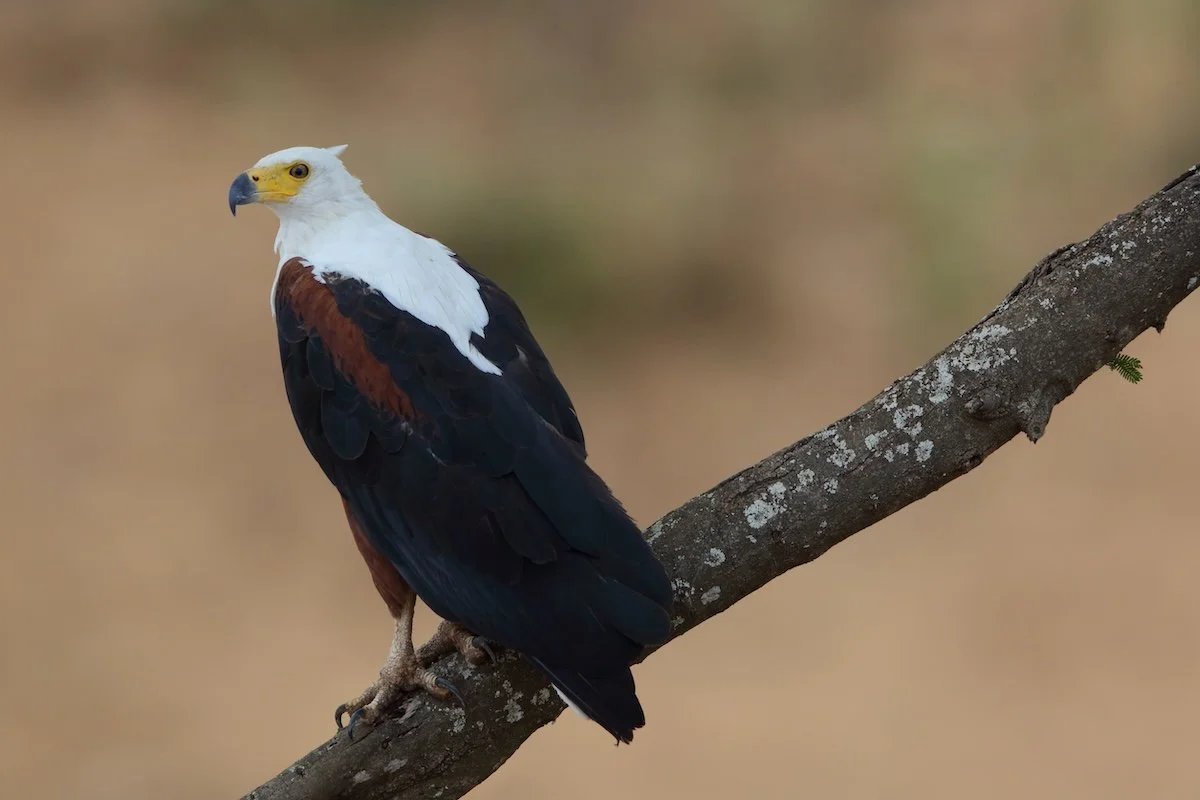
African Fish Eagle, Marian Herz/Audubon Photography Awards

Lilac-breasted Roller, Judy LaNier/Audubon Photography Awards
Equally captivating and ever prettier is the Lilac-breasted Roller. The bird is known for its colorful plumage and as its acrobatic displays. The roller typically eats small bugs and animals and can often be found perched among the tall termite mounds that litter the river beds along the Zambezi. This is one of my personal favorites as they have a very distinct look and a wide variety of colors.
A particularly interesting native of the region is the Southern Ground Hornbill. As the largest member of the hornbill species this massive bird is quite recognizable along the river with its big black frame and distinct red face. A formidable predator, the hornbill feeds upon anything that moves, from bugs to snails, frogs, and small mammals. The Southern Red-Billed Hornbill also lives in this region and is more or less famous because it is the same species of hornbill as Zazu in The Lion King.
Southern Ground Hornbill, Clay Harrison/Audubon Photography Awards

Long-crested Eagle, Loi Nguyen/Audubon Photography Awards
The Chimanimani National Park in the mountainous region in the east of the country is home to two of my favorite Zimbabwean birds, the Long-crested Eagle and the Half-collared Kingfisher. The Long-crested Eagle, which is relatively small for an eagle, has a distinctive crest. The bird is widely distributed. I saw them in Chimanimani, but we even had a family of Long-crested Eagles living in our backyard in Harare. Some African kingfishers are among the tiniest birds in the country, but like the Lilac-breasted Roller, many species are famous for their vibrant colors. My personal favorite, the Half-collared Kingfisher, is bright cobalt blue on its back, with a buffy undercarriage.
I look forward to learning more about northern Virginia’s resident and migrating birdlife.
A Closer Look: Nature All Around Us, May 2025
Judy Gallagher is an NVBA board member and a regular surveyor of local wildlife who also captures photos of what she sees, in particular the less common species.
Photo: Eastern Pine Elfin, Judy Gallagher
Judy Gallagher
May 2025
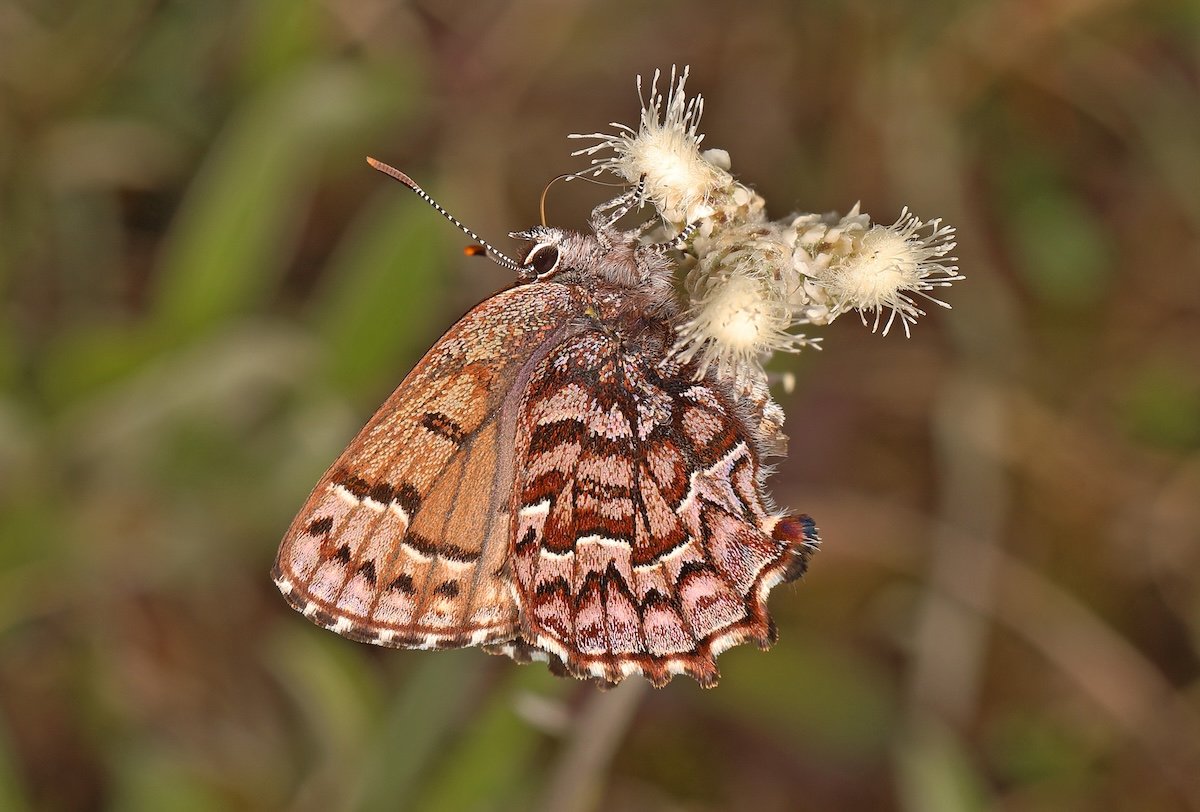
I look forward to spring's arrival each year, and particularly to the start of butterfly season. Elfins are among the first butterflies to emerge each spring. They are small with about a 1-inch wingspan, are furry looking, and have brown, gray and black markings. They look drab unless you look at them really closely. Elfins are part of a larger butterfly group called "hairstreaks," so named because of the fine, hair-like marking extending across the under surface of the hind wings. Elfins generally don't fly as fast as other butterflies, and they only have one brood, so you won't see them later in the year.
Eastern Pine Elfin, beautiful in its muted colors, Judy Gallagher
When not visiting flowers or moist soil, Eastern Pine Elfin males rest on pine foliage to await females. They are the only butterflies that use pine as a host plant. Early instar caterpillars eat pine needle sheaths and are the same reddish-brown color as the sheaths. Later instar caterpillars are green to match the pine needles that they feed on. The pupae overwinter in leaf litter beneath pine trees.

Eastern Pine Elfin showing its colorful scales, Judy Gallagher
Like other elfins, it looks brown and uninteresting until viewed closely. But look intently at its scales - there are reds, blues and greens in there, and the whole wing looks like it's gently washed with pink. This is a really hard butterfly to see intentionally. But examine flowers near pine woods, and you may be fortunate enough to see one.

Frosted Elfin, Judy Gallagher
Frosted Elfins are considered imperiled in Virginia, and we've only seen one once in our wildlife survey circle. Caterpillars feed on lupine and wild indigo flowers and developing seed pods, which are most common in habitats that are regularly burned, not a common environment in our area. The loose cocoons are found in the leaf litter at the base of the plants.

Henry's Elfin, Judy Gallagher
Henry's Elfin tends to be found in woods. There are at least six host plants for Henry's Elfin caterpillars, with American Holly being the preferred host species in our area. Henry's Elfins in the Piedmont feast on redbud. In other areas, caterpillars eat Persimmon, coastal holly species, blueberries and huckleberries and Maple-leaf Viburnum.

Henry's Elfin showing greenish color, Judy Gallagher
Henry's Elfins found near the northern edge of their range tend to be darker than southern individuals, and coastal Henry's Elfins often have strong green highlights. Males frequently perch during daylight hours, often just beyond the reach of my camera lens. The young caterpillars feed on buds (holly or redbud in our area) and young leaves. They pupate in about a month and overwinter in leaf litter.
While Henry's Elfins are pretty common, they aren't seen very often, partly because they are small and brown, and partly because they blend in well in the woods they frequent.
Other elfins found in Virginia are the Hoary Elfin and Brown Elfin, but they aren't common in our area.

Henry's Elfin soaking up the sun, Judy Gallagher
Macro photography of elfins is challenging. They are small and fly erratically, and they always seem to perch at an angle where I can't get the butterfly all in focus. As it turns out, there is a reason for this. These early season butterflies align themselves to soak up as much of the sun's rays as possible, which is why they are so rarely in a good position for me to take their picture.

Henry's Elfin with hairy eyeballs, Judy Gallagher
I was astonished when I took this picture and discovered that Henry's Elfin has hairy eyeballs. According to a study at Harvard University, several insect species have ocular hairs evenly spaced between the individual units of their compound eyes. Studies with wind tunnels show that the ocular hairs reduce airflow at the eye's surface and also reduce particle deposition without significantly reducing vision, much like our eyelashes protect our eyes. Nature never fails to delight me!
View more of Judy’s articles on A Closer Look: Nature All Around Us (formerly Observations from Meadowood).

Wildlife Sanctuary Almanac: Backyard Birdathon!
Have you taken steps to create bird habitat in your yard? Now is your chance to see the fruits (or rather, birds) of your labor by observing how many species visit your yard in a single day.
Photo: Brown Thrasher, Randy Lewis/Audubon Photography Awards
Betsy Martin
Have you taken steps to create bird habitat in your yard? Perhaps you planted a native fruiting shrub to feed migrating birds, or a native oak to support the caterpillars that birds need to feed their young, or removed invasive vines that threaten trees and outcompete the native plants that wildlife depend on.
Now is your chance to see the fruits (or rather, birds) of your labor by observing how many species visit your yard in a single day.
Every year NVBA sponsors a Birdathon. Participants form teams of up to five to identify as many different species as they can on a single day between April 19 and May 18, the peak period of spring migration. The Backyard Birdathon is a special prize category for teams competing from a single private residential property.
Gather up to four family members or friends to spend time throughout the day in your yard observing birds. If you’ve got a birder friend you can invite to join your team, that can help improve your bird ID skills and your chances of observing more species.
It’s fun! Last year, my husband and I participated, along with our neighbor Claire, who’s an experienced birder. We watched for birds in our yard (very) early in the morning, then gathered again for periods throughout the day. We used the free app Merlin to help identify the birds by their songs, and reported our observations on eBird. We saw 51 species in our yard on May 3rd, including some I’d never seen before. We won the competition, but it wasn’t much of an achievement—we were the only team competing in the backyard category. I hope more people in more yards will participate this year.
Backyard Birdathon is a great opportunity to get outside and forget, for a little while, the disturbing news that confronts us daily. Just focus on the birds and the beauty of spring. It’s a chance to record enough sanctuary species to get your yard certified as a Wildlife Sanctuary, and obtain an attractive yard sign. You can read more about how to create habitat in your yard and get it certified as a Wildlife Sanctuary here.
Birdathon is a fund-raiser for NVBA, and team leaders and members are asked to seek pledges, as in a walk-a-thon. Birdathon helps NVBA to support the Wildlife Sanctuary Program, outdoor education, citizen science, and habitat conservation.
Learn more about Birdathon and register your team here.
Catch up on past Wildlife Sanctuary Almanac articles here.

Weekly Bird Word: April 28, 2025
Our new feature, the Weekly Bird Word, introduces a new bird-related vocabulary word each week.
Photo: Mallard, Alan D. Wilson, Wikimedia
This week’s Bird Word is:
Dabbling
According to the Cornell Lab Bird Academy, dabbling is a foraging technique in which a bird moves the beak rapidly on the surface of shallow water to pick up small aquatic animals and plant materials; it is used by “dabbling ducks” (like the Mallard pictured below) and a few other species.
Mallard, Erik Hansen/Audubon Photography Awards
Each week, we introduce a new Bird Word along with a briefing on the latest news and events from NVBA. If you’d like to receive this email, make sure you sign up for our mailing list!

Good News at the I-95 Landfill to Help Offset Some Bad News
First, the bad news: The U.S North American Bird Conservation Initiative just released its State of the Birds 2025 report, and the birds with the most dire losses continue to be grassland birds, a 43% decline since 1970.
Photo: Bobolink, Gerald Sneegas/Audubon Photography Awards

Eastern Meadowlarks, Haoyu Li/Audubon Photography Awards
First, the bad news: The U.S North American Bird Conservation Initiative just released its State of the Birds 2025 report, and the birds with the most dire losses continue to be grassland birds, a 43% decline since 1970. The report calls out the need for proactive conservation initiatives, particularly across the Midwest and Great Plains, where conversion of grasslands for row-crop agriculture, woody plant invasion, and drought are causing collapse of a crucial resource. The report cites some positive actions, including a National Audubon Society initiative, the Conservation Ranching program, which is creating partnerships to convert marginal cropland to grassland.

Grasshopper Sparrow, Susan Ward/Audubon Photography Awards
Now, the good news: Although urbanization in northern Virginia has eliminated most grassland habitat in our area, Fairfax County’s I-95 Landfill has taken steps to protect grassland birds by adjusting mowing procedures at the landfill. NVBA had suggested that the Department of Public Works and Environmental Services (DPWES) find a way to protect grassland birds at the closed landfill while still complying with regulatory mowing requirements that ensure adequate landfill monitoring. In response, in February 2024, the Board of Supervisors directed DPWES to identify a no-mow area for the bird nesting season and develop a pilot plan for landfill procedures that could protect grassland birds.
Blair Evancho, a DPWES intern, then organized a survey conducted between August 22 and October 17, 2024, and produced the I-95 Landfill Complex Grassland Habitat Program Pilot Study Report, which identified 39 bird species in the study area, including three of regional or continental concern: Eastern Meadowlark, Bobolink, and Grasshopper Sparrow. The most recorded birds were Grasshopper Sparrow, Savannah Sparrow, American Kestrel, and Eastern Meadowlark, all of which are experiencing population declines. The study confirmed that grassland birds were using the habitat provided by the no-mow area.
The study outlines a bird-friendly standard operating procedure for the landfill:
Annual mowing in the no-mow area only between September 15 and April 1, except where required to maintain methane well access
If feasible, annual mowing scheduled to take place only between February 15 and April 1
Setting blades for mowers and bushhogs to eight inches or higher
A staff survey around the methane well mowing path before turning the blade on
No more than two mowers and/or bushhogs active at the same time in the no-mow area
The study includes some further recommendations for conservation: long-term monitoring at the landfill, identifying and monitoring the locations of nests in the no-mow area, installation of additional American Kestrel nest boxes inside and outside of the no-mow area, planting native grasses and forbs to replace the predominant non-native grasses, and additional public education. To learn more about the study and the landfill listen to Fairfax County’s EnviroPod Episode 52.
NVBA is truly grateful that Fairfax County developed and implemented a plan to protect grassland birds within its jurisdiction. We hope this initiative can serve as a model for other closed landfills, creating islands of valuable habitat for grassland birds.

Bird Flu: An Update for Birdwatchers
Avian influenza has been around for centuries in many strains, but the strain making the news as bird flu is a “highly pathogenic avian influenza,” caused by the H5N1 virus. It’s being found in both wild birds and domestic fowl and, less commonly, in mammals, even humans.
Photo: Northern Shovelers, Steve Jessmore/Audubon Phtography Awards
Sarah Wilton
Avian influenza has been around for centuries in many strains, but the strain making the news as bird flu is a “highly pathogenic avian influenza” caused by the H5N1 virus. It’s being found in both wild birds and domestic fowl and, less commonly, in mammals, even humans. In the U.S., bird flu is being monitored by the Centers for Disease Control and Prevention (CDC) and the U.S. Department of Agriculture (USDA). USDA monitors incidence of the disease in domestic birds, operating a national hotline (866-536-7593). With some other agencies USDA also is surveilling incidence in waterfowl. See Implementation Plan for Avian Influenza Surveillance in Waterfowl.
The virus can infect poultry, including chickens, turkeys, pheasants, quail, ducks, geese, and guinea fowl in commercial and backyard flocks. Since the current strain of bird flu was identified in 2022, afflicted birds have been identified in 51 states, including cases on Virginia’s eastern shore as recently as January 2025. No cases of infected livestock (including cattle, swine and alpaca) have been reported in Virginia; however, nearby North Carolina had one confirmed case in 2024. Other mammals that are susceptible to infection with bird flu include rodents, racoons and cats. See Detections of Highly Pathogenic Avian Influenza in Mammals, which reports 126 cases in domestic cats since May 2022.
After living through the pandemic, people have cause to be concerned and ask questions about risks to humans, particularly for people who come in contact with birds and livestock. To date the CDC, working with state and public health departments, has reported 70 confirmed and probable human bird flu cases and one fatality since 2024, but it rates the risk of transmission to humans as low. It reports no confirmed case in Virginia and only one probable case in the Delmarva Peninsula. See H5 Bird Flu: Current Situation. No person-to-person has been diagnosed; however, influenza viruses mutate constantly, so continued monitoring is essential.
Of course, we also have concerns as birdwatchers and citizens worried about the health of wild bird populations in a world where they face serious challenges from climate change, habitat loss, and other threats. Peak migration in our area begins in April, and detections are higher within the wild bird populations in the fall and spring, because the birds spread the virus as they migrate to and from their breeding grounds. The most common victims of the virus are waterfowl, shorebirds, seabirds and raptors that may feed on carcasses of diseased birds. USDA reports 132 wild bird cases in Virginia since January 2022; six of those cases were recorded since December 2024. Given the time lag between collection and confirmation and the problems associated with wild bird sample collection, the figures are likely an understatement of the actual number of cases.
So, what do we need to know and do as we head outdoors to observe wildlife and participate in conservation projects, or as we live and participate in other community activities?
If you find a dead wild bird, either on your property or elsewhere, report it to your state wildlife agency or health department. In Virginia, that is the Department of Wildlife Resources (DWR). DWR particularly asks you to report by phone (855-571-9003) or email (wildlifehealth@dwr.virginia.gov) (i) five or more dead vultures, waterfowl, shorebirds, or seabirds in the same area within five days; (ii) sick or dead eagles, hawks, owls, or turkeys, excluding carcasses found on the road, or (iii) ten or more dead wild birds of any species in the same area within five days.
If you have backyard chickens, don’t put up feeders for wild birds. Although Cornell Lab's All About Birds reports low risk to songbirds from the bird flu, it has been detected in a number of species, making it prudent to avoid encouraging poultry and wild birds to mix. Cornell recommends not putting up feeders and making sure that poultry food and water are not accessible to wild birds. Its website also includes recommendations for wildlife rehabilitators and people who maintain wild bird nest boxes. Unusual poultry illness or death should be reported in Virginia to the State Veterinarian’s Office (804) 692-0601 or at vastatevet@vdacs.virginia.gov or to USDA’s toll-free number at (866) 536-7593.
If you dispose of a dead wild bird, make sure you use disposable gloves and disinfect your shoes and clothing afterwards. You can find guidance from the USDA flyer: Found a Dead Wild Bird? Here's What to Do Next.
What about cats? If you have a cat, by all means keep it indoors. We have advised you to keep your cats indoors for years in order to protect wild birds from predation. Now you have even more reason to keep your cat indoors to protect it from possible bird flu infection. See the American Veterinary Medical Association article, Avian influenza A (H5N1) in cats, for recommendations for preventing infection, along with a list of symptoms and steps to take in the case of suspected infection.

Don’t let Light Pollution Spoil Spring Migration—Turn out Those Lights!
The spring migration for birds is happening NOW - from March 15 through May 31 our feathered friends are making their long journeys north. It is estimated that over 100 million birds fly over northern Virginia in the spring. Migration usually occurs at night, and many birds use the stars to navigate.
Photo: Purple Martins, Keith Kindon/Audubon Photography Awards
Laura Anderko
The spring migration for birds is happening NOW - from March 15 through May 31 our feathered friends are making their long journeys north. It is estimated that over 100 million birds fly over northern Virginia in the spring. Migration usually occurs at night, and many birds use the stars to navigate.
Artificial light can turn their migration journey into a deadly one. Bright lights and city skyglow attract the migrating birds, leading to window collisions or exhaustion from circling lit structures, and can lead to death. In some areas light pollution is doubling every 8-10 years, increasing concerns about the dangers to migrating birds.
Bird Safe NOVA’s spring Lights Out for Birds campaign asks you to reduce the hazard to our migrants with a few simple actions:
Turn off non-essential lights from 11 PM until 6 AM during critical migration periods, March 15 through May 31, and be ready to do the same for fall migration (September 1 through November 15).
Where lights cannot be turned off for security or operational reasons, dim the lights or draw curtains where practical.
Turn off decorative landscape lighting.
Aim other outside lights down and make sure they are shielded to minimize light pollution.
Prioritize warmer colors for outdoor lighting where lighting is absolutely needed.
If you live or work in a multi-tenant building, encourage your building management to reduce excessive outdoor light during the migration season, and encourage tenants and other occupants to turn off indoor lights at night or close blinds to prevent glare, particularly from upper floors. We encourage you and your building management to sign our lights out pledge.
Bird Safe NOVA also is getting some assistance from local governmental authorities. Fairfax County’s Board of Supervisors pledged to promote our campaign and identify county facilities where nighttime lighting can be reduced or eliminated during migration. It offers tips on reducing lights and helping birds on its website, and other northern Virginia jurisdictions have promoted dark skies to help birds and other wildlife.
To increase the fun of helping out northern Virginia’s migrants, make sure you use Cornell Lab’s BirdCast, which can give you information about migration in your location (migration dashboard), alerts for peak migration (for Washington, D.C.), and maps showing migration forecasts and live bird migration. The local alerts and forecasts can tell you when it is particularly important to douse those nighttime lights.
So, let’s all take steps to help migrants passing through our area make it to their northern breeding grounds. And consider what you can do during the rest of the year to reduce light pollution. Artificial light can be detrimental not just to birds, but to other wildlife and to people. In her book Night Magic, author Leigh Ann Henion describes how light impacts owls and many nocturnal pollinators such as insects and bats who depend on the dark for their survival and are important to our food supply. Bird Safe NOVA’s Restore the Night program seeks to reduce light pollution to protect our environment and migrating birds.
If you want to get more involved in helping us build a bird-safe community, contact NVBA at advocacy@nvbirdalliance.org and check out our Bird Safe NOVA resources.

The Prairie Warbler
There are more than 50 species to see and hear at this time of year. Most migrants pass through, but the Prairie Warbler, Setophaga discolor, breeds in northern Virginia.
Photo: Prairie Warbler, Matt Felperin
Evelyn Novins
It’s that time of year again. The warblers will be migrating through our area from their winter habitats in the far south to reach their breeding grounds in North America, making spring an exciting time for birdwatchers. There are more than 50 species to see and hear at this time of year. Most migrants pass through, but the Prairie Warbler, Setophaga discolor, breeds in northern Virginia.
Unfortunately, the Prairie Warbler faces challenges. It is one of the five species of birds that breed in our area that the U.S. Northern American Bird Initiative has designated as at the “tipping point,” that is, a bird that has lost two-thirds of its population in the past 50 years and is on track to lose another 50 percent in the next 50 years.
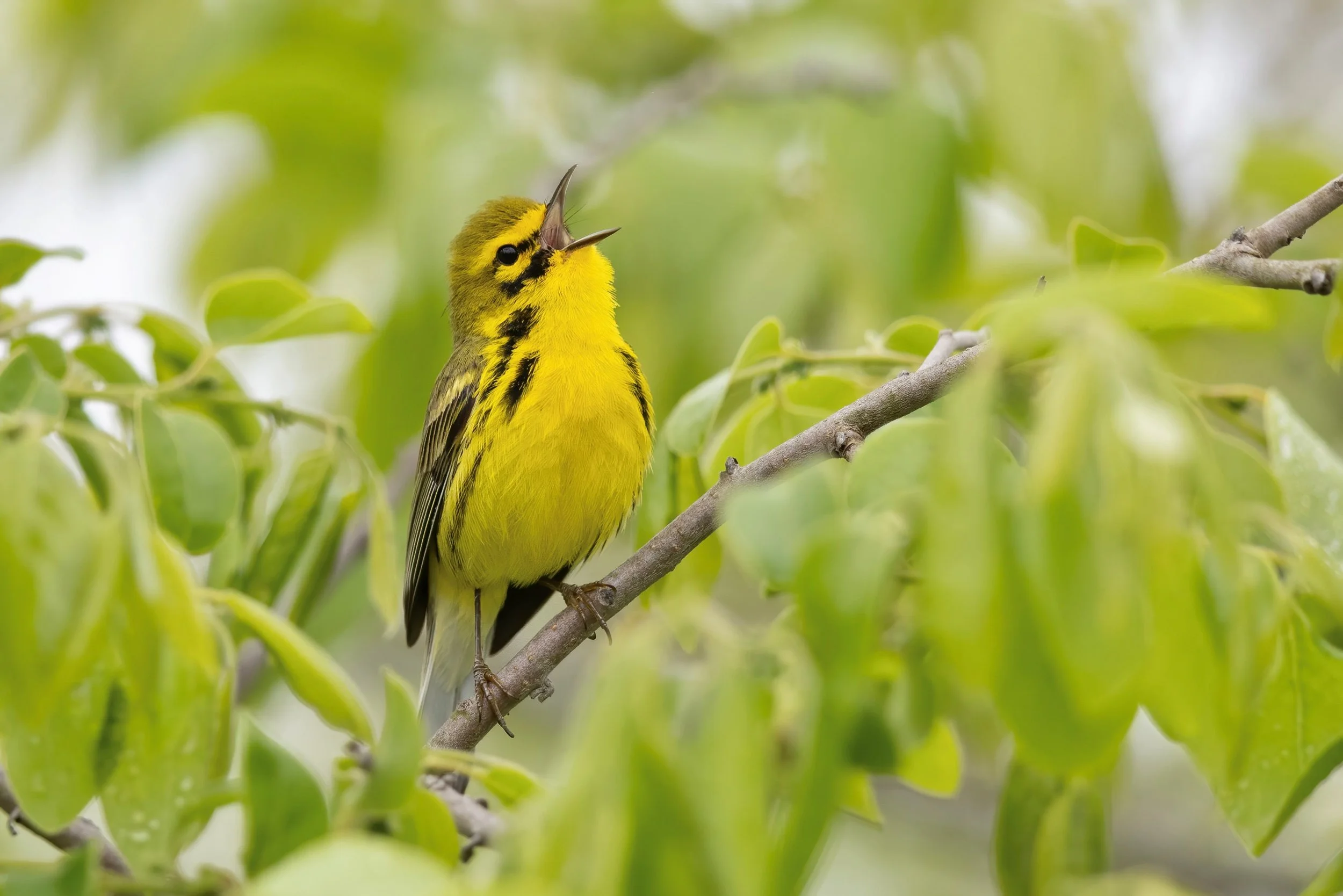
Prairie Warbler at Occoquan Bay NWR, Matt Felperin

Prairie Warbler at Occoquan Bay NWR, Matt Felperin
Like most warblers, it’s a beautiful little bird. The male Prairie Warbler is a bright yellow with black streaking on his sides. The defining features are the black eyeline and black semicircle under the eye, along with a chestnut patch on its back. The unique face pattern with the semi-circle of black, differentiates it from other warblers although it takes good skill with binoculars to spot this! The female’s streaks are blurry on the side and the face pattern is gray with the signature semi-circle under the eye a darker gray.
Of course, with many warblers it is often their songs that alert us to their presence. The Prairie Warbler does not disappoint. The male has two songs, one for the female and one for his territory. The first is a rising series of buzzy notes from low to high. The second generally consists of several long, clear notes followed by several harsh, raspy notes. In either instance the male appears to love to perch at the highest tree top while singing. He also makes a chek contact call and a tsip alarm call. You can hear Prairie Warbler calls on Cornell’s All About Birds site.
The Prairie Warbler’s habitat here is generally in second growth forests such as overgrown pastures, regenerating woodlands or power line cuts. It thrives in brushy areas growing up after clearing or fires. As the forest matures, the Prairie Warbler disappears. Because the habitat can be temporary, its breeding site can change from year to year. The Florida paludicola subspecies lives in the mangrove forests.
Migrating birds need supportive habitat all through their annual life cycle which includes their breeding grounds, stopovers during migration, and the overwintering area. They are insectivores, so each habitat must be rich in insects to supply these tiny birds with food for themselves and their young, as well as fuel for their long journeys. They eat large quantities of caterpillars, moths, beetles, ants, and flies, as well as spiders, millipedes and mollusks. They forage near the ground, grabbing prey from leaves and branches while moving through the underbrush, pumping their tails all the while.

Prairie Warbler at Piney Grove Preserve, Matt Felperin
In northern Virginia, Prairie Warbler decline generally is attributed to the loss of habitat and a diminishing food supply from use of insecticides. Urbanization is not, however, always the culprit in habitat loss. Good forest management is necessary to combat habitat loss. For example, the Virginia Department of Wildlife Resources (DWR) actively collaborates with many organizations to promote forest management that allows for a range of forest habitats, including both old growth and early successional habitat areas with young and regrowing vegetation that benefit species like the Prairie Warbler. You can read about DWR’s efforts here.
Conservation initiatives also can benefit several struggling species at the same time. Projects to support the Golden-winged Warbler also benefit Prairie Warblers, because they rely on similar habitat. Nature Conservancy’s maintenance of habitat to benefit the Red-cockaded Woodpecker in Piney Grove Preserve in southern Virginia also benefits Prairie Warblers. Conservation initiatives that support grassland birds also can benefit Prairie Warblers because they encourage a diversity of land types, including shrublands bordering grasslands and meadowlands. A good example is the Virginia Grassland Bird Initiative, a collaboration of Smithsonian’s Virginia Working Landscapes, Piedmont Environmental Council, American Farmland Trust, and Quail Forever. The organizations worked with the American Bird Conservancy to designate the Northern Virginia Piedmont and Shenandoah Valley BirdScape as a conservation area.
In our area, you can see the Prairie Warbler at Occoquan Bay National Wildlife Refuge, the Laurel Hill Equestrian Center, Sulley Woodlands and Huntley Meadows as early as April and May. Remember to first listen for its song before searching the brush for that spot of yellow!