
NVBA NEWS BLOG
Welcome to the blog for Northern Virginia Bird Alliance, a wealth of resources about northern Virginia birds, wildlife, habitat conservation and restoration, native plants, wildlife-friendly gardening, advocacy and more.

Expanded Polystyrene Foam Now Banned in Takeout Containers in Virginia
If you have ever participated in a trash cleanup along a shoreline, creek or road, you’ll undoubtedly have come across pieces of expanded polystyrene foam (EPS), popularly known by one of its brand names, Styrofoam.
Photo: Scavenging gull, Chris Downer / Mallaig
Tom Blackburn
If you have ever participated in a trash cleanup along a shoreline, creek or road, you’ll undoubtedly have come across pieces of expanded polystyrene foam (EPS), popularly known by one of its brand names, Styrofoam. There is good news on the environmental front: as of July 1, 2025, Virginia implemented a ban on the use of EPS in takeout and beverage containers for vendors with more than 20 locations in Virginia, including grocery stores, restaurants, food trucks and caterers. On July 1, 2026, the ban goes into effect for all vendors.
Scavenging gull, Chris Downer / Mallaig
EPS is extremely harmful to the environment. It is fragile, and quickly breaks into smaller pieces, making it difficult to clean up. And because it is very lightweight, it often blows far from where it was initially deposited, making it even harder to collect for proper disposal. Like all plastics, EPS biodegrades very slowly. Scientists estimate that plastics may take at least five hundred years to biodegrade. If Captain John Smith had tossed a piece of EPS over the side of his ship as he traveled up the Potomac River in 1608, tiny pieces of it would still be in the water, where fish, birds and other wildlife could eat them.
EPS and all other plastics break down into microplastics and nanoplastics before they biodegrade and can have severe health impacts. A recent article, “Seabirds in crisis: Plastic ingestion induces proteomic signatures of multi-organ failure and neurodegeneration,” in the journal Science Advances, reports that the stomachs, livers and kidneys of 90-day-old seabirds that had eaten plastics were not functioning normally, and the birds also showed symptoms of Alzheimer’s-like brain deterioration. While no studies have demonstrated adverse health effects in humans yet, an article, “Bioaccumulation of microplastics in decedent human brains,” in the journal Nature Medicine, reports that nanoplastics have breached the blood-brain barrier and are accumulating in human brains.
Virginia State Representative Betsy Carr introduced HB 533 in the 2020 Virginia General Assembly to prohibit the use of EPS in carryout food service containers. It passed, but with an amendment requiring reenactment in 2021 before it could take effect. Rep. Carr’s reenactment bill, HB 1902, passed in 2021, but Governor Youngkin inserted language in the 2022 budget bill delaying implementation of the ban. He attempted to do the same thing earlier this year, but the legislature overturned the delay, allowing the initial ban to take effect this year.
The Virginia Department of Environmental Quality has implemented a Foam Free Virginia campaign, providing information on its website about the ban, alternatives to EPS containers and filing a complaint about vendors violating the law.

Ospreys May Be in Trouble Again
This year has brought some troubling signs for these impressive birds.
Photo: Osprey and its young at the Belle Haven Marina platform nest on June 18, 2025, Glenda C. Booth
Glenda C. Booth
Reprinted by permission from the Connection Newspapers
Osprey and its young at the Belle Haven Marina platform nest on June 18, 2025, Glenda C. Booth
They usually grow up and leave in July — Ospreys, 22-inch-tall, brown and white raptors with a 65-inch wingspan, birds that nest and raise their young near open water in northern Virginia from March to August.
Many people are intrigued watching them dive feet first to catch fish with their sharp talons, take them to the nest, rip them apart and eat and feed them to their young. They build nests, a jumble of sticks, or refurbish old nests every spring, in northern Virginia generally along or near the Potomac and Occoquan Rivers, in trees, on platforms, duck blinds, poles and channel markers.
This year has brought some troubling signs for these impressive birds.
Ospreys in Dyke Marsh
For many years, Ospreys have returned to Dyke Marsh in March and a pair has built a nest and raised their young on a platform at the Belle Haven Marina on the northern edge of Dyke Marsh. This year, the pair had two chicks, but around the end of June, one had perished.
Larry Cartwright, who has conducted a breeding bird survey in Dyke Marsh since 1994, reported on June 30, “The female was feeding the survivor today and the nestling was taking the offered food quite readily but looks a little stunted in development. The bird just sat there after eating with a quick break to jet a nice stream of excrement over the side of the nest, but little additional movement.” His July 6 report was more encouraging: “The youngster was more active today, standing up in the nest and flapping its wings for the first time. Hopefully, fledging will occur within the next two weeks.”
Ospreys at Porto Vecchio
For over a decade, Osprey pairs have successfully raised young in nests on two platforms near Porto Vecchio condominiums next to Hunting Cove at the confluence of the Potomac River and Hunting Creek. Three chicks from the northeast nest and two chicks on the southeast nest born this spring are now flying.
Several Porto Vecchio residents have had to come to the birds’ rescue over the years. Ospreys from these nests have died from fishing line entanglements at least twice in the past. Last summer, two residents rescued a chick from fishing line and this year, rescued two more chicks, one after falling from the nest and the second from twine wrapped around its wing.
More Ospreys
Jay Spiegel has had an Osprey camera on a Little Hunting Creek nest behind his house for several years. This year a pair had two chicks, but Spiegel reports that around June 23, the chicks disappeared. He does not know why.
For several years, a pair has nested atop a light pole over Walt Whitman Middle School’s softball field. Observers saw an Osprey there this year several times, but no one confirmed nestlings.
Challenges for Ospreys
Ospreys appear to be having a difficult year. Definitive data await final surveys. Local experts point to stressors like a weak shad run this spring on the Potomac, warming waters that affect the timing of fish migration, extreme cold and heat events during the hatchling phase, fewer ideal breeding areas because of ever encroaching development, competition with increasing eagle populations and more severe storms.
A May 2025 survey of nesting Ospreys on Virginia’s Delmarva Peninsula, led by Dr. Bryan Watts of the College of William and Mary’s Center for Conservation Biology (CCB), reported a 90 percent decline there. He recorded nine pairs in the survey area and said that compared to past surveys from the 1970s and 1980s, “the 2025 survey reveals a nearly complete collapse of the population.” Watts concluded, “The most likely cause of the decline is prey availability. However, no Osprey diet studies have ever been conducted within this site, and we know very little about trends in fish availability.”
CCB scientists previously reported that in the lower Chesapeake Bay, a silvery fish called Atlantic menhaden are nearly 75 percent of Ospreys’ diet. Some conservationists argue that large-scale, commercial menhaden harvests are depleting menhaden stocks and that government officials should reduce current limits on the number landed or caught.
There have been several efforts in the Virginia General Assembly in recent years to require a comprehensive study of the menhaden population, but those bills have failed. The Chesapeake Bay Foundation’s website says, “Atlantic menhaden are the target of Virginia’s largest commercial fishery, run by a company called Omega Protein, and its affiliates. Typically turned into fishmeal and fish oil products in a process known as ‘reduction fishing,’ the small schooling fish also are a key food for iconic predators like striped bass, bluefish, and Ospreys. All other states have banned the practice of reduction fishing.”
More Osprey Facts
Ospreys mate for life and usually return to the same nest every spring. They typically incubate one to four eggs for 36 to 42 days.
Because they add materials to their nest year after year, a nest can be ten to 13 feet deep, three to six feet across and weigh up to 250 pounds. They may “decorate” their nests with items like shoes, cans, fabric, fast food debris and toys. Ospreys can become entangled in things in the nest, like plastic bags, balloon ribbons and monofilament fishing line.
Over their 15-to-20-year lifetime, Ospreys may migrate more than 160,000 miles.
In the early 1970s, Osprey numbers plummeted and scientists concluded that the eggshells of Ospreys, eagles and other birds were so thin that they broke during incubation and birds failed to hatch. They concluded that the hatching failure was due to pesticides that moved up the food chain. In 1972, the U.S. Environmental Protection Agency banned DDT and populations recovered, until recently.
EDITOR’S NOTE: For more information about the challenges Ospreys face, see the article about Ospreys and menhaden from the June 2025 Potomac Flier, and watch Joanie Milward’s March 2025 talk, Ospreys in the Chesapeake Bay Watershed.
Pollinator Pathways: Connecting your yard to the bigger picture
Is it possible to reconnect isolated fragments in our urban, suburban, and rural settings to benefit pollinators and the creatures that depend upon them?
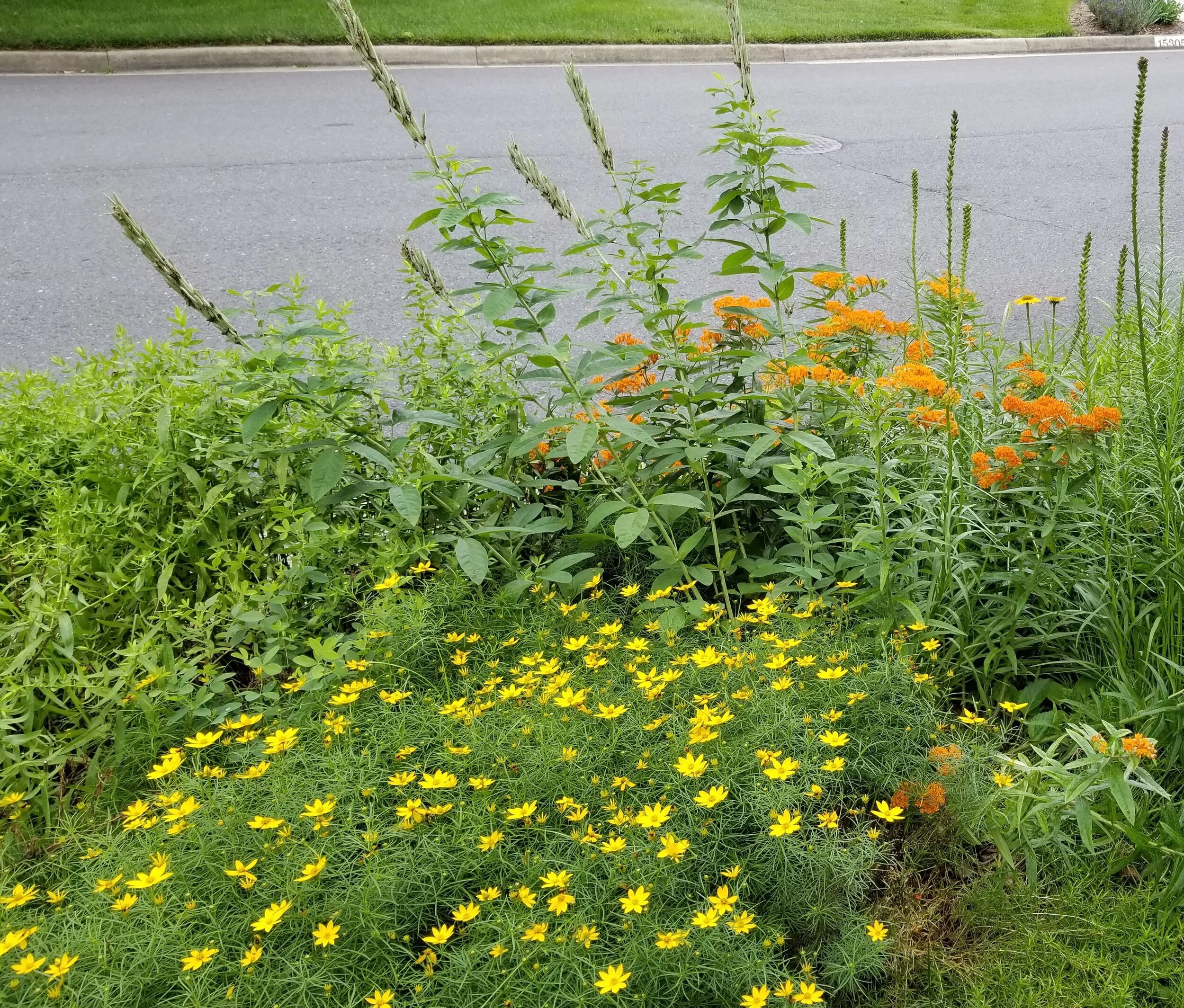
Photo: Native plant garden, Margaret Fisher
By Eileen Ellsworth
Imagine the world as it once was. Verdant forests, buzzing meadows, and numerous other natural areas were immense, whole, and pulsing with life. Over time, human activity emerged and carved the natural world into disconnected, even isolated parts. Ecologists refer to this process as habitat fragmentation. You can see it in urban settings where green parks are biological islands surrounded by buildings and concrete roads. You can see it in rural settings where agriculture simplifies ecosystems and amplifies the populations of only certain insects to the detriment of others. You can see it in suburban settings where developments destroy natural habitats and where landscapes are “replaced” with all non-native species.
Large and mostly undisturbed ecosystems can still be found, of course, especially in our beloved national parks and forests. But even they are distant from each other, understaffed, and too small in total acreage to sustain the biodiversity of the continent. Any solution to the problem of habitat fragmentation and the resulting loss of biodiversity, therefore, must be found right here among the throng of human life – where we live, work and play.

Is it possible to reconnect isolated fragments in our urban, suburban, and rural settings to benefit pollinators and the creatures that depend upon them? That was the question that sparked the “pollinator pathway” concept in 2007 by Sarah Bergmann, an artist living in Seattle. As part of a social and ecological project, she envisioned and described a network of native gardens that could create a “pathway” to support pollinators. This core idea led to the creation of a nonprofit – Pollinator Pathway – by Donna Merrill, a conservationist from Wilton, Connecticut, in 2017. Since then, the group has helped inspire and launch a national movement.
The idea is a powerful one. Anybody can take part, even at a novice level. There are very few barriers to participation. If all you have is one native tree or a small pollinator garden – preferably one with some native plants – it’s a start, and you can build from there.
The main goal of a pollinator pathway is to reinstate connectivity between several small but healthy habitats. A single native tree can support bees and other pollinators as much if not more than a flower garden. Building a pollinator pathway on your street, for example, may include adding a new native tree or two, or creating new healthy gardens on communal grounds or private property as “stepping stones” along the way. It may include the expansion of existing native plant areas. Removal of invasives that disrupt the pathway will certainly be part of the plan, along with pledges to avoid all broadcast pesticides including mosquito and tick sprays. Only unpoisoned ecosystems can be included in the work.
Many communities across America are already building pollinator pathways and proving the concept. You can recruit participants on your own, or have fun working with like-minded people to muster engagement. Hold a kick-off meeting to build some early momentum. Don’t over-plan. Take some early action, starting with 1 or 2 easy planting projects, then see where it takes you.
On a new webpage just launched by Plant NOVA Natives you will find some handy tools to help you build a pollinator pathway in your neighborhood or community. They include:
A tip sheet for pollinator pathway organizers
Instructions for ordering medallion signs that will be delivered to your house from Plant NOVA Natives for you and your participants — If you are in northern Virginia, we will have the sign company mail you the first five for free.
Ideas for how to pitch the idea to the folks you want to engage
Pollinator Pathway handouts to leave with your neighbor
Join the movement! Let’s work with our neighbors and friends to connect the fragments, rebuild some beneficial habitats, and heal the everyday ecosystems that surround us. Their resilience is astonishing. New life, activity, and hope will certainly emerge, along with a new joy in being part of something much bigger than our own backyards.
If you want help identifying plants to remove from your yard, and native replacements, consider signing up with NVBA for a Wildlife Sanctuary Consultation.

Biodiversity or mosquito fogging: You can’t have both
Some of our neighbors turn to commercial-grade mosquito fogging, persuaded by marketing claims that the product is both effective and “safe.” But a closer examination of these claims reveals an ineffective process that is devastating for native bees, butterflies, fireflies, moths, and a plethora of other beneficial insects we work so hard to attract with native plants.
Photo: Asian Tiger Mosquito, Judy Gallagher
We’ve written before about harm from mosquito fogging, but it’s such an important issue, we encourage you to read this additional article from Plant NoVA Natives.
Plant NoVA Natives
Ah, the mosquito. It plagues our summers and can ruin our outdoor fun. Is anyone a fan? If so, consider the Asian tiger mosquito, which has no regard for personal space or time. If you happen to have it in your yard, it bites everyone, morning, noon, and night. In winter we long for warm weather, but when it finally arrives, in some neighborhoods we are indoor prisoners. Understandably we want to rid ourselves of this awful pest.
Some of our neighbors turn to commercial-grade mosquito fogging, persuaded by marketing claims that the product is both effective and “safe.” But a closer examination of these claims reveals an ineffective process that is devastating for native bees, butterflies, fireflies, moths, and a plethora of other beneficial insects we work so hard to attract with native plants.
How effective is mosquito spraying? How effective can it be when the chemicals in the product only target adult mosquitos and only those adults within direct range of the fog? By some estimates, no more than 20-30% of adult mosquitos are killed in one treatment. Meanwhile all mosquito larvae, which are laid and hatched in standing water, are unaffected. They continue to grow and emerge as if nothing harmful has happened in their environment. As a result, the adult population of mosquitos is quickly replenished while nearly every other insect the fog touches is indiscriminately killed.
Mosquito spray producers point to EPA statements that the chemicals are safe for bees when used according to label instructions. But there are severe limitations to the EPA’s testing method. The agency only tests on honeybees and only measures the chemical toxicity resulting from surface exposure, not oral ingestion.
This is highly problematic. Honeybees are only one species of bees and are non-native to boot. That leaves 400 species of native bees in Virginia, along with all butterflies, moths, dragonflies, ladybugs, fireflies, and numerous other beneficial insects that are not tested. Those insects have entirely different life cycles, foraging methods, and ways of protecting and feeding their larvae which render them tragically vulnerable. It is a complete folly to extrapolate EPA’s honeybee-focused test results to any other insect species.
Consider this: One spray of mosquito fog leaves a persistent residue on the surface of everything it touches. Repeating the applications every 10-30 days, as many commercial services recommend, just compounds the problem. The EPA says it considers how long the chemical residue persists in the environment and its effect on honeybee colonies. However, honeybees can forage up to 5 miles away from their hives if necessary, far away from the fogged area and the residue. Our native mason bees, on the other hand, forage no further than 300 feet from their nests. They are wholly dependent on the health of their immediate surroundings to eat and reproduce. Adults have no way to avoid exposure.
Neither do their larvae. Leaf cutter bees and mason bees, for example, produce dough balls that are left in hollow stems for their developing larvae to eat. The balls are composed of pollen and nectar from the flowers in their immediate foraging range. As the larvae hatch and eat the dough balls, they ingest concentrated levels of the pesticides and die. For our native bees, there is no honeybee equivalent of the hive to ensure their survival. They live their lives alone. As their larvae die, all subsequent lines of offspring from affected individuals are gone for good.
Fortunately, as research has advanced on fogging, so too has the thinking on several alternative, inexpensive methods of control. Here are some very safe and effective suggestions, especially when used together as a suite of tools.
Source Removal. The most effective method of mosquito control by far is “source removal,” or emptying/eliminating all sources of standing water on your property. This practice kills mosquito larvae before they become biting adults. Regularly inspect your property for containers or areas that hold water, then remove or empty them. Remember to inspect flowerpots, buckets, or any other feature or item that can hold water. Change the water frequently in places where you want it – like birdbaths – so the larvae have no time to grow and emerge. Maintain your gutters and downspouts so the water flows. Keep your swimming pools and hot tubs clean and properly chlorinated.
Mosquito Larva Traps: This is a favored method of control by Doug Tallamy, an entomologist at the University of Delaware and national proponent of supporting biodiversity in our own backyards. He recommends filling a five-gallon bucket of water, placing it in the sun, then adding a handful of hay, grass, straw, or leaf litter to decay and attract egg-filled female mosquitos. Add a quarter of a Mosquito Dunk® tablet you can purchase at any hardware store, garden center, or home improvement retailer. It contains bacteria that kill several species of fly larvae, including mosquitoes. A more detailed explanation of the process - and photos of lovely painted buckets - can be found on Dr. Tallamy’s Homegrown National Park website. Or follow NVBA’s instructions for setting up a mosquito larva trap. To make your life even easier, you also can find kits for making mosquito larva traps on Etsy.
Water Wigglers: Water wigglers are devices you can purchase to keep water moving in birdbaths. They were designed to attract birds to the sight and sound of running water but are also highly effective in stopping female mosquitos from laying eggs.
Deck Fans: Mosquitos are weak fliers. Turn on a fan while you enjoy your deck and make it harder for mosquitos to reach you.
Personal Protection: When spending time outdoors, consider wearing long pants, sleeves, and a hat, and spraying your clothing and skin with insect repellant. Personal precautions such as these can prevent mosquito bites entirely.
Community Efforts: Mosquito control is very successful when several neighbors in a larger community participate. Talk to your neighbors about source removal, mosquito larva traps, fans, and water wigglers. Show them your homemade mosquito bucket and encourage them to do the same. Some studies tout this approach above all others, suggesting that mosquito populations can be reduced by 85% when the whole street or block works together. One way to approach your neighbors is by inviting them to join a Pollinator Pathway and giving them a nifty little sign to display which will encourage other neighbors to rethink their mosquito-spraying contracts.
We all enjoy our yards and our pollinator gardens, and we understand how including native plants promotes biodiversity. But along with joy comes responsibility. If we don’t protect the very life we’ve helped emerge, no one will. We can have improved biodiversity, or we can have pesticides. They do not co-exist.

A Closer Look: Nature All Around Us, September 2025
Judy Gallagher is an NVBA board member and a regular surveyor of local wildlife who also captures photos of what she sees, in particular the less common species.
Photo: Horse Fly eyes, Judy Gallagher
Judy Gallagher
September 2025
Our eyes determine how we see the world. This is an oversimplification of human vision, but human eyes have a single lens that focuses light onto the retina, which has photoreceptors called rods which help us see in low light and cones that help us see colors. It's easy to assume that other species see things the same way we do, but that is not the case.
Most adult insects have compound eyes, which are made up of many individual lenses called ommatidia that allow them to see a wide field of view and detect movement. The number of individual lenses can vary from 6 in worker ants to more than 25,000 in dragonflies.
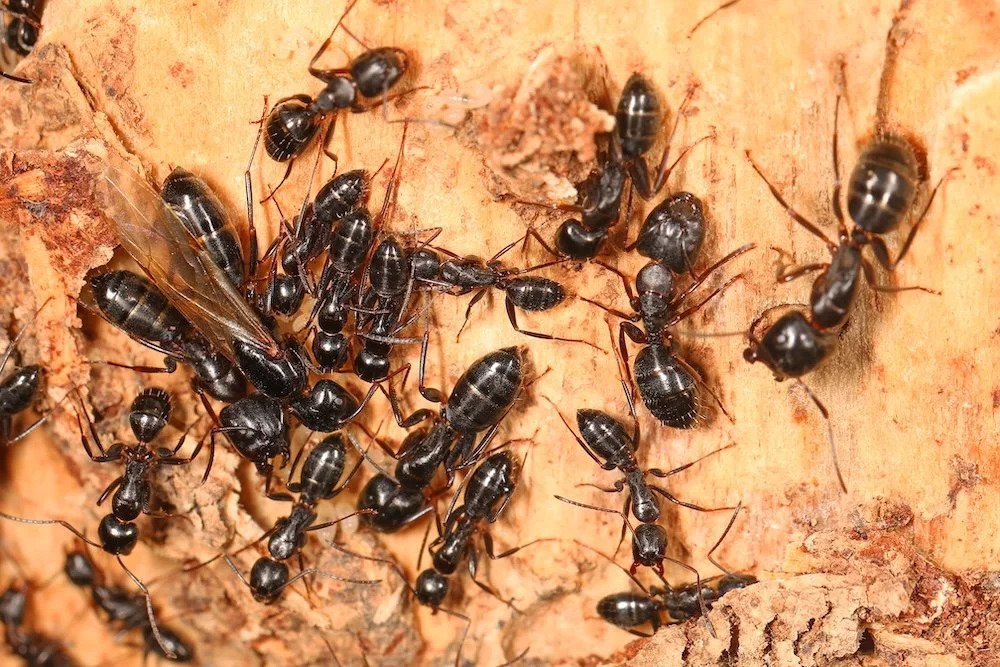
Nearctic Carpenter Ants. The worker ants are the ones with the smaller heads. Judy Gallagher
Evolution favors traits that benefit a species in some way. It's possible that visual acuity is not that important to worker ants who stay close to the colony and use other senses like smell and touch.
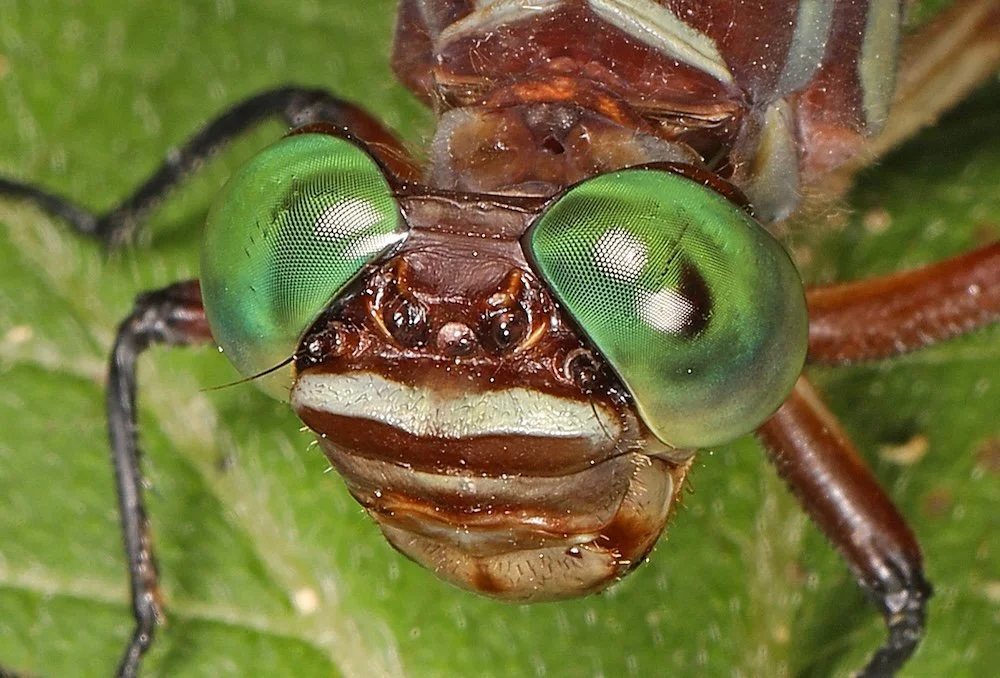
Russet-tipped Clubtail dragonfly, Judy Gallagher
Dragonflies, on the other hand, need good vision. They have a greater number of light-sensitive proteins in their eyes than we do and likely have great color vision. Their range of view is almost 360 degrees and they can see up to 200 images per second, enabling them to track motion easily. They are aerial predators, catching all their prey in flight. Their excellent vision and flight prowess are responsible for them catching up to 95% of the prey they target.
There are two basic types of compound eyes. Apposition compound eyes produce multiple images, one for each ommatidium. The vision is likely not as sharp as our single-lens eyes, but movement is tracked more easily.

Black Witch Moths, with their light-sensitive superposition eyes shining, Judy Gallagher
Most nocturnal insects have superposition compound eyes, which form a single image. This allows increased light sensitivity, but it's at the expense of resolution.
Many insects can distinguish between polarized light (coming directly from the sun) and unpolarized light. That enables them to detect the sun’s position and use it as an orientation cue even when the sun is obscured by clouds. Many insects can “see” light in the ultraviolet range. But they often can't see red. Bees and butterflies have good color vision, but many insects don't.

Western Honey Bee with pollen on its hairy eyeballs, Judy Gallagher
Speaking of bees, Western Honey Bees have hairy compound eyes, which allows them to capture pollen there when the bee is foraging.
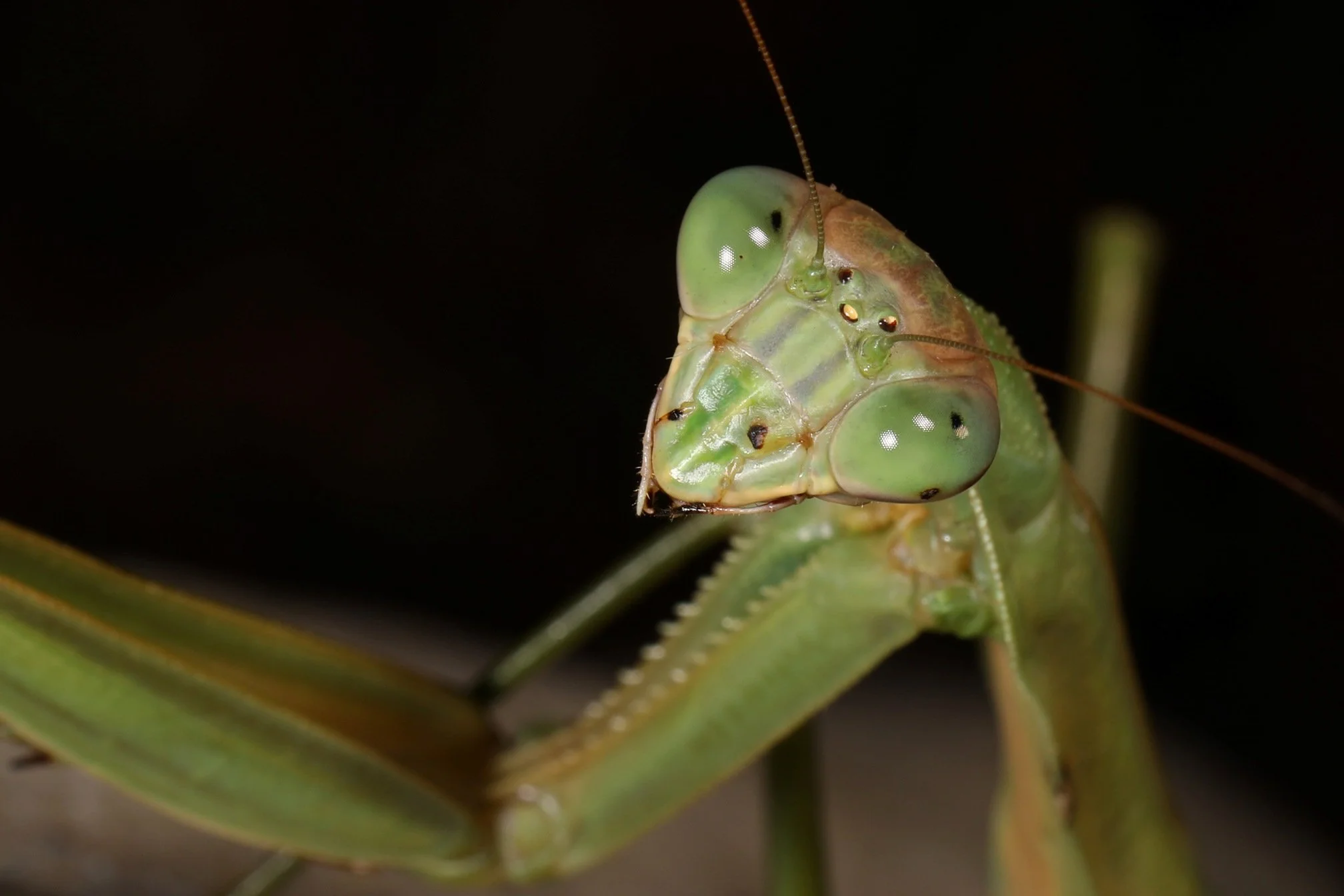
Chinese Mantis, Judy Gallagher
Some insects like the Praying Mantis have good vision. An area of their eye is slightly flattened and the ommatidia in the flattened zone are larger than in the rest of the eye. The flattening allows more ommatidia to receive light from a spot and therefore provides higher resolution.
Horse Fly eyes, Judy Gallagher
Female horse flies are attracted to linearly polarized light when searching for animals to bite. Scientists speculate that this helps them to locate dark host animals in sunlit vegetation because the vegetation and the animal reflect light differently. This suggests that wearing light colored clothing while outside might help you avoid being a horse fly target.

Eastern Hornet Fly showing Ocelli, Judy Gallagher
Most flying insects also have simple eyes called ocelli that may help them maintain a balanced course. They are pretty unassuming relative to the compound eyes. But there are a few flying insects that don’t have ocelli; for instance, some horse flies.
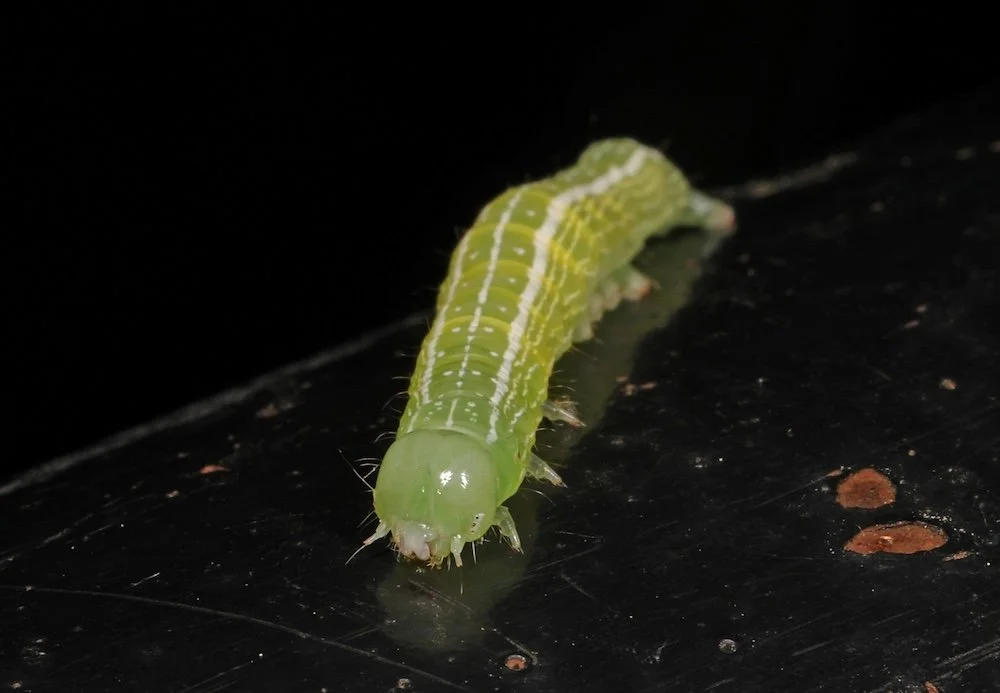
Intractable Quaker caterpillar - the little black dots on its head are stemmata. Judy Gallagher
Stemmata are simple eyes found on most larvae of insects that undergo complete metamorphosis. They can detect motion and sometimes polarized light. They are located where the compound eyes will be when the larva transforms into the adult form.

Antlion, showing its amazing eyes, Judy Gallagher
My favorite insect eyes are on members of the Neuroptera order. Adult lacewings, ant lions and mantidflies have mesmerizing eyes. But I couldn't find any research that detailed why. This may be a topic for a future article!
View more of Judy’s articles on A Closer Look: Nature All Around Us (formerly Observations from Meadowood).

Letter to Our Members
I have been admiring the fireflies in my backyard recently. I didn’t see them there for many years, but I’ve attracted them by making several simple changes.
Photo: Common Eastern Firefly, Judy Gallagher
Connie Ericson
A Gradual Transformation
I have been admiring the fireflies in my backyard recently. I didn’t see them there for many years, but I’ve attracted them by making several simple changes (planting some native grasses, leaving the leaves as natural mulch, building a small stick and leaf pile and dimming the lights). And I’ve accomplished the change in spite of a lifetime of avoiding gardening, except when it involved cutting things back. I’ve always thought of myself as a slasher rather than a nurturer, but I’m evolving apparently.
Some background: not long after I joined the NVBA board in 2018 (I retired in 2024), a few members encouraged me to schedule a visit from a Wildlife Sanctuary Ambassador. I was taking Arlington Regional Master Naturalist training at the time, so I already knew that my professionally landscaped yard likely was a wasteland. But I hesitated. I dreaded the work involved in changing to a more natural habitat that would welcome native wildlife.
But once I arranged the visit, I was pleasantly surprised. I had a few natives already (coral honeysuckle and Virginia spiderwort), and the visiting ambassador didn’t lecture, but rather encouraged me to make changes a little at a time. She identified the most problematic invasives (e.g., a long row of nandina along the back retaining wall) and made a few suggestions for substitutes.
I’ve been chipping away at it ever since, and I’m pleased to report that the results are positive. In addition to fireflies, in the past few weeks I’ve enjoyed seeing eastern tiger swallowtails, zebra swallowtails and huge numbers of bees and bumblebees I can’t identify. I’ve done most of the work in my backyard, which is challenging: it’s steep, and mostly taken up by 3 tiers of stacked stone walls, but the fence and terrain keep deer out. I’ve taken out the invasives and planted some natives, with some massed plantings of flowers where I get the best sun. I’ve had successes (a red oak, shrubby St. Johnswort, black-eyed Susans, coneflowers, green and gold, virgin’s bower, little bluestem) and some misses (mountain laurel). But the increased insect population suggests to me I’m going in the right direction.
I’ve also had some unwelcome visitors. It took some work to fence out a groundhog attracted by my plantings, but it was necessary to keep it out because I didn’t want its tunneling to disturb some pretty elaborate (and essential) drainage on my steep lot. I regret that the changes mean I no longer see the occasional Eastern box turtle in the backyard.
I have not had any adverse consequences from cutting out the quarterly pesticide treatment on the outside of the house that I maintained for years after finding silverfish when I first moved in. I’ve found that a little boric acid powder in areas my indoor cats can’t get to is effective for that problem. But I’m wrestling with how to manage the latest yellowjacket nest in my stacked stone walls. I don’t have children playing in the yard, and, for now, I’m just not weeding the bed in that area, but at some point I’ll want to thin some of the flowers there. My current plan is to wait until winter when I understand the nest will die out. I’m also researching the possibility of non-pesticide yellowjacket traps, but I’ve just started that investigation.
I can do more, of course, but I’m still taking my time, particularly in areas where taking out problematic plants (the vinca in my front yard, and more lawn than I want) likely will require some professional help given some physical limitations that have come with age. But I’m having more fun than I ever imagined I would doing a little pottering around the yard.
If you haven’t done so, I’d encourage you to invite a Wildlife Sanctuary Ambassador to your yard. It may be your first step in inviting more native wildlife to your life.

Dyke Marsh: A Fragile Treasure
The Dyke Marsh Wildlife Preserve, in northern Mount Vernon along the Potomac River shoreline, is the "nearest thing to primeval wilderness" in the Washington area, wrote Louis J. Halle in 1947 when he biked from the city at dawn to watch the wetland awaken.
Photo: A view of Dyke Marsh, Dixie Sommers
Glenda C. Booth, President, Friends of Dyke Marsh
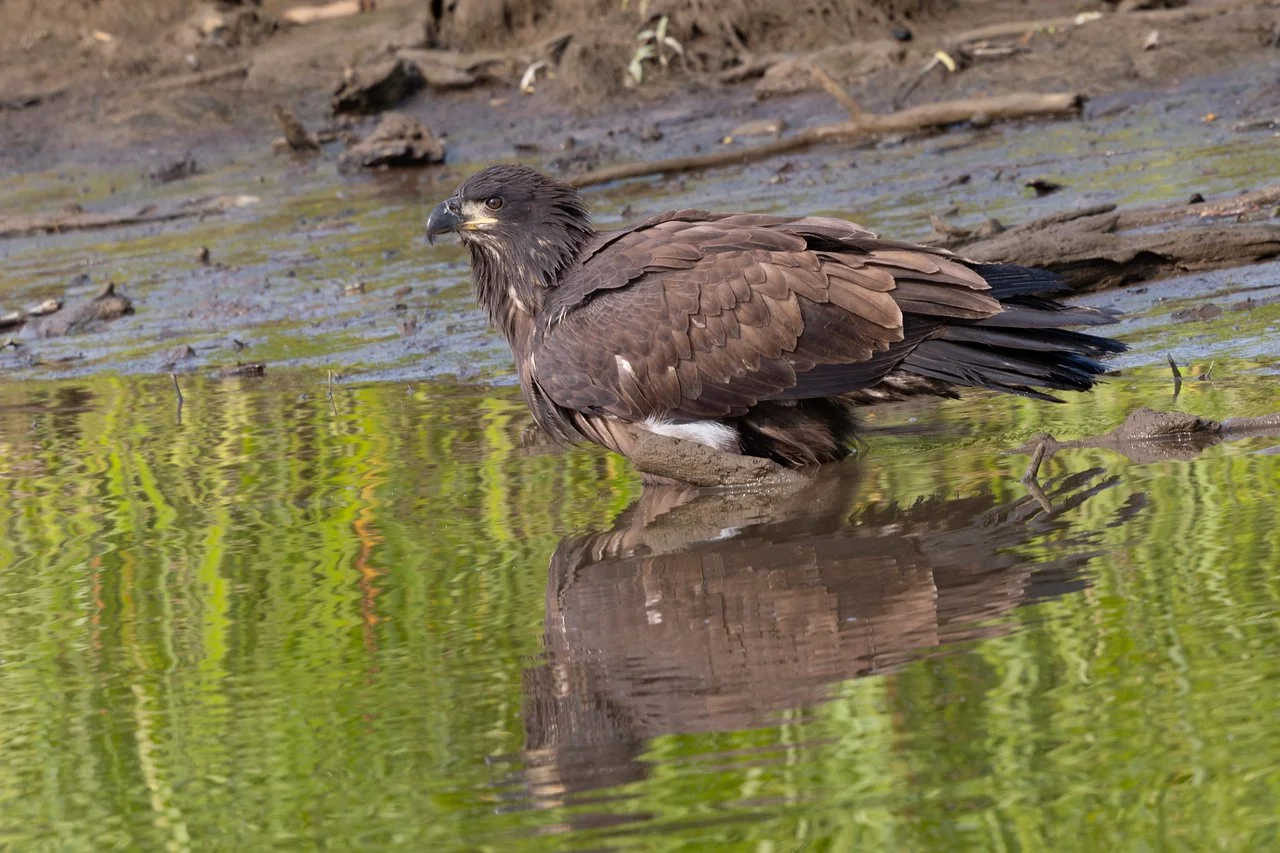
Juvenile Bald Eagle bathing at Dyke Marsh, Dixie Sommers
Experienced and novice birders alike have had “front-row seats” this year in the Dyke Marsh Wildlife Preserve, observing both an Osprey and a Bald Eagle pair raising their young. The Ospreys had two young at an easily-viewed nest on a platform just off the Belle Haven Marina boat ramp. Sadly, one of the chicks did not survive. The Bald Eagle pair raised three young at a very visible nest along the Haul Road Trail. The birds’ fans started seeing the eagles bringing sticks to the nest as early as December. These are just two examples of birds in the preserve. Cornell’s eBird lists Dyke Marsh as a birding hotspot with 271 species reported.
The Dyke Marsh Wildlife Preserve, in northern Mount Vernon along the Potomac River shoreline, is the "nearest thing to primeval wilderness" in the Washington area, wrote Louis J. Halle in 1947 when he biked from the city at dawn to watch the wetland awaken.
Congress’s intent in adding it to the national park system in 1959 is clear: “so that fish and wildlife development and their preservation as wetland wildlife habitat shall be paramount.” Dyke Marsh is a unit of the George Washington Memorial Parkway managed by the National Park Service (NPS).

Black Swallowtail butterfly on Cardinal Flower, Dixie Sommers
It is one of largest remaining tidal, freshwater marshes in the Washington area and one of largest tidal, freshwater, temperate, climax, riverine, narrow-leafed cattail marshes in the NPS system. Part of the marsh is at least 2,200 years old.
According to NPS data, its tidal wetland, swamp forest, floodplain forest and open water provide habitat for over 230 known species of birds, 300 plants, 6,000 arthropods, 38 fish, 16 reptiles, 14 amphibians and 26 mammals, the latter including exotics like feral cats. Wetlands are “biological supermarkets,” notes Kirk Havens with the Virginia Institute of Marine Science.
Marshes Unappreciated
Many wetlands, tidal and nontidal, have been sacrificed – filled and paved over – for roads, buildings and other development. For much of U.S. history, people viewed wetlands as mosquito-ridden dumping grounds to avoid. Some names were telling. In the 1800s, Dyke Marsh was called “Hell Hole,” and William Byrd named the wetland in eastern Virginia the Great Dismal Swamp. On an intriguing side note, during prohibition, Dyke Marsh was a hideout for bootleggers. Clandestine, enterprising purveyors could conduct their business in the dense vegetation and along the river, where state and federal jurisdictional lines were blurred.
Dyke Marsh has endured years of excavation, dumping, pollution, invasive plants and animals, poaching, illegal bow fishing, hunting, polluted runoff, off-leash dogs and endless trash.

Eastern Kingbird nesting, Dixie Sommers
Six species of birds that breed in Dyke Marsh are on Virginia’s list of Species of Greatest Conservation Need: Black and White Warbler, Brown Thrasher, Eastern Kingbird, Gray Catbird, Green Heron and Least Bittern.
And while it is a favorite place to watch birds and other wildlife, Dyke Marsh is much more than birds. It provides ecological services, including flood control, storm buffering, water quality enhancement, biodiversity, carbon sequestration and shoreline stabilization.
Saving Dyke Marsh
Over half of Dyke Marsh was hauled away by dredgers from 1940 to 1972, which destabilized the whole hydrologic system, two U.S. Geological Survey (USGS) studies concluded. USGS reported that in 1940, the wetland part of the preserve was around 180 acres. By 2010, it was around 53 acres. The dredging that removed around 101 acres or 54 percent of the 1937 marsh was a strong destabilizing force, transforming it from a net depositional state to a net erosional state.
In 2010 and 2013, the USGS concluded that Dyke Marsh was eroding six to eight feet or 1.5 to two acres per year a year on average and at an accelerating rate. They predicted that at this rate Dyke Marsh would be gone by 2035.
Said USGS: “Analysis of field evidence, aerial photography, and published maps has revealed an accelerating rate of erosion and marsh loss at Dyke Marsh, which now appears to put at risk the short-term survivability of this marsh.”
NSP prepared a restoration plan and, with the help of the Friends of Dyke Marsh (FODM or the Friends) and other organizations, received over $25 million to stabilize the marsh. In 2013, then Interior Secretary Sally Jewell came to the marsh to announce the funding and a restoration-stabilization plan. In 2020, NPS completed phase one, construction of a breakwater that replicates a former promontory that protected the marsh. USGS identified the breakwater as a priority that would “redirect erosive flows in the marsh, particularly during strong storms and re-establish hydrologic conditions that would encourage sediment accretion.” In 2022, NPS’s contractor completed four sills north of the breakwater to also help stem erosion and encourage accretion.
FODM Projects
Another restoration effort is underway as well. Many of the upland areas of the marsh, especially along the trails, are overrun with invasive plants, like much of northern Virginia’s habitat. FODM teams work twice a month to control invasive plants near the Haul Road Trail, where most people visit the marsh. In June, FODM recently received a Dominion Energy Charitable Foundation grant to control three plots infested with mile-a-minute, porcelain berry, English ivy and other non-native plants. In one area in 2018, after clearing invasive plants, volunteers and NPS staff planted over 4,000 native trees and plants. NVBA helped fund the purchase of the plants.
The Friends have several other projects:
breeding bird, butterfly, dragonfly and plant surveys;
treatment of 20 pumpkin ash trees to combat the invasive emerald ash borer;
a wildlife monitoring camera;
planting black willow stakes to stabilize the marsh;
guided walks focused on birds every Sunday;
other periodic walks focused on butterflies, trees, ecology and plants’ fall colors;
trash cleanups;
water testing;
annual raptor event;
advocating for national parks, clean water and other issues; and
public meetings with speakers on conservation topics.
Dyke Marsh like many natural areas offer what Henry David Thoreau called “the tonic of wildness.” The best way to really see Dyke Marsh is in a kayak or canoe. We hope you will visit and try nature’s restorative elixir. We invite you to join the Friends of Dyke Marsh by visiting our website, where you also can find more information about the marsh and a printable bird checklist.

Fall color at Dyke Marsh, Dixie Sommers

Happy Bees, Happy Yards
Gardening to attract as many bees as possible is more than a rewarding pastime. It’s a blend of purpose, beauty and connection to something grand and greater than we are.
Photo: Spring Beauty Bee, Judy Gallagher
Plant NoVA Natives
Gardening to attract as many bees as possible is more than a rewarding pastime. It’s a blend of purpose, beauty and connection to something grand and greater than we are. The growing season is marching by, but sufficient time remains to add a few new bee-favorite flowering plants and shrubs to your property. Bees are key to the environment. Their health reflects the state of the health and interconnectedness of the surrounding world. If the bees are happy, so are the habitats they occupy.
Bees are among the most efficient and effective pollinators in the insect kingdom. Pollinators ensure the reproduction of 80% of all flowering plants, a Herculean feat that bees accomplish inadvertently. In the process of collecting nectar and pollen for their own use, bees become covered in the plant pollen, fertilizing plants as they move from bloom to bloom. The plants that bees pollinate have played their part as well, evolving flowers that are custom-built to attract bees by accommodating their unique preferences, anatomy and behavior. It is an ancient and productive partnership between two very different forms of life.
In more recent times we’ve come to appreciate the direct benefit bees provide to uncultivated ecosystems. In meadows, for example, bees cross-pollinate many different plants, which leads to genetic diversity and stronger, more resilient plant stocks. Bees promote the diversity of plants that help clean the air and water and reinvigorate the soil. Plants are the foundation of food chains that feed herbivores and, subsequently, carnivores. The native plants that grow and thrive in undisturbed natural settings fix carbon, release oxygen and mitigate soil erosion. In short, the health of wild ecosystems is greatly enhanced by the activity and industry of bees.
The non-native European honeybee, which arrived in North America in the 1600s, is well known and recognized in our region. However, the ecosystem depends on the 400+ species of native bees that were here in northern Virginia to begin with. Eighty percent of them are generalists and will visit many different flowers. The rest are specialists that need access to specific native plants to survive.
Native bumblebees are a good example of generalists. There are 14 species of native bumble bees in northern Virginia, all of which are adorable, hardworking and fast. A bumblebee can pollinate six blueberry flowers in the time it takes a European honeybee to pollinate just one. European honeybees are highly social insects that live together in colonies. The native Spring Beauty Bees, on the other hand, are small, solitary bees. It is a specialist that emerges in early spring and relies heavily on the Spring Beauty ephemeral flower to survive. You can often see females carrying large amounts of pink pollen collected from the Spring Beauties.
But whether they are large or small, generalists or specialists, social or solitary, all native bees are suffering. Habitat loss and fragmentation, pesticide use, and climate change are the primary causes. Their food sources and nesting sites are disappearing. Their numbers are declining, some drastically, others less so. Despite these complex threats, there is much we as individuals can do to protect them.
Tuck some of the native flowers and shrubs that are known to support bees into blank spaces in your garden. (See the Gardening for Bees link, below). After the heat of summer fades, add some spring ephemerals to help the early season native bees next year. It’s worth mentioning that bees are highly unlikely to sting when gathering food, as many gardeners will attest. When issues occur, it’s almost always because bees are defending their nests, and that is only an issue for a few species.
Remove non-native invasives from your property. They greatly disrupt native ecosystems.
Plant and maintain a pollinator garden that is reserved exclusively for native plants. With some care and planning, it can mimic a mini meadow.
Add a source of water like a birdbath to your garden.
Don’t spray for mosquitoes. The mosquitoes tend to reappear quickly after a spraying, but almost every other insect the mosquito fog reaches, including bees, will be annihilated.
Avoid the use of any pesticide.
Most native bees nest in the ground, so leave some bare ground in your garden or landscape for tunneling.
Think about leaving dead stalks in place for a year or two. Some native bees overwinter or reproduce in those stalks and need time to grow and emerge.
Bees are small but mighty creatures who need our help as never before. Our own future is served when we help shelter, feed, and protect them. Let’s see what we can do to help. For more information about native bees and the plants that attract and support them, visit the “Gardening for Bees” page of the Plant NoVA Natives website, which, among other interesting information, offers suggestions for pairing specific plants with the bees that are known to visit their blooms.
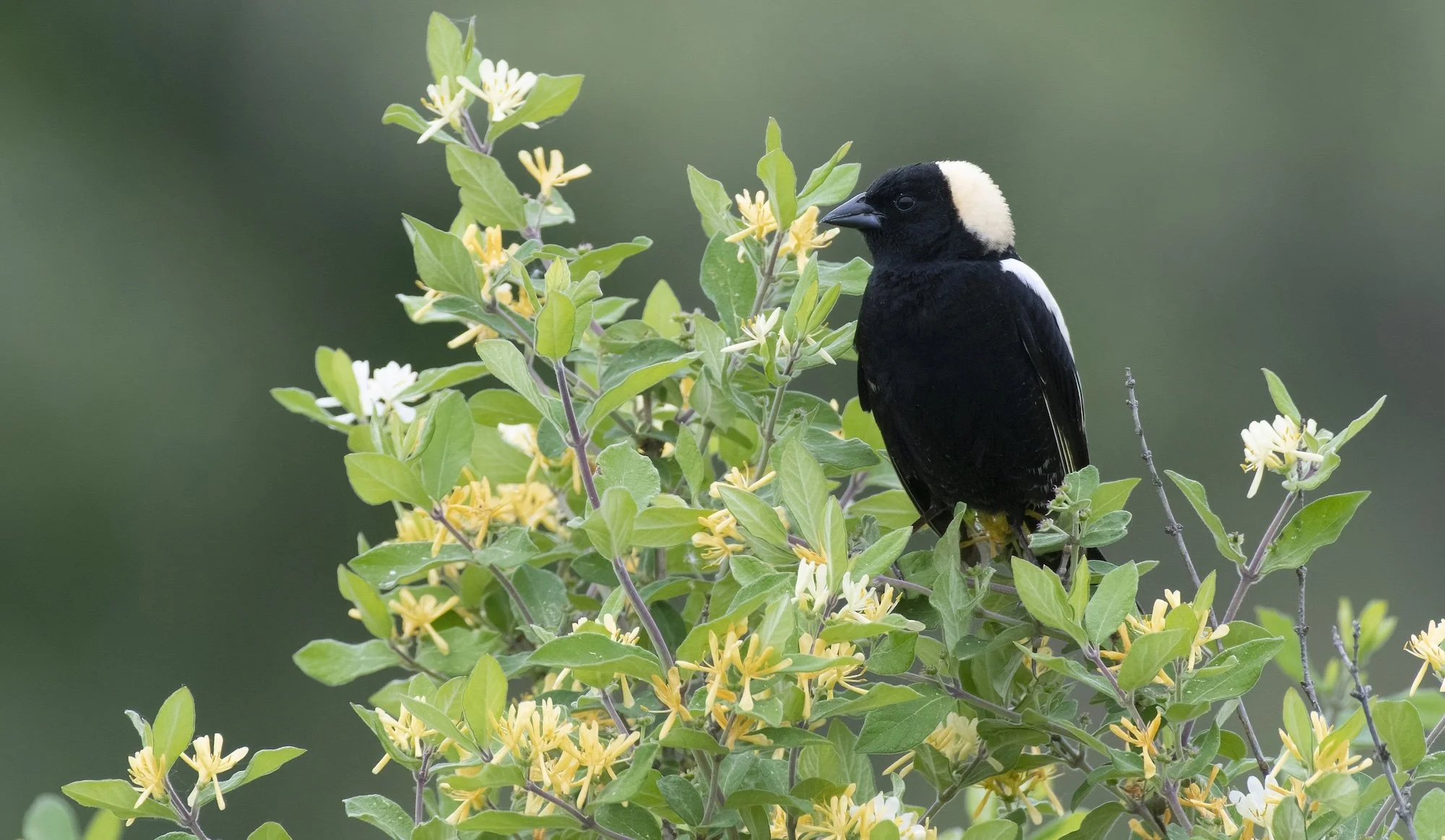
The Bobolink
The Bobolink, Dolichonyx oryaivorus, also called the rice bird or rice bunting, is yet another migrating songbird that has declined in population over the last fifty years.
Photo: Bobolink, Calvin Borgmann/Audubon Photography Awards
Evelyn Novins
The Bobolink, Dolichonyx oryaivorus, also called the rice bird or rice bunting, is yet another migrating songbird that has declined in population over the last fifty years. People have trapped and sold them as pets in South America, collected them as food in Jamaica and shot them in the US as agricultural pests. The primary reason for the species’ decline, however, is changes in land use, particularly the disappearance of useful habitat in many areas of its historic range.
The Bobolink, as a ground-nesting bird, looks for large areas dominated by grasses without woody plants or trees. With the loss of prairie land due to development and agriculture, the Bobolink has adjusted to smaller, often flower-rich open meadows and hayfields. In urbanizing areas, of course, that kind of habitat also is disappearing.
The threats are not news to most birdwatchers, but before going into too much detail on the dire circumstances (and some hopeful moves toward conservation), let’s look at the special bird in question.
The Bobolink is a seed-eater. It passes through northern Virginia in migration, breeds in more northern North America and winters in South America. During their long migration, mostly through Florida and the West Indies although a few migrate through Mexico and Central America, they stop in marshes and rice and other grain fields. In years past when the Bobolink was very abundant, flocks of birds might strip rice fields of seeds, behavior that gave it its common rice bird or rice bunting name and its scientific name “orvaivorus”, which means rice-eater. Once considered a pest, hunting the bird was a common practice.
Although John James Audubon’s Birds of America was limited to the plates, a separate, companion publication written by Audubon and Scottish naturalist and ornithologist William MacGillivray provides observations on the birds’ migration as well as the damage they caused to crops along the way. See the text for Audubon’s Plate 54, the Rice Bird. It’s interesting to compare their observations with the information in current field guides.
Male Bobolink in breeding plumage, Calvin Borgmann/Audubon Photography Awards
The breeding male Bobolink is easily identified by his stunning black and white “reverse tuxedo” plumage (black below with white above) and his straw-colored nape. The nonbreeding male and female have a yellow/buffy nape and bold, brown stripes on the wings. The breeding female is paler. Many birders, however, recognize the bird by its bubbly call, which some say gave it its name, that is, they hear “Bob O’Lincoln” as part of the song. Listen to the recording on the American Bird Conservancy's website to see if you can hear the name.
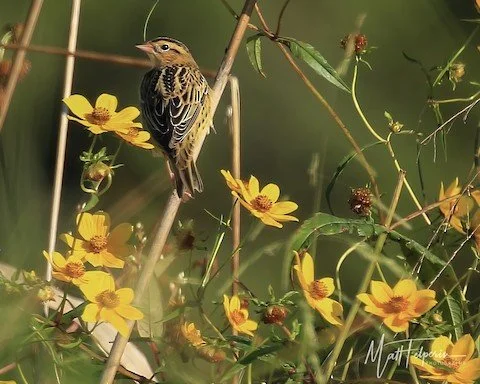
Bobolink with nonbreeding plumage, Matt Felperin
After migrating in the spring, the males arrive in the breeding ground first. Females arrive later, choosing a nest site within a male’s territory. The female scratches a depression in the soil and then builds an outer wall of dead grass and weed stems. She lines the inside of the nest with fine grasses and sedges placed directly on the soil about 2-1/2 inches deep and 2 inches across for a clutch of 3-7 eggs.
Bobolinks are truly social birds. Males mate with several females per breeding season and the eggs in a female’s clutch may represent multiple fathers. Both parents feed the young, and families from several nests form forage flocks. The adults eat seeds, but the nestlings are fed invertebrates exclusively. The young leave the nest unable to fly and hide in the underbrush until their flight feathers emerge fully. Outside the nesting season Bobolinks continue to flock, and the males molt adopting a drabber plumage as they begin their migration to the South American wintering ground. The males molt again on their wintering ground.
The 2025 State of the Birds report lists the Bobolink as an Orange Alert Tipping Point species, a classification that means it has lost more than 50% of its population in the last 50 years, and its decline has accelerated in the past 10 years. The US Geological Survey’s North American Breeding Bird Survey indicates that grassland bird populations have fallen 53%, and Partners in Flight also acknowledges the imperiled status of the Bobolink.
Conservation efforts focus on maintaining the birds’ breeding ground by refraining from mowing fields until after the young have fledged. Using prescribed burns in natural prairie habitat also prevents encroachments by trees and other woody plants. Locally, Fairfax County has implemented a timed mowing schedule at several capped mounds at the I-95 Landfill Complex. Birders spotted Boblinks there this spring as they made their way north to breed. Because of the dearth of natural, open meadows in an urbanizing area like northern Virginia, managing landfills for these (and other) imperiled birds may be the birds’ best chance for finding a resting and feeding stop on their migrations.
A Closer Look: Nature All Around Us, July-August 2025
Judy Gallagher is an NVBA board member and a regular surveyor of local wildlife who also captures photos of what she sees, in particular the less common species.
Photo: Common Milkweed with multiple insects on flowers, Judy Gallagher
Judy Gallagher
July-August 2025
I am fascinated by the concept that plants and insects have co-evolved. Many plants rely on insects to pollinate them and disperse their seeds, and most insects rely on plants for food, either directly, or indirectly by eating other insects that have eaten plants. But it isn't in the plant's best interest to have all its vegetation eaten, and plants have evolved strategies to ensure that they survive the hordes of hungry insects.
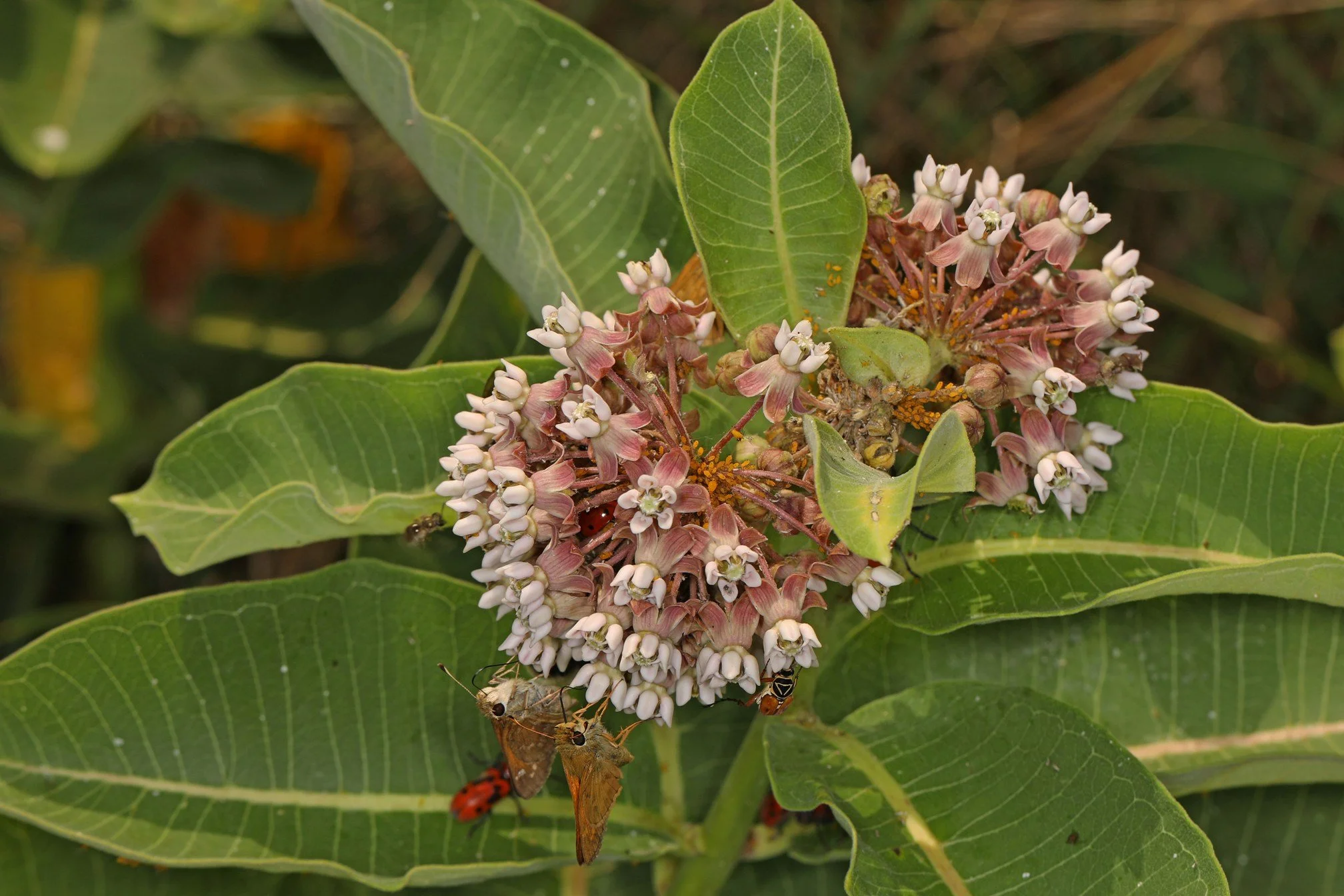
Common Milkweed with multiple insects on flowers, including Sachem Skippers, Oleander Aphids, Delta Flower Scarab Beetle, Small Carpenter Bee and Seven-spotted Lady Beetle , Judy Gallagher
Members of the Milkweed family produce chemicals called cardenolides which are toxic to most invertebrates, thereby preventing them from eating Milkweed's foliage. But a few insects, including the Monarch butterfly caterpillar, Small and Large Milkweed Bugs, Milkweed Longhorn Beetles, Milkweed Stem Weevil, Milkweed Tussock Moth caterpillars, three aphid species, a leaf-mining fly and the Swamp Milkweed Beetle have developed a tolerance to these chemicals. Some of these insects eat the leaves, at least one eats the roots, and Milkweed Bugs eat the seeds. The ingested cardenolides then protect most of these insects from predation by birds and other vertebrates. Milkweed's toxins aren't found in the flowers, so most insects can dine on nectar and pollinate the plants without being affected.

Monarch caterpillars, Judy Gallagher
Although the insects mentioned above can eat Milkweed, Milkweed still has some defense against them. The undersides of Milkweed leaves are hairy, and these inedible hairs make it challenging for insects like newly hatched Monarch or Milkweed Tussock Moth caterpillars to access edible leaf tissue. The caterpillar must remove the hairs from an area of leaf before biting into the leaf, and many new caterpillars die of dehydration before they have removed enough hairs to get to the edible part of the leaf.

Milkweed Stem Weevil with mouthparts clogged with latex, Judy Gallagher
Up to 60% of the caterpillars that get this far die after their first bite of Milkweed, which has another defense mechanism of gummy white latex. If the latex isn’t removed quickly, it will seal an insect's mouth closed, preventing further feeding. Milkweed tolerant insects compensate for that by chewing through small sap-carrying veins, forming a trench around an area of leaf tissue. This cuts off the flow of sap into that part of the leaf, and the insect can eat without encountering latex.

Red Milkweed Beetle adult with latex on its head. Fortunately for it, the latex is not clogging its mouthparts. The beetle's bright color advertises that it is toxic. Judy Gallagher
Many Milkweed-tolerant insects are brightly colored. This is called aposematic coloring, and it advertises to predators like birds that the insect is unpalatable. Red Milkweed Beetle larvae burrow into the soil and feed on milkweed roots. Like the leaves, milkweed roots have toxic cardenolides; however, unlike the leaves, they aren’t protected by latex. But they do have another defense. When attacked, milkweed roots release volatile chemical compounds that attract soil-dwelling non-segmented worms called nematodes, which then prey upon the beetle larvae. Red Milkweed Beetle adults feed on Milkweed leaves and flowers.

Milkweed Leaf Beetle, Judy Gallagher
The Milkweed Leaf Beetle is sometimes found on Common Milkweed but more commonly on Swamp Milkweed. It can also process Milkweed’s toxic cardenolides but does not keep the toxins in its body. It is somewhat protected from predation by its warning coloration which resembles that of insects that are toxic.

Small Milkweed Bug eating another Small Milkweed Bug, Judy Gallagher
Large and Small Milkweed Bugs feed on Milkweed seeds, inserting their long proboscises into the seeds, injecting enzymes to liquefy the seeds' contents, and then sucking out the juice. The seeds have more cardenolides than the leaves, and both Milkweed Bugs sequester them and advertise their unpalatability with bright colors. Small Milkweed Bugs aren't as picky about their food as some other Milkweed-dependent insects. When Milkweed is scarce, they can also feed on Honey Bees, Monarch caterpillars and pupae, Large Milkweed Bugs, Dogbane Beetles, and each other.
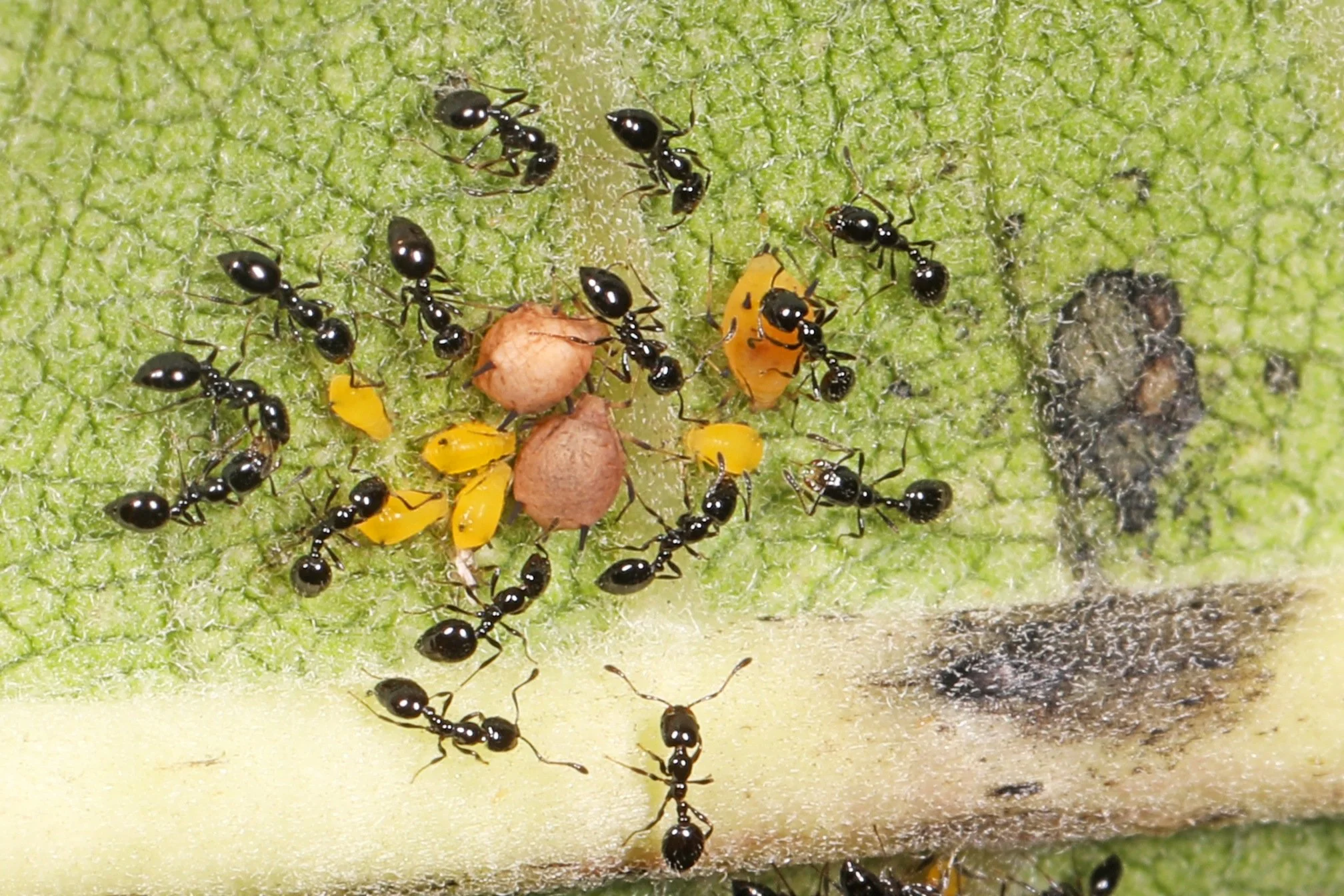
Ants tending Aphids on Milkweed, Judy Gallagher
At least three aphid species feed on Milkweed. Some aphids are tended by ants, who like the sugary waste that aphids excrete. In exchange for the sugary waste, called honeydew, the ants protect the aphids from predation. But too many aphids could hurt the Milkweed plant, and it responds by producing more cardenolides. If the aphids' honeydew contains too high a concentration of cardenolides, ants won't eat it and won't protect the aphids. This tends to reduce the aphid population to a level that doesn't harm the Milkweed plant too much.
Nature is so complex! I hope you have a chance to observe insects on Milkweed this season.
View more of Judy’s articles on A Closer Look: Nature All Around Us (formerly Observations from Meadowood).

Wildlife Sanctuary Almanac: Creating Habitat for Butterflies
Do you want more butterflies around your home? Consider creating a butterfly habitat that will attract not just adult butterflies passing through but will support butterflies throughout their life cycles.
Photo: Monarch butterfly nectaring on a thistle, Judy Gallagher
Cliff Fairweather
Do you want more butterflies around your home? Consider creating a butterfly habitat that will attract not just adult butterflies passing through but will support butterflies throughout their life cycles. A habitat is where a living thing finds what it needs for survival: food, water, shelter, and space. Butterflies undergo a four-stage metamorphosis, which includes egg, caterpillar (larva), chrysalis (pupa), and adult. The specific habitat needs of butterflies change as they go through their life cycles, so the challenge in creating butterfly habitat is to meet their needs in each stage.

Tiger Swallowtails, Virginia’s state insect, nectaring on buttonbush. Photo: Judy Gallagher
Adult butterflies need high-energy fuel for activities such as flight, foraging, mating, and egg laying, and that fuel is flower nectar. Nectar is essentially sugar water produced by flowers to attract pollinators. Butterflies seek it from a wide variety of herbaceous and woody flowering plants. They are opportunistic feeders, mostly without strong preferences for particular species of nectar flowers. They do have preferences, however, for particular flower characteristics. Butterflies have good color vision and are attracted to flowers with bright colors, especially yellow, orange, white, pink, red, and blue. They also are attracted to flowers with floral scents and flowers rich in nectar.
Flower shape and the arrangement of flowers on a plant influence which nectar plants butterflies choose. They strongly favor flowers with tubular corollas, such as phloxes, which accommodate a butterfly’s long, thin proboscis. Because different butterflies have proboscises of different lengths, plant flowers with a variety of corolla lengths to attract a wider diversity of butterflies.
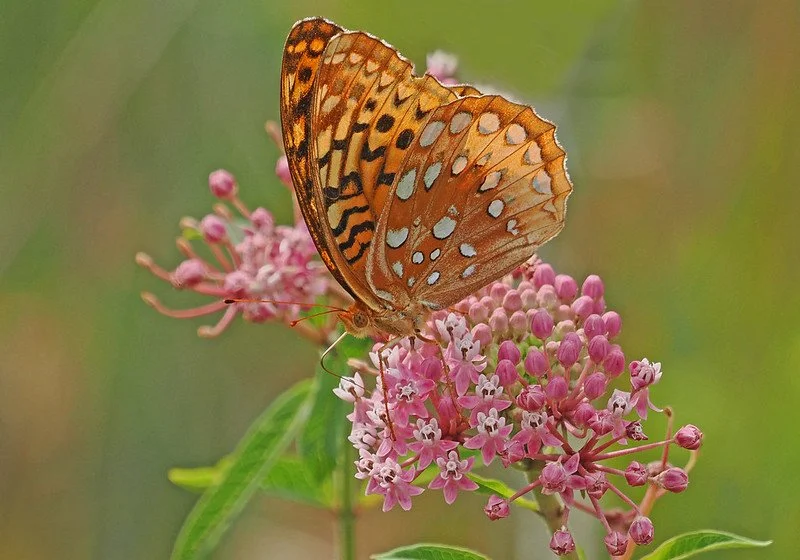
Nectar plants with clusters of many small flowers offer efficient nectaring for butterflies, such as this Great Spangled Fritillary. Photo: Judy Gallagher.
Butterflies tend to prefer plants with loose clusters of smaller flowers, like milkweeds, or tight clusters of small to tiny flowers, like asters. Clustered flowers offer efficient nectaring opportunities, enabling butterflies to visit many flowers quickly with a minimum of flying. Butterflies also tend to select flowers, such as sunflowers and asters, that provide a relatively flat, stable landing place. This allows them to rest while they feed.
Most native plants have relatively short blooming periods, so try to offer a diverse mix of nectar plants with varied blooming times to ensure that something is blooming throughout the growing season. This bloom time table from Plant NoVA Natives is a good reference. Different butterfly species often forage at different heights, so offering plants of various heights can draw more butterfly diversity. Avoid cultivars of native species, because they might have undesirable characteristics, such as not producing nectar or producing nectar that is difficult to access. This document lists some examples of nectar plants native to northern Virginia, but there are many others. Consult your local native plant society chapter, butterfly club, naturalist organization, native plant vendors, or nature center for more choices.
Massing nectar plants of the same species together, rather than spreading them out, will create beacons for foraging butterflies. Plant taller plants towards the back and shorter plants in front of them so they aren’t hidden from view. If you have space, place trees and shrubs to shield nectar plants from the prevailing winds, making it easier for foraging butterflies to nectar on windy days. These also provide butterfly perching, roosting, basking, and sheltering sites.
Nectar and host plants alone don’t provide all the nutrients butterflies need. Most also need nutrients such as amino acids, nitrogen, and sodium. These are especially important for reproductive success. To obtain these, they engage in a behavior called puddling, where they land on patches of damp soil or sand, often at the edge of water puddles. They use their proboscises to imbibe nutrients from the wet spot.
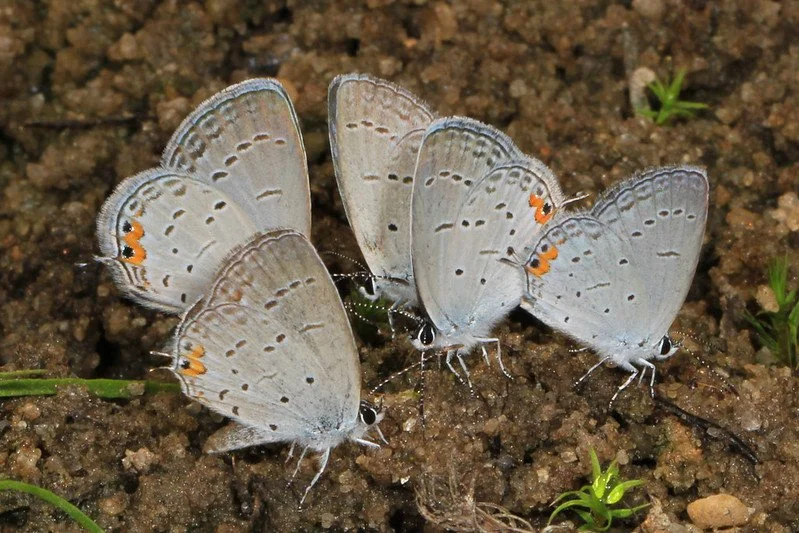
Butterfly adults, mostly males, visit damp soil or sand to imbibe nutrients not available in nectar. These are Eastern-tailed Blues. Photo: Judy Gallagher
You can create a puddling site by creating a patch of bare soil or sand in a flat, sunny spot in your habitat that you can wet down every day or so. Puddling sites also can be an important source of water for butterflies. Some butterflies seek additional nutrients from animal dung and carrion. Some also feed on rotted fruit, so putting some out in your habitat, or leaving some fallen fruit from trees, might attract some additional species.
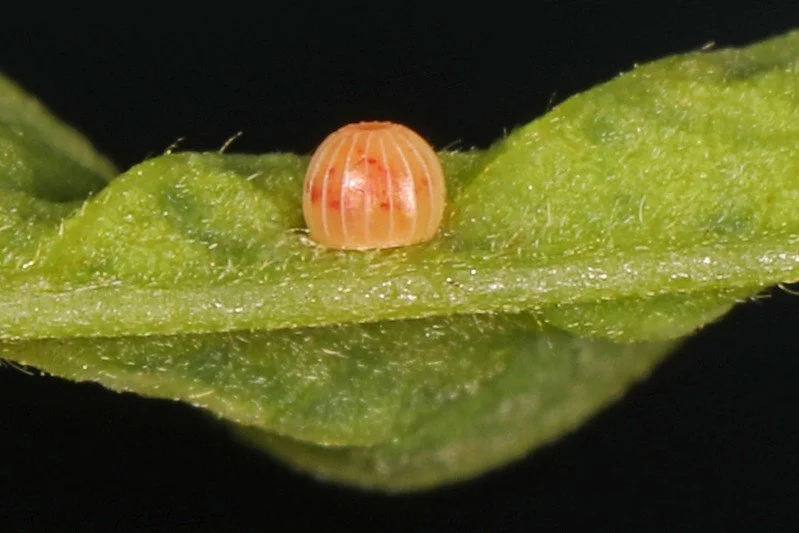
Silver-spotted Skipper egg on a Black Locust leaf: providing habitat for the entire butterfly life cycle will result in more butterflies using your habitat. Photo: Judy Gallagher.
While nectar plants fuel adult butterflies, caterpillars need something more substantial to nourish their enormous and rapid growth to as much as 100 times their size at hatching. To satisfy the appetites of their progeny, female butterflies search out host plants on which to lay their eggs. Not just any plant will do as a host, it must be a plant that their species is adapted to eat. Most plants produce toxins and other defenses to deter insects from eating them. Caterpillars evolve tolerances for or countermeasures against these defenses, giving them nearly exclusive access to their host plants as a food source. Because different plants have evolved different defenses, caterpillars usually specialize in a few species of host plants.
To help decide what host plants to grow, learn what species of butterflies are likely to be found in your area. Of course, you’ll also need to take into consideration the growing conditions on your site. Host plants include many woody, as well as herbaceous, forms. Many, such as milkweed, do double duty as nectar plants. This document includes a table of butterfly species and their host plants. Butterfly field guides usually list host plants for each species they cover. Also, remember that because the purpose of planting host plants in your habitat is to feed caterpillars, you need to tolerate some damage to host plant foliage. That damage, though, is a sign of success – it means you’re raising caterpillars!
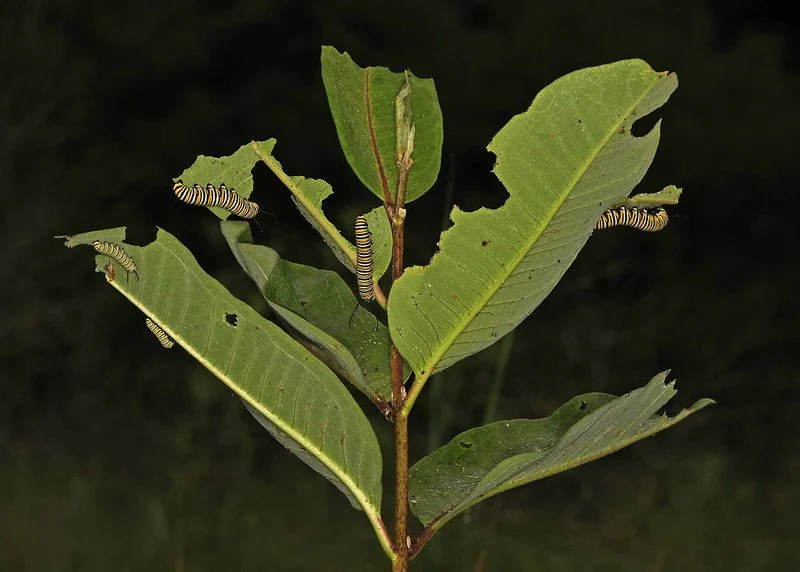
Monarch butterfly caterpillars feeding on Common Milkweed. Creating butterfly habitat means tolerating some damage to host plants. Photo: Judy Gallagher.

Monarch Butterfly chrysalis: Chrysalises need an undisturbed place in your habitat to transform from caterpillar to adult. Photo: Judy Gallagher.
When they are ready to metamorphose into their pupal stage, caterpillars usually leave their host plant, but they don’t go far. Many species suspend their chrysalises from a plant, branch, or other structure, natural or human-made, while others pupate under leaf litter or in the soil. To support butterflies in their egg, caterpillar, and chrysalis stage, avoid being an overly tidy gardener. Leave leaf litter on the ground, as some butterflies, many moths, and other beneficial insects pupate in the fallen leaves. Also, resist the urge to do a late winter or early spring cleanup by removing last year’s dead vegetation, at least until temperatures have warmed for a while and overwintering eggs, caterpillars and chrysalises have had a chance to move on to their next stage.
Beyond food and nutrients, butterflies need places to bask in the sun, find shelter from storms and predators, spend the night, hibernate, and perch. A large rock or steppingstone placed in a sunny spot can provide a basking site where butterflies can warm their flight muscles up to flying temperature. They also will use large leaves as basking sites. The underside of leaves can provide a shelter against rain, a hiding place from predators, or a place to spend the night. Tree cavities, loose bark, or even old bird houses can provide short-term shelters or hibernation sites for overwintering butterfly adults and chrysalises. Some male butterflies use rocks, shrubs, or trees as perches from which to watch for potential mates and rivals.
Monarch Butterfly nectaring on a thistle. Photo: Judy Gallagher.
Planning and managing your butterfly habitat needn’t be complicated, but there are some basic things you should consider. First of these is where to locate the habitat. Monitor your property to see if butterflies are already visiting and where they linger. Also, look for any existing native nectar or host plants. Butterflies are “cold blooded,” so select an area that gets sun for at least six to eight hours a day. The space needn’t be large, just enough room for some host and nectar plants and some other habitat elements. Even a patio or balcony can provide some habitat with container-grown plants
Once established, a butterfly habitat should be fairly low maintenance, but it is not maintenance-free. You will need to manage invasive exotic plants and thin out natives that are trying to take over. Pesticide use is incompatible with raising caterpillars, so consider non-toxic alternatives to pest control, including just waiting out infestations. Often, a predator or parasite will come along and handle the problem.
Creating a butterfly habitat will do more than provide a home for butterflies. Other wildlife, from fireflies to songbirds, will use your habitat as well, and you will be making a valuable contribution to local biological diversity. Also, it’s just plain fun to have butterflies around!
Catch up on past Wildlife Sanctuary Almanac articles here.

Report on the 2025 Occoquan Bay Area Annual Butterfly Count
Not the best of mornings for finding butterflies; sunless, oppressively humid, just the slightest of breezes, downright uncomfortable. But more than two dozen volunteers were ready for the challenge.
Photo: Eastern Tiger Swallowtail, Sheryl Pollock
Jim Waggener
0730, Sat., 28 Jun. 2025: Not the best of mornings for finding butterflies; sunless, oppressively humid, just the slightest of breezes, downright uncomfortable. But more than two dozen volunteers were ready for the challenge, forming small teams to cover Occoquan Bay NWR, and other promising sites nearby (Meadowood Recreation Area on Mason Neck, Occoquan Regional Park, the Metz Wetlands Preserve and Rippon Landing). Following a routine honed over decade of practice, every adult butterfly that could be identified would be recorded and, if unusual or rare, photographed. All done by sight, without capturing or harming any of the various swallowtails, sulphurs, skippers or other butterflies encountered.
This particular count was begun in 1990s to document the lepidoptera of a then U. S. Army facility slated for closure, both to draw public attention to the site’s unique nature and to generate support for its permanent protection. By the time the Occoquan Bay refuge was finally established in 1998 the count had taken on the form and routine that are followed today. Over the years, other sites with varied natural habitats were added. Certified in 2001 by the North American Butterfly Association, the Occoquan Bay-area Count presently encompasses the four sites (listed above) that are surveyed in a multi-year, citizen science project, long supported by the Northern Virginia Bird Alliance and other regional organizations.
Over the years, count results have varied considerably in numbers of species and individual butterflies. For example, 2005’s count resulted in 19 species and 114 individuals while 2013’s count resulted in 42 species and 1022 individuals. The count in 2015 resulted in 37 species and 1269 individuals, with the average over the past 24 years at 33.9 species and 593.6 individuals. Expectations for this year’s tally diminished as unfavorable conditions persisted until late morning. Less than an hour before count’s end, breaks appeared in the clouds, spurring heightened butterfly activity. While results from individual sites were not impressive, combined they were unexpectedly positive: 34 species and 828 individual butterflies.
In addition to the butterflies, this day’s count produced reports of a Mississippi Kite, confirmation of Blue Grosbeaks breeding, an uncommonly encountered Mole King Snake, other wildlife (Rough Greensnake, Box Turtle, Beaver, Cottontail, etc.) and plants (including first-of-season records of bloom).
In sum, another successful count and more records for the expanding base of data on these important natural sites. Certainly a tribute to the diversity and health of habitats across the various sites. A tribute as well to the skills and perseverance of the teams and leaders of today's count. A more difficult job than expected, perhaps, but exceptionally well done.
Learn more about butterfly counts and how you can join us!

Letter to Our Members
As the sun slowly sank into Belmont Bay, a full moon rose behind us, lighting our way down Kane’s Creek. We paddled our kayaks back to the launch site with only the splash of our paddles to disturb the quiet of the evening.
Photo: Mouth of Kane’s Creek, Mason Neck State Park Photo Archive
Tom Blackburn, NVBA Director
As the sun slowly sank into Belmont Bay, a full moon rose behind us, lighting our way down Kane’s Creek. We paddled our kayaks back to the launch site with only the splash of our paddles to disturb the quiet of the evening. I was at Mason Neck State Park, a hidden gem just 15 minutes from I-95 near Lorton, Virginia. The park offers twenty guided morning and evening kayak trips from May through September, and kayaks and canoes are available for rent seven days a week.
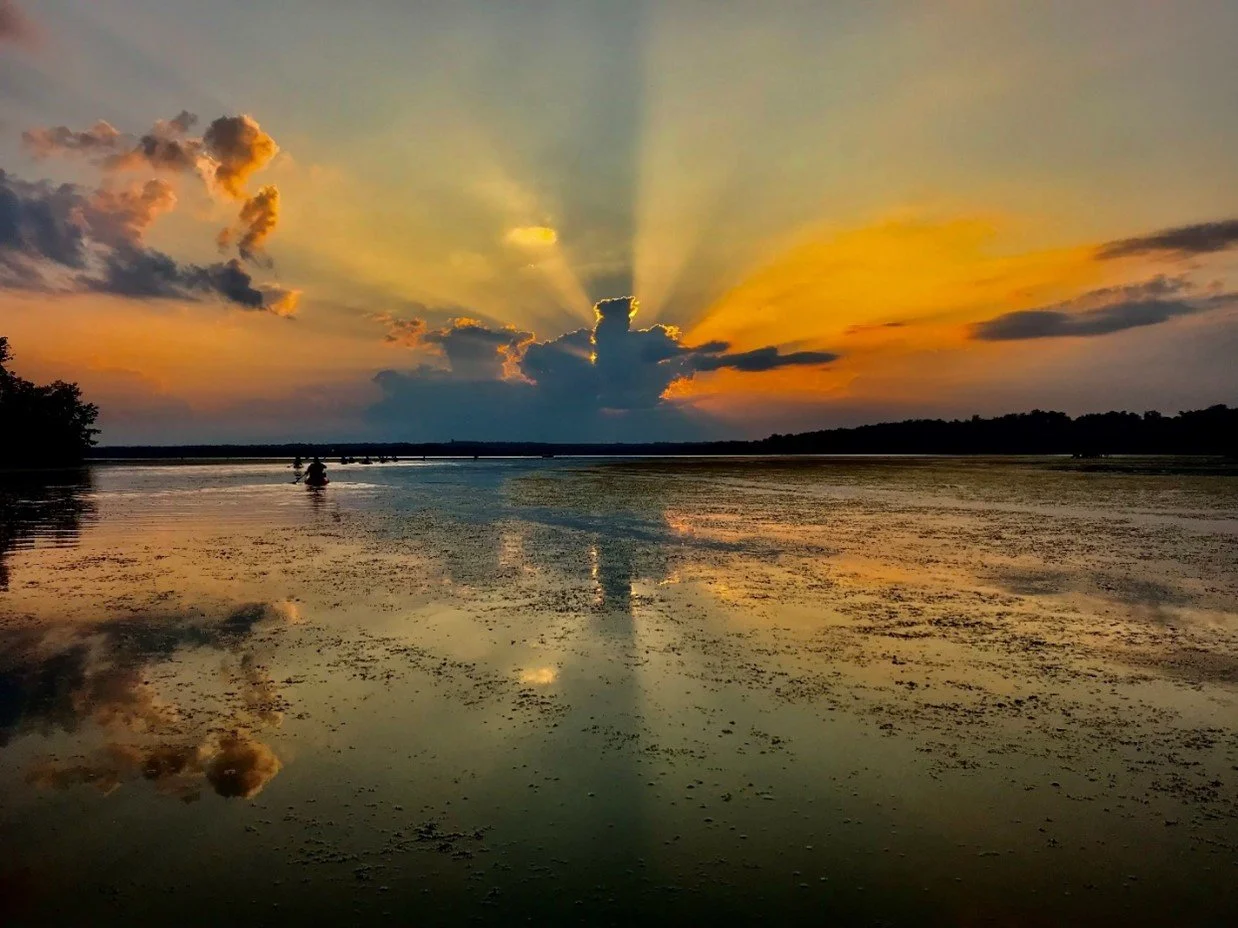
Kayaking into crepuscular rays, Jerry Nissley
Mason Neck State Park has other “quiet enjoyment” opportunities as well. The park’s varied habitats provide food, shelter and nesting areas for more than 200 species of birds. Bald Eagles nest at several sites in the park as well as at the adjacent Elizabeth Hartwell Mason Neck National Wildlife Refuge, the first NWR in the country established to protect the nesting area of Bald Eagles. The park’s now-retired manager used to guarantee to visitors that he could show them an eagle within 20 minutes. Ospreys nest on a platform near the Visitor Center, and the other day both adults put on an aerial display, drawing a crowd of photographers as they swooped and soared in 20 mph winds. The Woodmarsh Trail, just outside the park in the wildlife refuge, leads to the Great Marsh, where as many as 300 Tundra Swans can be seen from November through mid-March.

Kris Gulden, Accessibility Advisor for Mason Neck State Park, at the end of the Marsh View Trail. Photo: Pam Cressey
Mason Neck State Park offers eight hiking trails. The most popular is the Bay View Trail, which traverses three distinct habitats – shoreline, beaver-created wetland, and forest – in just one mile. On the Meadow View Trail, in contrast, you will likely see no one else as you walk through forest to an expanse of grassland. Several of the park’s trails are wheelchair-accessible, and the park also has an electric all-terrain wheelchair that visitors can reserve without charge.
The park is a testament to the importance of conservation activism in preserving our natural areas. In the 1960s developers had big plans for “the Neck,” a peninsula bounded by Pohick Bay, Gunston Cove, Belmont Bay and the Potomac River. They envisioned a regional airport, thousands of homes and a bridge across the river as part of an Outer Beltway, among other projects. Elizabeth Hartwell, a local resident, campaigned against the development because it would disturb a nesting area for then-critically endangered Bald Eagles. Hartwell’s efforts, along with those of other conservationists, prevailed. Instead of massive development Mason Neck now boasts the state park, the wildlife refuge, Pohick Bay Regional Park and golf course, the Bureau of Land Management’s Meadowood Special Recreation Area, Gunston Hall, and Mason Neck West County Park. Two-thirds of Mason Neck – 6,000 acres – is now protected parkland.
You can learn more about Mason Neck State Park, including the park’s accessible features, from the Friends of Mason Neck State Park’s website.

Ospreys and the Menhaden Question
It’s always a joy when Osprey return to northern Virginia in the spring to breed after their winters in the Southern Hemisphere, but reports of increased nest failure are cause for concern.
Photo: Osprey, Lewis Scharpf/Audubon Photography Awards
Evelyn Novins
It’s always a joy when Osprey return to northern Virginia in the spring to breed after their winters in the Southern Hemisphere. Like the Bald Eagle, the bird is a prime example of successful population recovery following the ban of DDT, increasing in Chesapeake Bay from 1,450 pairs in the 1970s to 10,000 nesting pairs today, about ¼ of the population in the United States. So, it’s disheartening to learn of an increase in nest failure in areas of the Chesapeake Bay, reported by both Greg Kearns, senior naturalist for the Patuxent River Park, and Dr. Brian Watts, from the Center for Conservation Biology at William and Mary University.
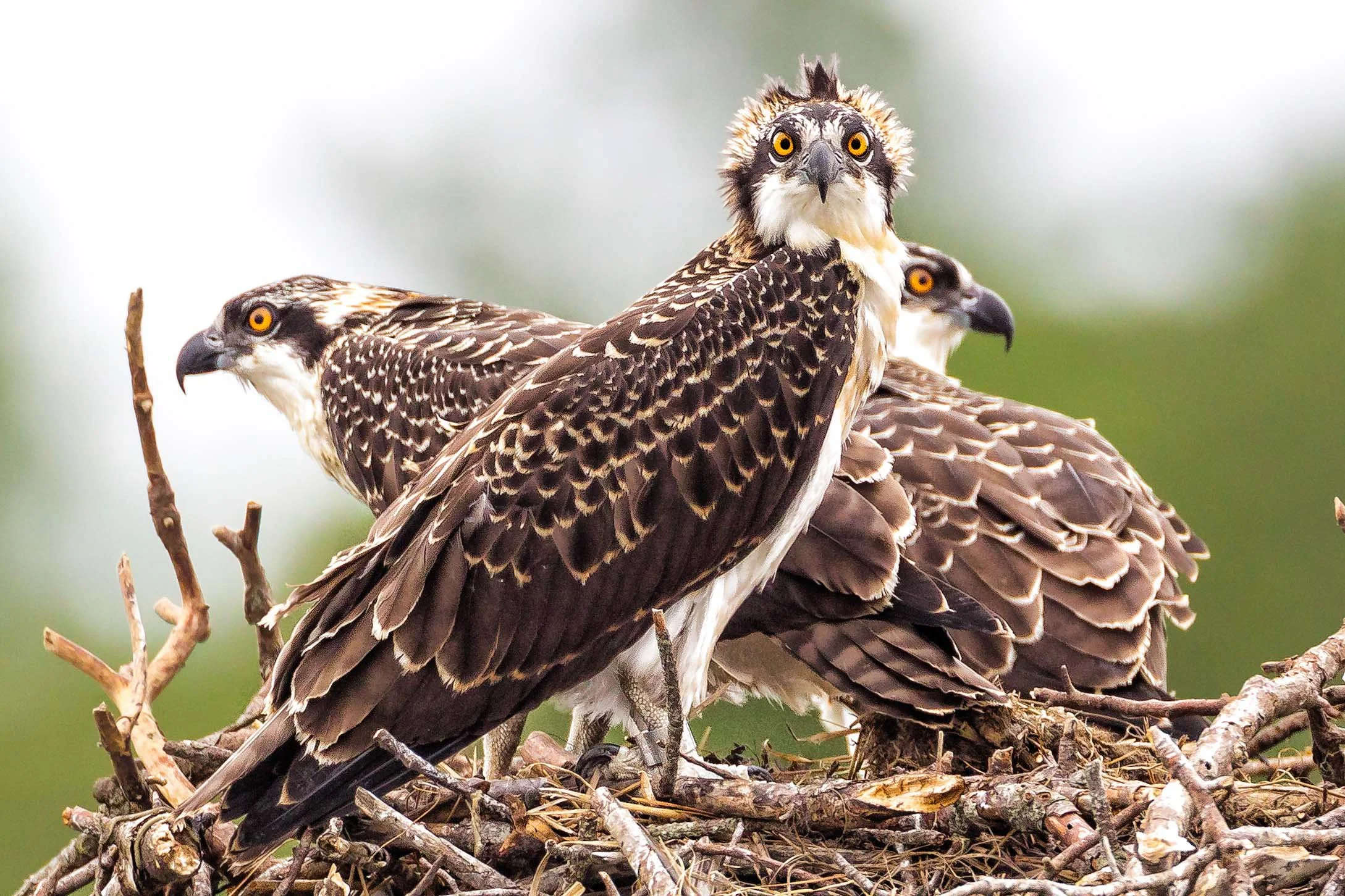
Osprey, Kurt Wecker/Audubon Photography Awards
But before we dig into that discussion, let’s review a little information about the Osprey, Pandion haliaetus, sometimes called the fish hawk, seahawk, or fish eagle. It’s a diurnal bird of prey which hovers over water before making spectacular dives for fish. It spots the fish from as far as 150 feet up and begins a forward dive to the water, but it enters with its feet first to grab the prey. Its nostrils close to keep out the water, and a nictitating membrane protects its eyes. The Osprey’s talons have a 6- to 8-inch spread and are equipped with spicules (spiky spines) to grasp its catch securely. Holding the fish head forward as it flies back to the nest, it usually stops along the way to eat the head first, killing the fish and stopping its struggle. It appears that 1 in every 3 or 4 dives is successful.
Osprey traditionally build their nests at the top of tall trees. However, they have become accustomed to and look for man-made platforms which suit them well. They seem to know that their primary predator, racoons, find these structures difficult to raid. However, the great horned owl and the eagle still have access. Ospreys exhibit nest fidelity, returning to the same nest site year after year, especially if they have been successful in raising chicks. First year Osprey often remain on wintering grounds for an extra year before heading north to breed in the area where they were born.
Back to reports of nest failure at high levels in certain areas of the Chesapeake Bay. First, note that a nest productivity rate of 1.15 or greater is required to sustain a population. Greg Kearns, who has been monitoring Osprey along the Patuxent River for 40 years, reports a drop in nest productivity from 1.8 in 2013 to 0.86 in 2024, or 6.57% nest failure in 2013 to 45.07% in 2024. Even higher levels of nest failure were reported in some intervening years: 58.95% in 2017, 60.41% in 2020, and 56.67% in 2023, productivity rates of 0.73, 0.67, and 0.61, respectively. Kearns’ March 18 talk, Ospreys on the Patuxent, a Smithsonian Environmental Research Center presentation and the source of those figures, is still available online free of charge following registration.
Dr. Watts’s research of Ospreys in the Chesapeake Bay indicates that Osprey feeding in lower salinity areas in the rivers appear to be doing better than those Osprey near the middle of the Bay, the main stem of the Chesapeake with its brackish waters. The diet of river Ospreys consists of gizzard shad and catfish while the diet of Ospreys in the main stem of the Chesapeake is 75% menhaden.
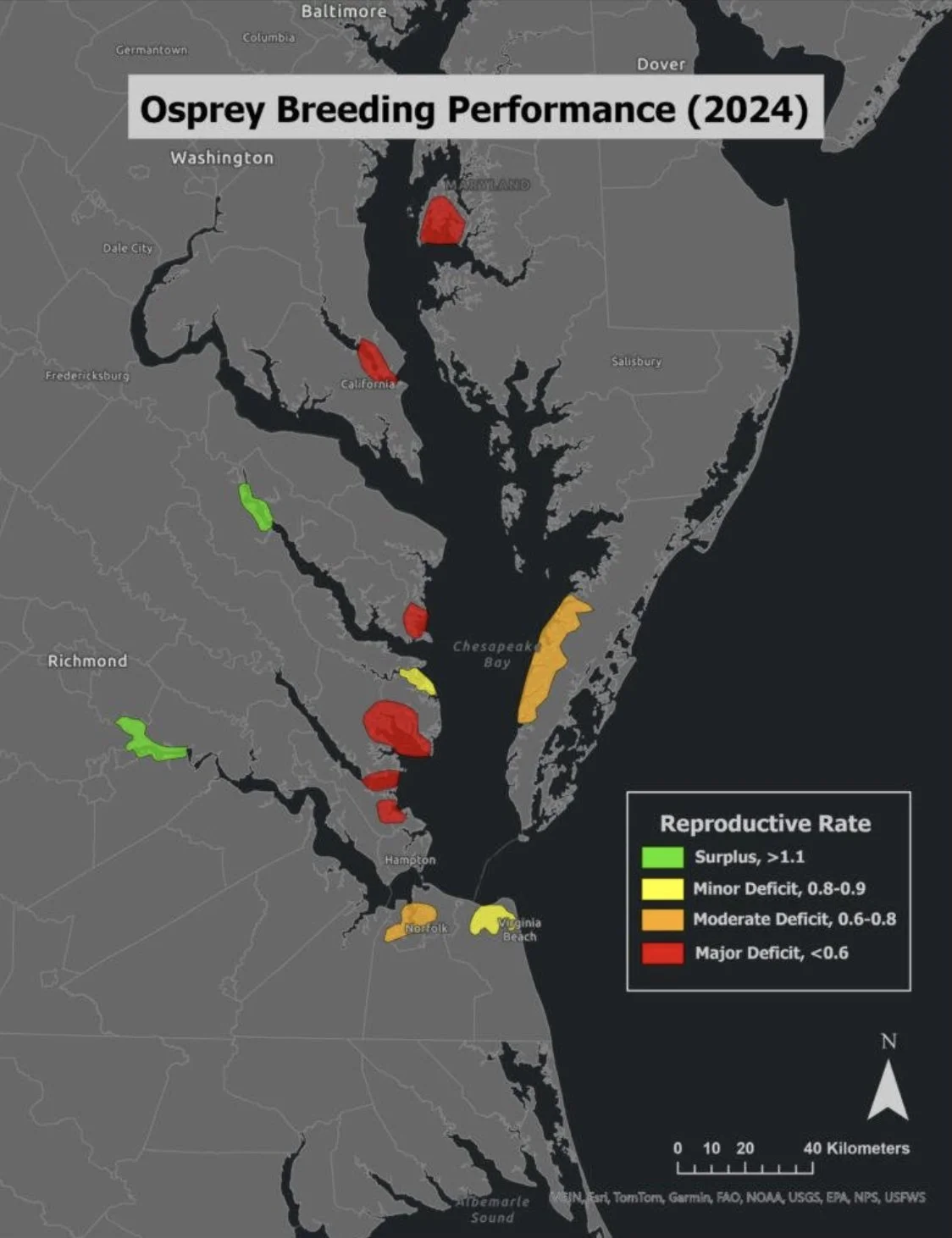
An Osprey breeding performance map from an article by Dr. Brian Watts shows areas of steep decline.
He reports that mean breeding performance for Osprey pairs nesting within the main stem of the Bay did not meet the productivity rate required for population maintenance. The reproductive rate in this area was 0.51 young/pair in 2024. The cause of nest failure, documented through webcams, nest inspections and necropsies of dead chicks, is starvation. Dr. Watts’s article on poor breeding performance of Chesapeake Bay Osprey is available here. A graphic from his article shows areas reporting steep declines.
Conservation groups have urged protections to prevent overfishing of menhaden in the Bay, and the fisheries industry has pushed back. Regulation of the industry in this area is by the Virginia Marine Resources Commission in Virginia’s waters, and the Atlantic States Marine Fisheries Commission, which monitors stock assessment. Menhaden spawn in the Atlantic and swim into the mouth of the Bay, with the Bay becoming a menhaden nursery, where they live for several years before returning to the Atlantic to spawn.
Menhaden is a nutrient-rich fish containing a very high concentration of protein and omega-3 fatty acids. It is also the primary food source for Chesapeake Bay Osprey and striped bass (rockfish), an iconic Chesapeake Bay fish, which is in decline. Humans don’t consume menhaden, but it is a target of the reduction fishery, which reduces it to a protein-rich fish meal, a commodity used in salad dressing, pet food, omega-3 supplements, oils, makeup, pellet food, and other products.
Conservation and sport fishing organizations argue that the area is being overfished, disrupting its ecological balance and causing the increasing rate of Osprey nest failures and decline in striped bass. The menhaden industry is an important one in Virginia, and it has pushed back.
In 2024 the Chesapeake Legal Alliance, with the Southern Maryland Recreational Fishing Organization and other organizations, submitted a petition for rulemaking to the Virginia Marine Fisheries Commission urging regulation of menhaden fishing in Chesapeake Bay and the reduction fishery. After receiving 1,325 comments, the Commission decided to take no action.
Two bills to authorize a three-year study of the ecology, fishery impacts, and economic importance of the Atlantic menhaden population in Virginia’s waters failed in the 2025 General Assembly, HB19, a proposal introduced by Delegate Lee Ware in 2023, and HB2713, introduced by Delegate Paul Milde in 2025. It’s likely that the issue will return in the 2026 session, in January 2026. We all need to support collection of the necessary scientific information to determine how best to balance the needs of conservation and industry. It’s not too early to send a letter to your representative in the General Assembly urging support for a similar bill in 2026.

Bird Banding at Occoquan Bay National Wildlife Refuge
During spring migration’s height, in April and May, from 6 a.m. to noon, volunteers catch and band birds in the Occoquan Bay National Wildlife Refuge near Marumsco Creek three mornings a week, a project undertaken there every spring since 2001, except 2020, the “covid year.”
Photo: Female Northern Cardinal with a bander, Glenda Booth
Glenda C. Booth, originally published in the Connection Newspapers
The 1.4-ounce female Northern Cardinal was squawking and squirming between Brian Rademacher’s fingers and then bit his hand, leaving a red mark, as he prepared to release her after putting a tiny metal band on her leg.
Brian Rademacher uses the bander’s grip to hold this female northern cardinal. Photo: Glenda Booth
“The bite was like a severe pinch,” Rademacher said calmly. The agitated bird was what he called a “recapture.” She had been caught and banded there three weeks ago.
During spring migration’s height, in April and May, from 6 a.m. to noon, volunteers catch and band birds in the Occoquan Bay National Wildlife Refuge near Marumsco Creek three mornings a week, a project undertaken there every spring since 2001, except 2020, the “covid year.”
They typically catch on average 20 to 30 birds in mist nets per six-hour stint, 500 per season. Their most commonly-banded bird is the White-throated Sparrow.
Birdcast.info shows that by April 27, 45 million birds had crossed the region since early March. Birds migrate to find food and favorable climates, and to breed.
Factors like weather, wind, human disturbances and habitat, including conditions in their wintering grounds, can affect the numbers. “A calm, cold night without rain or a big headwind is ideal for migration,” said Suzanne Miller, the project’s leader. “Songbirds migrate at night, up high. Hawks migrate on thermals.”
Next Steps: Recording Data
The team follows Monitoring Avian Productivity and Survivorship protocols. They do not use seeds or audio lures. They check the black, very fine, barely visible nets every 30 minutes and, if a bird is snared, carefully extract it. “It comes out of the side it went in on,” explained Miller, “to prevent breaking a wing or leg.
Once in hand, they put the bird in a cloth bag and take it to the banding station where they measure the wings and tail length, weigh it and determine age and sex. The goal is to process the bird in around five minutes to minimize stress on the bird.

Banders blow on birds’ bellies to study their anatomy. Photo: Glenda Booth
One step is to blow on the bird’s breast and belly to check three things, Paul Napier explained: (1) the brood patch where naked skin indicates the stage of the egg incubation cycle; (2) a cloacal protuberance that indicates breeding condition; and (3) fat, a sign of energy reserves.
The cloaca is the rear orifice or vent for the digestive, reproduction and urinary tracts. In male birds, if it is bulging like a pimple, the bird is in breeding condition. If a female has a protuberance, she likely has eggs. Minimal fat in birds could mean they spent a lot of energy traveling. Fat accumulation could indicate a healthy habitat, abundant in insects, grubs and inchworms, for example.
Among other data, volunteers record recaptures. Miller said that, since 2001, out of 652 cardinals, they have recaptured 74 or 11.3 percent. Cardinals are non-migratory, resident birds in northern Virginia.
“They don’t go far from where they hatched,” Miller said. The recapture statistics can help determine a bird’s age. All data go to the U.S. Geological Survey Bird Banding Laboratory. Scientists use data to analyze bird behavior, population, distribution, survival rates and other factors.
Napier, a Falls Church resident, heads the Cape May (New Jersey) Raptor Banding Project and says that every time he bands a bird he learns something new. He has banded raptors since 1988 and songbirds since 2005.
Beverly Arnold drives up from Fredericksburg to band. “It’s a labor of love. I’m contributing to citizen science,” she said.
Janet Martin from Springfield said, “It’s so cool.”

The banding station. Photo: Glenda Booth
Banding is controlled by federal and state laws that require permits because it involves capturing and handling birds. All of this team’s banding, marking and sampling is conducted under a federally-authorized bird banding permit issued by the U.S. Geological Survey. The refuge also has a Virginia and U.S. Fish and Wildlife Service permit.
The one-square-mile Occoquan Bay National Wildlife Refuge at the mouth of the Occoquan River on Belmont Bay has tidal marshes, grassland and forest, and four miles of trails. Observers have documented over 650 plant and 200 bird species.
The banding station is open to the public from 7 a.m. to 12 noon until Memorial Day weekend. Groups larger than 10 people need a permit. Visit https://www.fws.gov/refuge/occoquan-bay/about-us.
To learn how many birds migrated through an area last night, visit https://birdcast.info/.

Attracting hummingbirds (and convincing them to stay a while)
With forethought and some planning, you can have a clear and frequent view of these 3.5-ounce, dive-bombing, backward-flying, shimmering, drama-obsessed, and Ferrari-engine-powered birds. If that sounds like fun, here are some tips to attract them now and get them to linger for the season.
Photo: Ruby-throated Hummingbird with Scarlet Beebalm, Sarah Holtz
Plant NOVA Natives
Hummingbirds may be the tiniest birds on the planet, but they are among the easiest and most delightful to observe. Ruby-throated Hummingbirds are especially common in northern Virginia during the spring migration months of April and May and are the only species of hummingbirds who breed here. Most Ruby-throated Hummingbirds we spot through mid-May are flying through to other destinations. But some will choose to stay for weeks if the landscape offers them what they need.
With forethought and some planning, you can have a clear and frequent view of these 3.5-ounce, dive-bombing, backward-flying, shimmering, drama-obsessed, and Ferrari-engine-powered birds. If that sounds like fun, here are some tips to attract them now and get them to linger for the season.
Feed them nectar
Hummingbirds have extreme metabolisms. A Ruby-throated Hummingbird’s heart beats up to 1,200 times per minute and its wings beat 53 times per second. They must consume very specific foods to survive, and they eat almost constantly.
At least 20 percent of a hummingbird’s diet is nectar. They can’t taste “sweet,” but the nectar is a source of high-quality carbohydrates for their energy needs. They are therefore attracted to areas with nectar-producing native plants, many of which you can purchase, plant and grow. Before you make your plant selections, however, consider this. Ruby-throated Hummingbirds need to find and consume nectar through spring, summer, and fall. You should therefore select nectar-producing plants that flower at different times during the growing season.
Ruby-throated Hummingbird with Scarlet Beebalm, Sarah Holtz
Cardinal Flower, Eastern Red Columbine, and Coral Honeysuckle are considered the “big three” wildflower nectar sources for hummingbirds. Their flowers are all red, which signals the presence of carbohydrates to hummingbirds but not to bees who can’t see the color. They have also developed long tubular flowers with a pendulous and perch-less form, making them ideal sources of nectar for hovering, long-billed hummingbirds.
Of these three, Coral Honeysuckle is probably the number one recommended native plant for attracting hummingbirds. It blooms continuously through the growing season, timing its first bloom in northern Virginia close to the arrival of migrating Ruby-throated Hummingbirds in April. Eastern Red Columbine blooms in the spring and provides an early source of nectar, while Cardinal Flower begins blooming in July and lasts approximately 6-8 weeks. Planting all three around your property ensures a steady flow of nectar for many months.
You can also supplement your nectar-producing plants with hummingbird feeders filled with sugar water that mimics the carbohydrate content of nectar. Feeders can be purchased at any wild-bird center and hung near your window for close up views of the birds. Make sure you select a feeder that is easy to open and clean. Bacteria and fungi grow quickly in them, especially if placed in the sun. Once a week, or more frequently in warm weather, disassemble and clean your feeder thoroughly in hot water with mild dish soap. Scrub the pieces with a clean brush, rinse in cold water, and air-dry before refilling.
The Cornell Lab of Ornithology provides a recipe for making your own hummingbird feeder solution. Use ¼ cup of granulated cane sugar per cup of unsoftened, hot, and non-distilled water. In cold rainy weather you can make it a bit stronger if you like with up to 1/3 cup of sugar per cup of water. While some people boil their sugar water solution, that is not necessary if your drinking water is safe and your feeder is kept clean. Never use food coloring in the solution.
Feed them protein and fat
Although we tend to think of hummingbirds as mostly nectar eaters, that isn’t close to the truth. According to Doug Tallamy, an entomologist at the University of Delaware and national proponent of incorporating native plants in residential landscapes, only 20 percent of a hummingbird’s diet is nectar while 80 percent is composed of insects and spiders. Cornell’s “Birds of the World” reports that rough estimates from fecal samples indicate a large percentage of insects in the birds’ diet, perhaps as high as 50-60 percent. Whatever figure further study indicates, it’s clear that only biologically diverse ecosystems that have incorporated a range of native plants and native trees can produce enough insects and spiders to feed any species of birds consistently and well. This is because native plants and trees co-evolved with specific insects, so they are entirely interdependent upon one another.
An adequate supply of insects, particularly caterpillars that birds use to feed their young, is simply necessary to attract and keep hummingbirds. Spiders, flies, aphids, caterpillars, and gnats are all common sources of protein and fat in a ruby-throated hummingbird’s diet. Dr. Tallamy believes that hummingbirds are actually insectivores who happen to eat nectar. If your yard is bereft of native plants and trees, hummingbirds can’t stay there, especially when you consider that they build their nests using spider silk to bind and hold the construction materials together. Such a landscape can neither feed them nor help them to successfully breed. It also follows that you must not spray your yard with insecticides, since chemicals intended to kill ticks or adult mosquitoes will kill all the other insects as well.
Know when to expect them next year
If you are able to attract hummingbirds this year, remember to put out your clean feeder once again in mid-April to welcome them back. There is evidence that they have strong “site fidelity,” meaning they tend to return to their favorite feeding and breeding sites year after year, a remarkable feat for such small and graceful creatures.
For more details, see the Plant NOVA Natives website, the Wildlife Sanctuary Program's website, and Cornell’s All About Birds.

New Study Documents Trends Using eBird Data
It’s difficult to be optimistic about the future of North American birds in the face of a relentless avalanche of news about national policy changes that can challenge conservation efforts.
Photo: Eastern Meadowlark, Sheri Douse/Audubon Photography Awards
It’s difficult to be optimistic about the future of North American birds in the face of a relentless avalanche of news about national policy changes that can challenge conservation efforts:
Massive cuts in staffing for national parks, refuges, and forests
A proposed budget with unprecedented spending cuts to agencies in charge of managing public lands and to other environmental and conservation programs
Endangered Species Act proposed rule changes that mean only an intentional take of an endangered bird (rather than an incidental or indirect harm through habitat loss) would be illegal, a change already in place for the Migratory Bird Treaty Act through guidance
Promotion of fossil fuel energy production and withdrawal of funds for clean energy projects, potentially exacerbating climate change
Recent studies also provide challenging news. The State of the Birds 2025 confirms that North American birds continue to decline, and a new trend in decline in duck populations dims a bright spot in earlier reports. And a May 2025 article in Science (Johnston et al., Vol. 388, Issue 6747, pp. 532-537) reports that declines in North American bird populations are greatest where species are most abundant.
On the hopeful side of the ledger, it’s clear that we have more, and more focused, information on bird populations that can direct conservation efforts. Recall that a little over 2.5 years ago we highlighted the Bird Migration Explorer, a joint project of multiple organizations that mapped migration patterns of more than 450 species using data from eBird at the Cornell Lab, BirdLife International, and National Audubon, making clear the need for healthy habitat across continents. And the latest report on North American birds documents changes in abundance of 495 species breeding in North and Central America and the Caribbean based on 14 years of eBird data. In other words, Cornell’s large citizen science initiative continues to produce results.
Although the study’s conclusions are grim in many respects, the writers offer some positive conclusions. The detailed range information provided by eBird can (i) detect localized declines that may not be evident from broader studies; (ii) help identify causes of declines, and (iii) inform management, which is typically implemented in local landscapes. In addition, although 75% of species were declining, with significant declines for 65%, 97% of species showed separate areas of significantly increasing and decreasing populations, possibly highlighting areas for focused conservation efforts.
Of course, we all have a lot of work to do to respond to political challenges, climate change, and habitat loss from land use changes. As the study makes clear, many of those challenges must be addressed at the local level. So, let’s all continue to talk to our elected representatives at the national, state and local levels, protect and enhance healthy habitat for wildlife, and participate in citizen science.

A Closer Look: Nature All Around Us, June 2025
Judy Gallagher is an NVBA board member and a regular surveyor of local wildlife who also captures photos of what she sees, in particular the less common species.
Photo: Green Mantidfly, Judy Gallagher
Judy Gallagher
June 2025
I went to North Carolina recently, searching for early season dragonflies. We searched for dragonflies by day, but at night we set up a black light to see what other insects we could attract. The highlight was a Pleasing Lacewing, an insect I had only seen once before, and it is the inspiration for this month's column.
Pleasing Lacewings are a family in order Neuroptera, or nerve wings. This is the oldest insect order that undergoes complete metamorphosis. Other members of the order include Antlions, Owlflies, Mantidflies and additional families of Lacewings. Adults in this order have four membranous wings with many veins, and chewing mouthparts. Most Neuropteran larvae are voracious predators. Some adults are also predators, but many feed on nectar or don't feed at all as adults.

Pleasing Lacewing - Nallachius americanus, Judy Gallagher
There are about 70 species in the Pleasing Lacewing family, only one of which occurs in our area. Pleasing Lacewing larvae prey upon beetle larvae that are under bark, and scientists aren't sure what the adults eat.

Golden-eyed Lacewing - Chrysopa oculata (member of Green Lacewing family), Judy Gallagher
There are several other Lacewing families, including Green Lacewings, Brown Lacewings, and Beaded Lacewings. There are at least 1,300 Green Lacewing species in the world, and they are the ones we see most commonly in our area. Male Green Lacewing adults vibrate their abdomens and send a signal out on the plant they are resting on, and females can feel these vibrations and respond. Each Green Lacewing species song is unique. Adult lacewings in subfamily Chrysopinae can detect the sound of bats with auditory organs in the large veins of their front wings. Some species are called Stink Flies because they release a stinky odor when threatened.
Green Lacewing larva with discarded body parts of its prey, Judy Gallagher
I mentioned before that Neuropteran larvae are predators. Some Green Lacewing larvae use discarded body parts of their prey to disguise themselves. Some decorate themselves with lichen, also as a disguise, but other larvae don't bother concealing themselves from predators. Green Lacewing larvae are particularly effective predators of aphids, and are used as a biological control. They're sometimes referred to as Aphid Lions or Aphid Wolves.

Lacewing larva preying on aphids, Judy Gallagher
Brown Lacewing larvae and adults also eat aphids. Confusingly, not all adults of the Brown Lacewing family are brown. Some are green, and some adult Green Lacewings are brown. This presents a challenge when I try to identify lacewings to species.

Antlion - Brachynemurus abdominalis, Judy Gallagher
Antlion larvae are, as the name suggests, predators of ants. But they're not too picky about prey and will eat almost anything. Some species build funnel-shaped pit traps in the ground. The Antlion larva, also known as a Doodlebug, settles at the bottom of the trap with its jaws projecting upwards. Prey that slips into the trap goes right into the Doodlebug's mouth. The arrival of food is unpredictable, and Antlion larvae have slow metabolisms so that they can survive when prey is unavailable. Adult Antlions are nocturnal, and they don't live very long.
Green Mantidfly - Zeugomantispa minuta, Judy Gallagher
My favorite members of order Neuroptera are the Mantidflies, which look like a cross between a Lacewing and a Praying Mantis. Despite their resemblance to Praying Mantises, they aren't closely related. The larva of many Mantidfly species are specialized predators of spider eggs. They find and either penetrate egg sacs, or hitch a ride on an adult spider. Adults prey on small moths and other insects. Green Mantidfly larvae penetrate spider egg sacs, chewing through the silk casing with their specialized jaws.

Say's Mantidfly - Dicromantispa sayi, Judy Gallagher
Mantidfly species that can't chew their way inside spider egg sacs climb onto a female spider and wait until she lays her eggs. The larva gets wrapped up with the eggs in the egg sac. If the Mantidfly larva climbs onto a male spider, it switches to the female while they are mating, or, even better, when the male spider is being eaten by the female spider. There also are some Mantidfly species larvae that prey on beetle larvae, bee or wasp larvae and caterpillars.
I am fascinated by the way species interact with their environment. I hope you get to see some Neuropterans interacting this summer.
View more of Judy’s articles on A Closer Look: Nature All Around Us (formerly Observations from Meadowood).

Wildlife Sanctuary Almanac: Pollinators
Pollinators are important to our daily lives. Without insects, around 80 percent of flowering plants would not be pollinated.
Photo: Sweat Bee with pollen, Judy Gallagher
Judy Gallagher
Pollinators are important to our daily lives. Without insects, around 80 percent of flowering plants would not be pollinated. Depending on the country, flowering plants make up 50 to 90 percent of people’s diets. Without food from flowering plants, many humans would likely starve. Obviously, we should support pollinators however we can.
Sweat Bee with pollen, Judy Gallagher
What does it take to provide a positive environment for insect pollinators? If you want to attract a specific insect, it's important to know its natural history. Is the insect attracted to flowers of a particular color or shape? Does the larval stage require a specific plant? For instance, Monarch butterflies require Milkweed for their larvae, but they can get nectar from many other flowers including Joe-Pye Weed, Black-eyed Susan, Narrow-leaved Mountain Mint, New York Ironweed and shrubs like Buttonbush. And while they're dining on nectar, they may be picking up pollen that will be transferred to another flower. Long tubular flowers attract insects with long tongues or proboscises, like Sphinx Moths. Native plants attract native insects.
Flowering plants can grow in both shady and sunny locations, but what kind of environment does your pollinator want? Some, like butterflies, like to bask in the sun and some of their favorite wildflowers grow best in full or partial sun with some protection from the wind.
The insect's first concern is finding a food supply. Having different flower sizes, shapes and colors, and varying plant heights and growth habits helps support a great number and diversity of pollinators. You'll have a larger pollinator population if you have a lot of flowers. And pollinators like to eat throughout the season, so you should try to have flowers that bloom at different times so that you have nectar and pollen from spring through fall.
Insect pollinators also need shelter and a place to nest. Insects that overwinter stay in protected places under soil, inside rotting logs, inside plant galls, in leaf litter and under rocks. Having leaf litter, woody debris and dead flower stems and stalks in your habitat helps them survive during cold weather.
Nesting requirements vary by species. Many ground nesting bees like bare, undisturbed patches of soil, preferably close to food plants. Some bees partition their nests with mud, so it helps to have a water source in or near your habitat. Other pollinators lay eggs on plants, in rotten wood, in crevices, or in hollow stems. If your habitat is diverse, you'll support more species.
Our Wildlife Sanctuary program can help you create a vibrant natural environment. More information is available here. You can request a visit by a Wildlife Sanctuary Ambassador, who will advise you on habitat.
Many pesticides, especially insecticides, but also fungicides and herbicides, are harmful to pollinators. Sometimes the pollinators are killed by pesticides, but even sub-lethal doses can affect their ability to navigate, and can compound the effects of other environmental threats. It is important that you don't buy plants that have been treated with pesticides.
Finally, we all need to spread the word about protecting pollinators. Our voices are necessary in discussions on agricultural policy, land use and conservation.
Catch up on past Wildlife Sanctuary Almanac articles here.

Weekly Bird Word: May 26, 2025
Our new feature, the Weekly Bird Word, introduces a new bird-related vocabulary word each week.
Photo: Chipping Sparrow, Troy Bynum
This week’s Bird Word is:
Eyline
According to the Cornell Lab Bird Academy, an eyeline is a distinctively colored line that passes through the eye, as seen below in the Chipping Sparrow.
Chipping Sparrow, Troy Bynum
Each week, we introduce a new Bird Word along with a briefing on the latest news and events from NVBA. If you’d like to receive this email, make sure you sign up for our mailing list!