
A Closer Look: Nature All Around Us, November 2025
Photo: Forcepfly, Judy Gallagher
Judy Gallagher
November 2025
I was fortunate recently to see a Forcepfly, a species in a family that was previously unknown to me, and that inspired this month’s column. Forcepflies, sometimes called Earwigflies, belong to Order Mecoptera (long wings), which also includes Scorpionflies, Hangingflies, and Snow Scorpionflies. Order Mecoptera is closely related to Siphonaptera (fleas) and slightly more distantly to Diptera (flies).
Members of this order look a bit like flies, with long slender bodies and narrow membranous wings. They have long beak-like mouthparts. They undergo complete metamorphosis with egg, larval, pupal, and adult stages. The larvae mostly feed on plant matter, but most adults are predators or eat dead organisms. Some scientists postulate that early Mecopterans fed on nectar and pollen, but so far fossil evidence has not confirmed this. Analyses of fossilized Mecopteran mouthparts, which didn’t find any iron, suggest that early Mecopterans did not feed on blood.
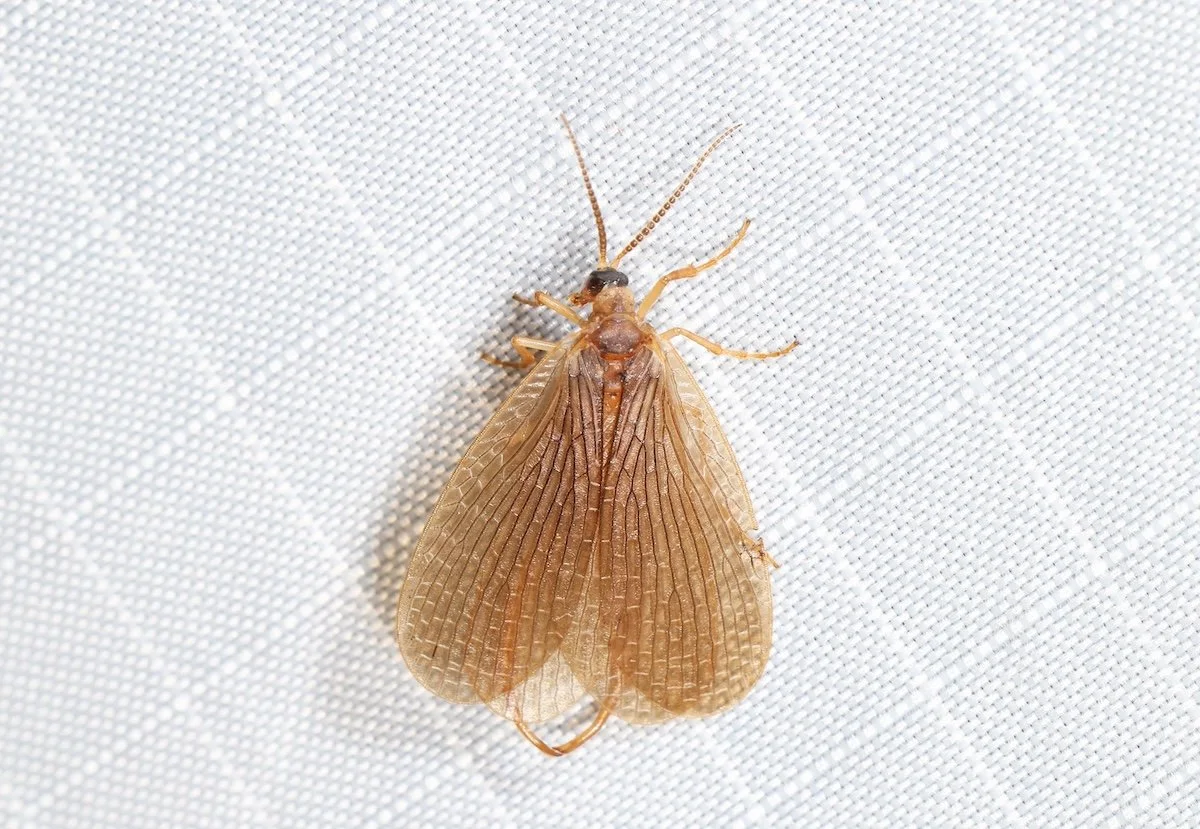
Forcepfly. Photo: Judy Gallagher
The Forcepfly that I saw recently is one of just three species in Family Meropeidae, and it’s the only species found in North America. Not much is known about this family. No larvae of any species have been found and the adults have never been seen feeding, although there is speculation that they feed on decaying organic matter. They are called Forcepflies because of the forcep-like male genitalia. Their bodies are flat, which enables them to live under tree bark or logs.
The biggest Mecopteran family is Panorpidae, or Scorpionflies. There are about 300 species worldwide, with 54 species in eastern North America. Female scorpionflies lay small masses of eggs in soil. The larvae live in or near the soil-layer before pupating in underground cells over the winter. Both adult and larva are primarily scavengers, eating dead insects and snails, bird droppings, pollen, nectar and fruit juices. Adults often steal prey from spider webs and occasionally also eat the live spiders.

Male Helena’s Scorpionfly (Panorpa helena), showing off its scorpion-like appendage. Photo: Judy Gallagher
Male scorpionflies have genitalia that look like scorpion stingers, which is the reason behind their name. Unlike scorpions, they can’t sting. Each species of scorpionfly has unique genitalia, and this is what is commonly used by entomologists to distinguish between species.

Another male scorpionfly, Panorpa species. Note the slightly different appendage and different wing markings. Photo: Judy Gallagher
Male scorpionflies try to attract females by offering them a dead insect, but if a dead insect isn’t available, they sometimes offer saliva instead. Some female scorpionflies will accept a male suitor only if he brings her a gift of prey, and females tend to prefer males that bring them big prey items. Males are reputed to occasionally mimic females in order to get a free meal. Some male scorpionflies also try to attract a female by issuing chemical signals (pheromones) and waving their wings, accompanied by sounds made by vibrating their abdomen against a solid surface.

Female scorpionfly, Panorpa species. Photo: Judy Gallagher
Female scorpionflies don’t have the scorpion-like appendage.

Female scorpionfly showing different wing markings. Photo: Judy Gallagher
Scorpionflies are usually among the first insects to start feeding on corpses, indicating that the body is at most a few days old, something that is used by forensic investigators to date the approximate age of a corpse. I am grateful that I don’t have pictures to illustrate this!
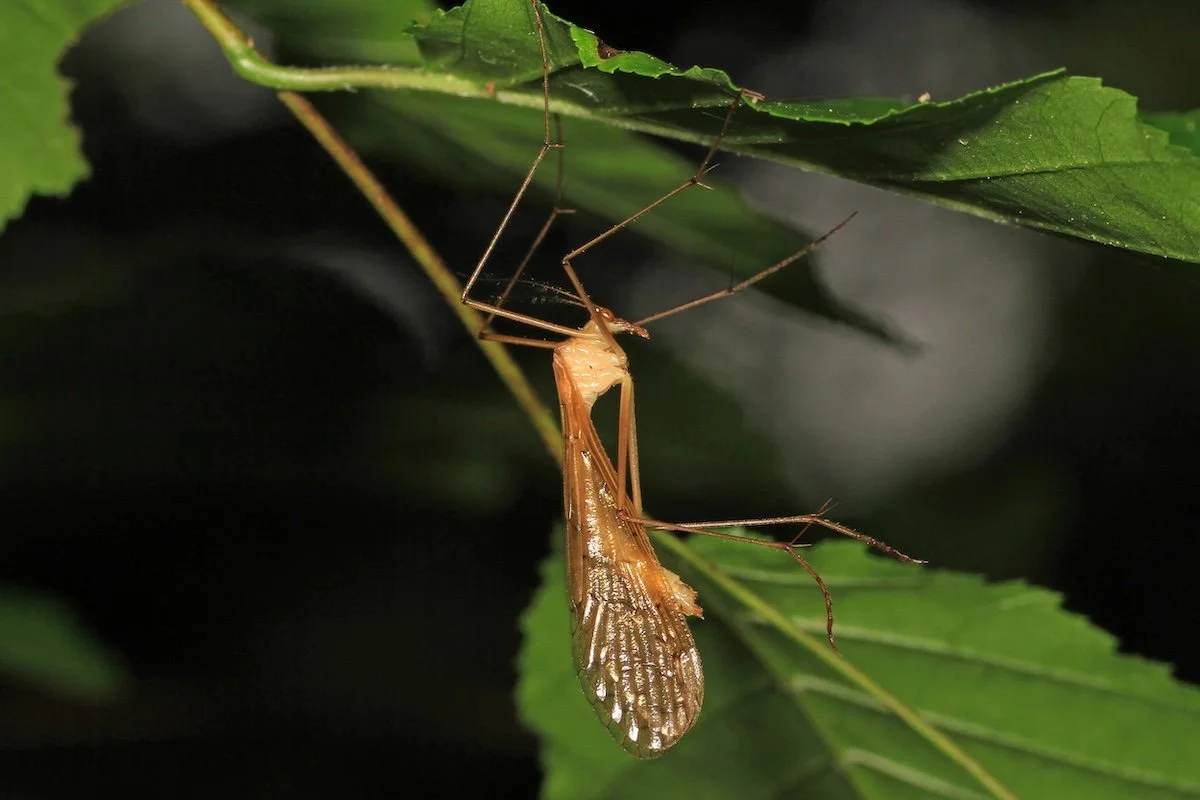
Hangingfly, Bittacus species. Photo: Judy Gallagher
The final Mecopteran family that occurs regularly in our area is Hangingflies (Bittacidae). They hang by their front and middle legs from low plants, and use their hind legs to capture passing prey. They look a little like Crane Flies, but have the long beak-like mouthparts characteristic of this order. Like scorpionflies, male hangingflies attract females by bringing them insect prey. If the female doesn’t think the prey is big enough, she flies away.
I’ve never seen a snow scorpionfly (family Boreidae). They are adapted to cold climatic conditions, often living on the surface of ice or snow, and may die if exposed to the heat of a human hand. A few individuals have been found in our area, but they typically live further north. My goal is to find one this winter.
View more of Judy’s articles on A Closer Look: Nature All Around Us (formerly Observations from Meadowood).