NVBA NEWS BLOG
Welcome to the blog for Northern Virginia Bird Alliance, a wealth of resources about northern Virginia birds, wildlife, habitat conservation and restoration, native plants, wildlife-friendly gardening, advocacy and more.
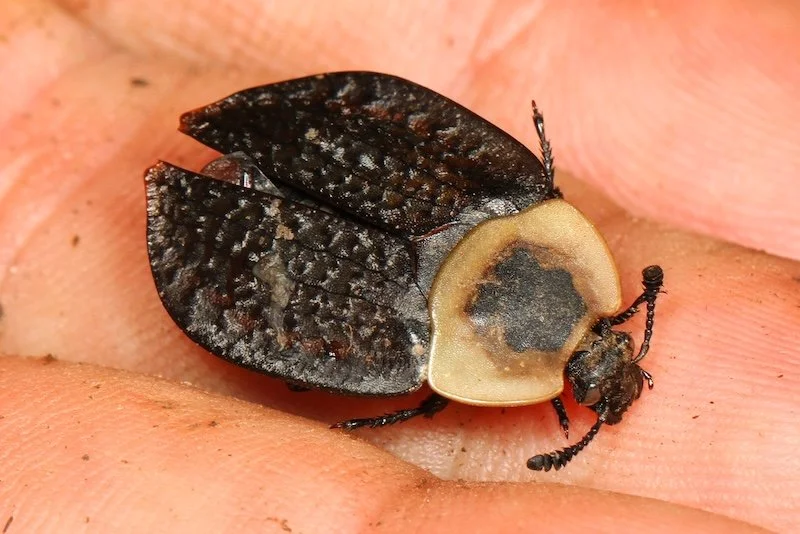
A Closer Look: Nature All Around Us, June 2026
Judy Gallagher is an NVBA board member and a regular surveyor of local wildlife who also captures photos of what she sees, in particular the less common species.
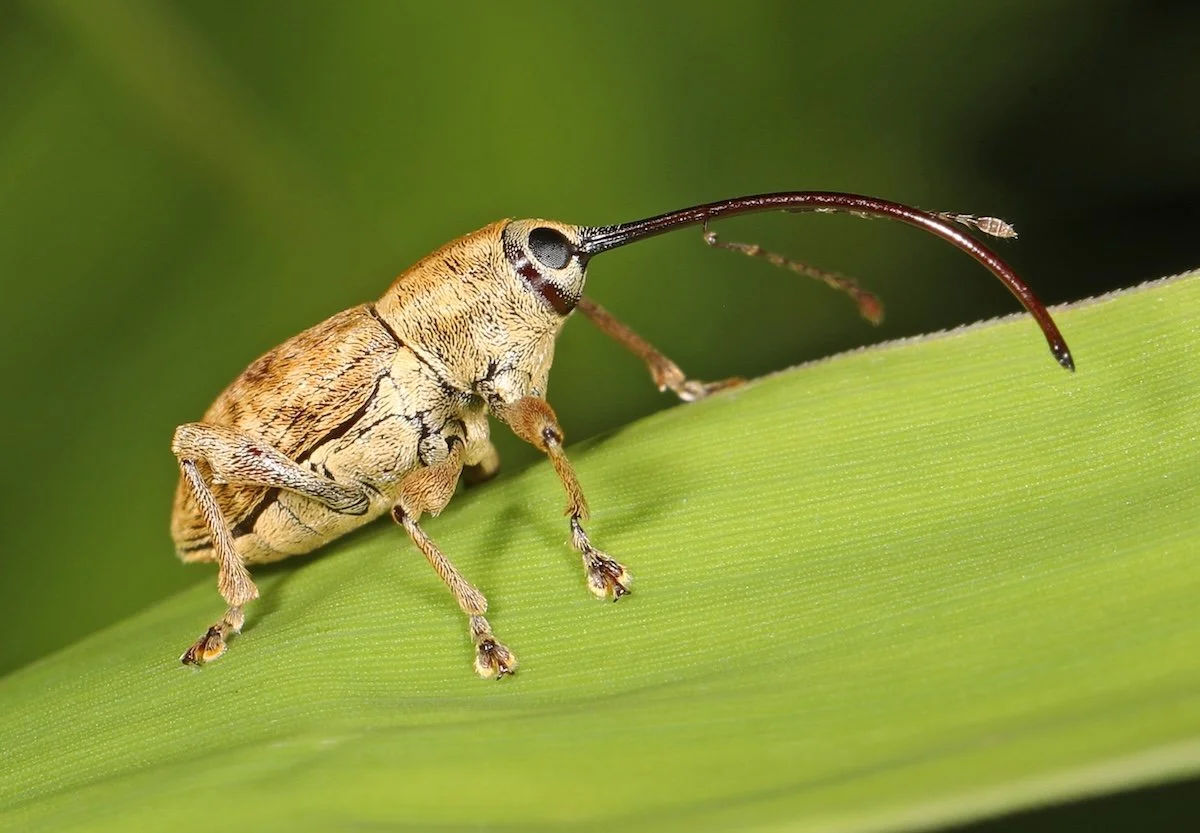
Photo: Curculio species, Judy Gallagher
Judy Gallagher
June 2026
Weevils have a bad reputation. As a child, I heard about the Boll Weevil, which decimated cotton crops in the 1800s. And every other reference to weevils contained the term "pest." But I've become fascinated with weevils as I see more of them through my macro lens. They are most unusual-looking creatures, and they aren't all pests.
Cocklebur Weevil. Photo: Judy Gallagher
Weevils are Beetles, mostly in the family Curculionidae, which, with over 80,000 species, may be the most species-rich animal family. Members of this family are known as True Weevils. They have a long snout (rostrum) and elbowed antennae that are bent sharply. Weevil mouthparts are at the end of the rostrum, and consist of a pair of mandibles that they use to chew on plants. Adult weevils have specialized claws that help them to hold onto plants, and some also have sticky substances on their feet that help them adhere to plant surfaces. Many are cryptically colored to blend in with their environment. Some weevils roll up and play dead when threatened, while others ingest plant toxins that make them unpalatable to potential predators.
Curculio species, with a rostrum that is longer than its body. Photo: Judy Gallagher
Some weevils, such as weevils that live on nuts, have a rostrum that is longer than the body.
Marbled Fungus Weevil. Note the straight antennae. Photo: Judy Gallagher
In addition to True Weevils, there are several other weevil families, collectively known as Primitive Weevils: Fungus Weevils (Anthribidae); Leaf-rolling Weevils (Attelabidae); Primitive Weevils (Belidae); Straight-snouted Weevils (Brentidae); Caridae; and Pine Flower Weevils (Nemonychidae). The total number of species in these other families is about 6,400. One visual difference from True Weevils is that their antennae are straight, rather than elbowed.
There is also a subfamily of the Leaf Beetle family named Bean Weevils, but they lack the elongated snout of True or Primitive Weevils.
Little Leaf Notcher - two males approach a female. Photo: Judy Gallagher
Like all beetles, weevils undergo complete metamorphosis, having egg, larva, pupa and adult stages. Most weevil species reproduce sexually, but a number of weevil species are asexual, where all individuals are female. Despite not having the genetic variation that occurs with sexual reproduction, they can adapt to digest toxins in different plants and pass that down epigenetically to their offspring. Epigenetic changes don't alter the underlying DNA, but act like chemical switches that turn genes on or off.
There is even one Australian weevil species that is eusocial, with non-reproductive females helping to excavate and defend the colony. Unlike other eusocial helping insects like ants and termites, who are short-lived, helper weevils can live for up to 10 years, almost as long as the queen weevil.
Weevil adults and larvae eat plants. Some species eat foliage, while others eat flower buds, seeds, and roots. Typically, more damage is done by the larvae than the adults, and weevils that feed on roots can cause the entire plant to be unhealthy. I mentioned the Boll Weevil earlier, but there are other weevils that are a problem for agriculture. Grain Weevils damage stored grain. Rice Weevils damage stored rice, wheat and corn. White Pine Weevils damage young pine trees. And there are many others. In addition to the problems caused by weevils chewing on plants, the damage also can allow pathogens like fungi and bacteria to enter the plant, which causes other challenges to the plant.
Canada Thistle Bud Weevil. Photo: Judy Gallagher
But some weevils are useful. Mile-a-minute Weed, a fast-growing invasive plant, is now somewhat under control because of the deliberate introduction of a tiny Chinese weevil, just 1/10th of an inch long, that eats Mile-a-minute Weed. The Canada Thistle Bud Weevil helps control invasive thistle populations, although it also sometimes also eats native thistles.
Flower Weevil with pollen. Photo: Judy Gallagher
Some weevils eat rotting vegetation, helping to decompose it. And Flower Weevils can be good pollinators. Scientists have identified at least 250 plant species where weevils are important pollinators. Flower Weevils eat pollen and inadvertently carry pollen from flower to flower. Most of the weevils are plant-specific, and are pollinating the plant in which they are living and reproducing. This is called brood-site pollination.
Jewel Weevil, found in south Florida. Photo: Judy Gallagher
Exophthalmus species, found in Colombia. Photo: Judy Gallagher
I'm going to finish with two particularly attractive weevils. One is found in south Florida, and the other in South America, so you won't see them here. But I encourage you to get out and see our local weevils, less brightly colored, but still fascinating.
View more of Judy’s articles on A Closer Look: Nature All Around Us (formerly Observations from Meadowood).
A Closer Look: Nature All Around Us, May 2026
Judy Gallagher is an NVBA board member and a regular surveyor of local wildlife who also captures photos of what she sees, in particular the less common species.
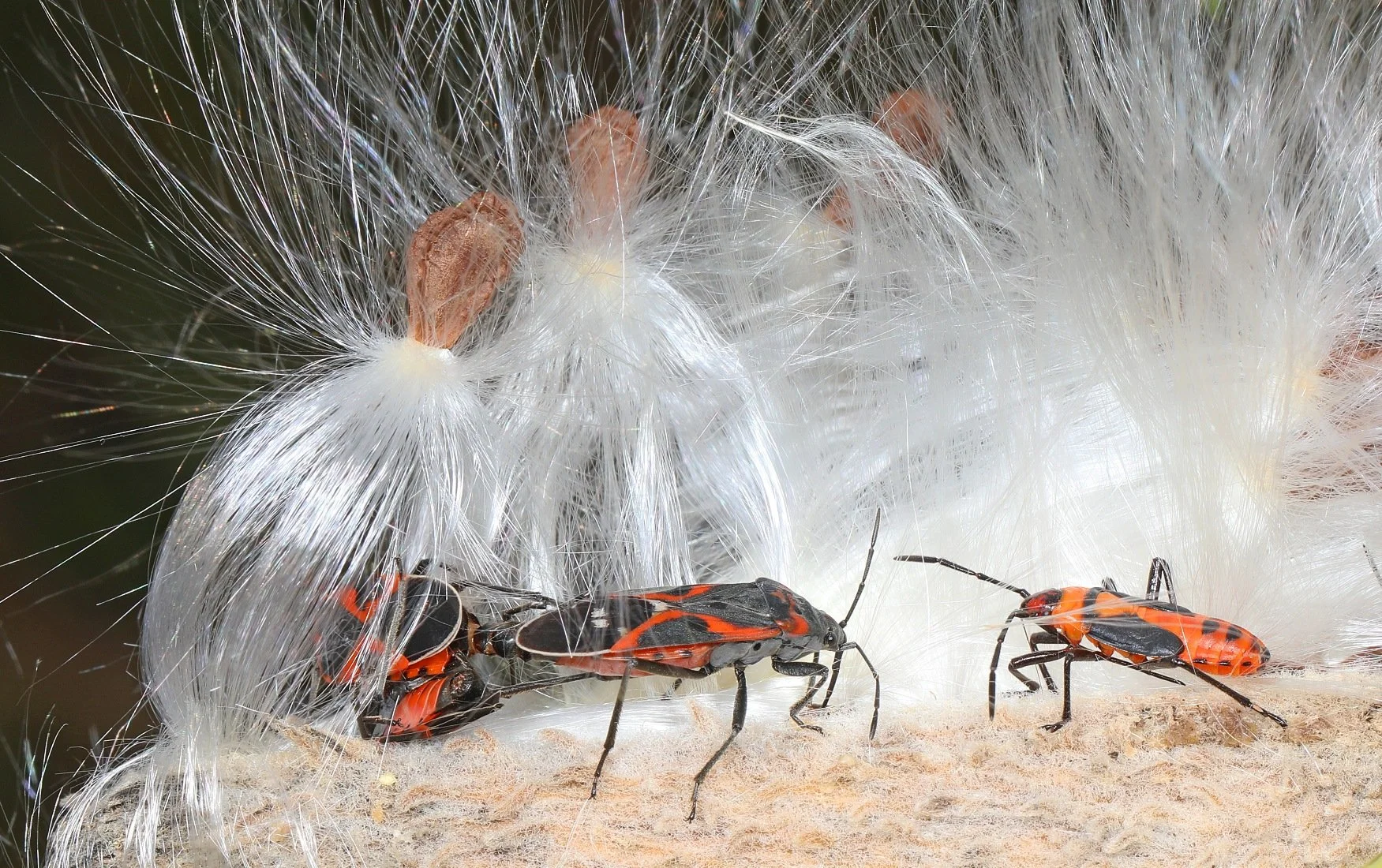
Photo: Small Milkweed Bug adult and nymphs with Common Milkweed seeds, Judy Gallagher
Judy Gallagher
May 2026
Small Milkweed Bug adult and nymphs with Common Milkweed seeds. Photo: Judy Gallagher
Milkweed will be blooming soon, and with it come Milkweed Bugs. Milkweed Bugs are true bugs, part of the Lygaeidae or Seed Bug family. As the name implies, most species in this family eat seeds, but some can also eat other plant parts. Like all other true bugs, they have piercing-sucking mouthparts, well adapted for piercing hard seeds.
Some seed bugs have a limited number of plant host species, while others are able to eat seeds from a broad range of plants. Availability of suitable plants tends to limit seed bug populations. Most seed bugs are found in open grassy areas, where there is a mixture of flowering plants. There are about 80 species of seed bugs in North America.
Like other true bugs, seed bugs undergo incomplete metamorphosis, with eggs hatching into nymphs that look like the adults, but without wings and reproductive organs. Some seed bug nymphs are gregarious, meaning that they cluster together. Entomologists speculate that, with a group, it takes less saliva per individual to soften the seeds for digestion. After the nymph undergoes its final molt, the winged adult emerges. All adult seed bugs have an X on their backs, produced by the way the wings fold.
Some seed bug species females lay multiple sets of eggs during their lifetime. Those laid later in the year mature faster than ones from earlier in the year, presumably to allow the nymphs to mature quickly before cold temperatures limit them.
Large Milkweed Bug adults and nymph on Common Milkweed Seed Pod. Photo: Judy Gallagher
Small and Large Milkweed Bugs are bright red with black markings. Both feed on milkweed seeds, inserting their long proboscises into seeds, injecting enzymes to liquefy the seeds' contents, and then sucking out the juice. The seeds contain toxins called Cardenolides. Small and Large Milkweed Bugs have evolved to be able to process the toxins, and they sequester the chemicals, making the Milkweed Bugs unpalatable to birds and other vertebrates. They advertise their distastefulness with their bright colors.
Small Milkweed Bug eating another Small Milkweed Bug. Photo: Judy Gallagher
Small Milkweed Bugs aren't as picky about their food as some other Milkweed-dependent insects. When Milkweed is scarce, they can also feed on Honey Bees, Monarch caterpillars and pupae, Large Milkweed Bugs, Dogbane Beetles, and each other.
White-crossed Seed Bugs mating. Photo: Judy Gallagher
White-crossed Seed Bugs feed on Ragwort seeds, and are chemically protected by alkaloids in Ragwort. They migrate to find new Ragwort sources, and females will also migrate to find a mate. But if a female has enough food and a mate, hormones trigger her flight muscles to shut down, instead using her resources to produce eggs. Males retain the ability to fly throughout their adult life.
False Milkweed Bug adult and nymphs feeding on aster species seeds. Photo: Judy Gallagher
But not all brightly colored seed bugs are toxic. The False Milkweed Bug looks very similar to the Small Milkweed Bug. However, it has a very different diet: it prefers to eat the seeds of members of the Aster Family. Its mimicry of the toxic Large and Small Milkweed Bugs discourages predators from attacking it.
The above-mentioned seed bugs are colorful, but many seed bugs are small and brown. The drab ones most likely aren't protected by toxins and depend on camouflage for protection from predation. Some seed bugs emit foul odors to deter predators.
Birch Catkin Bug, blending in well. Photo: Judy Gallagher
Birch Catkin Bugs are rust colored, and can blend in well with a background of fallen leaves. They overwinter as adults and breed in the early spring. They emit mating calls by striking a rigid part of the wing against a scraper on the thorax.
Most seed bugs aren't numerous enough to pose a major threat to plant populations. Some are controlled by birds and reptiles but one of seed bugs' major biological controls is parasites like bacteria, or Tachinid Flies, who lay eggs on the seed bugs.
I hope you'll have a chance to see some seed bugs this summer!
View more of Judy’s articles on A Closer Look: Nature All Around Us (formerly Observations from Meadowood).
A Closer Look: Nature All Around Us, April 2026
Judy Gallagher is an NVBA board member and a regular surveyor of local wildlife who also captures photos of what she sees, in particular the less common species.
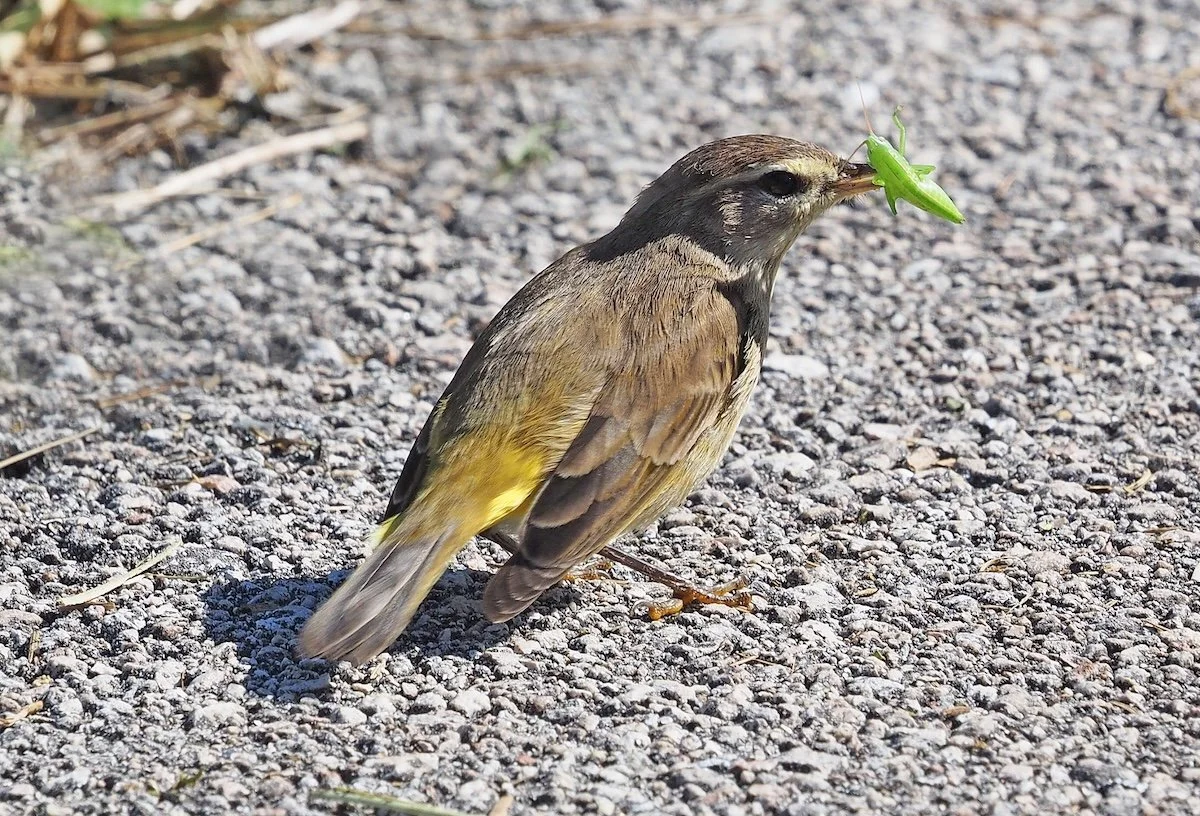
Photo: Palm Warbler with Katydid, Judy Gallagher
Judy Gallagher
April 2026
Common True Katydid, looking like a leaf. Photo: Judy Gallagher
I hear katydids more often than I see them. One reason for this is that many species are nocturnal, but many species are so well camouflaged that one doesn't always see them even when they are very close.
Katydids are named for the call of the Common True Katydid, whose males call "Ka-ty-did" when searching for a mate. But each species has its own song, and the songs are used for reproductive, territorial, aggressive, or defensive reasons. The males are usually the singers, but some females also produce sounds. The songs are produced by friction on special structures on the front wings. A few species pound on twigs, which produces vibrations that can be detected by other katydids.
Katydids are in the order Orthoptera, which also contains grasshoppers and crickets. Katydids hold their wings vertically over their body, have hearing organs on their legs, and have very long thin antennae that are often as long as their body. The antennae contain sensory receptors that facilitate them finding their way after dark.
There are around 6,400 species found worldwide, most of which are in the tropics, and approximately 270 species in the United States.
Handsome Meadow Katydid. Photo: Judy Gallagher
As I mentioned previously, most katydids are well camouflaged, but the Handsome Meadow Katydid is resplendent in a rainbow of colors. It shows up well against a gravel background, but it blends in surprisingly well in vegetation. Its genus is Orchelimum, from the Greek "meadow dancer," which aptly describes the way it moves around wet meadows.
Spiny-devil Katydid, protected by sharp spines. Photo: Judy Gallagher
The spiny-devil katydids, found in Central and South America, easily blend into their environment, but they also have spines on their bodies, making it difficult for a predator to catch and eat them. When threatened, they can produce loud hissing sounds by rubbing their wings together, and they have strong mouthparts that can deliver a painful bite.
Sooty Long-winged Katydid with insect prey. Photo: Judy Gallagher
Some katydid species are omnivorous, eating whatever they can, and a few species are ferocious predators, but most katydids eat plants. Their populations are typically low enough that they don't cause extensive damage to plants, so they aren't usually categorized as plant pests.
Female Shieldback Katydid with long ovipositor and nuptial gift (the jelly-like blob). Photo: Judy Gallagher
Female katydids tend to be larger than males, and they have a long ovipositor at the end of their abdomen suitable for laying eggs in plant stems or in the ground. When katydids mate, the males will sometimes provide a "nuptial gift," a sperm packet with additional protein that will help the female develop her eggs. Females prefer males that give such a gift, but it costs the male up to 40 percent of its body weight to provide it. Still, that could be worth it if it allows the male to have a greater chance of having offspring.
In our area, most katydids overwinter as eggs, which hatch in the spring. Katydids undergo incomplete metamorphosis, so the nymphs look pretty similar to the adults except they don't have wings. Nymphs typically molt five times before becoming a winged adult.
Katydid Wasp with prey (a cricket). Photo: Judy Gallagher
Katydids have a number of predators, including other insects. A thread-waisted wasp called the Katydid Wasp specializes in capturing katydids and crickets, paralyzing them and taking them to underground burrows to feed their young.
Palm Warbler with Katydid . Photo: Judy Gallagher
Bats prey on katydids, locating them by hearing their calls. Katydids also are a great food source for birds, including owls, bluebirds, kestrels and this Palm Warbler.
I'm looking forward to hearing and seeing Katydids soon. I hope you also see and hear them.
View more of Judy’s articles on A Closer Look: Nature All Around Us (formerly Observations from Meadowood).
A Closer Look: Nature All Around Us, March 2026
Judy Gallagher is an NVBA board member and a regular surveyor of local wildlife who also captures photos of what she sees, in particular the less common species.
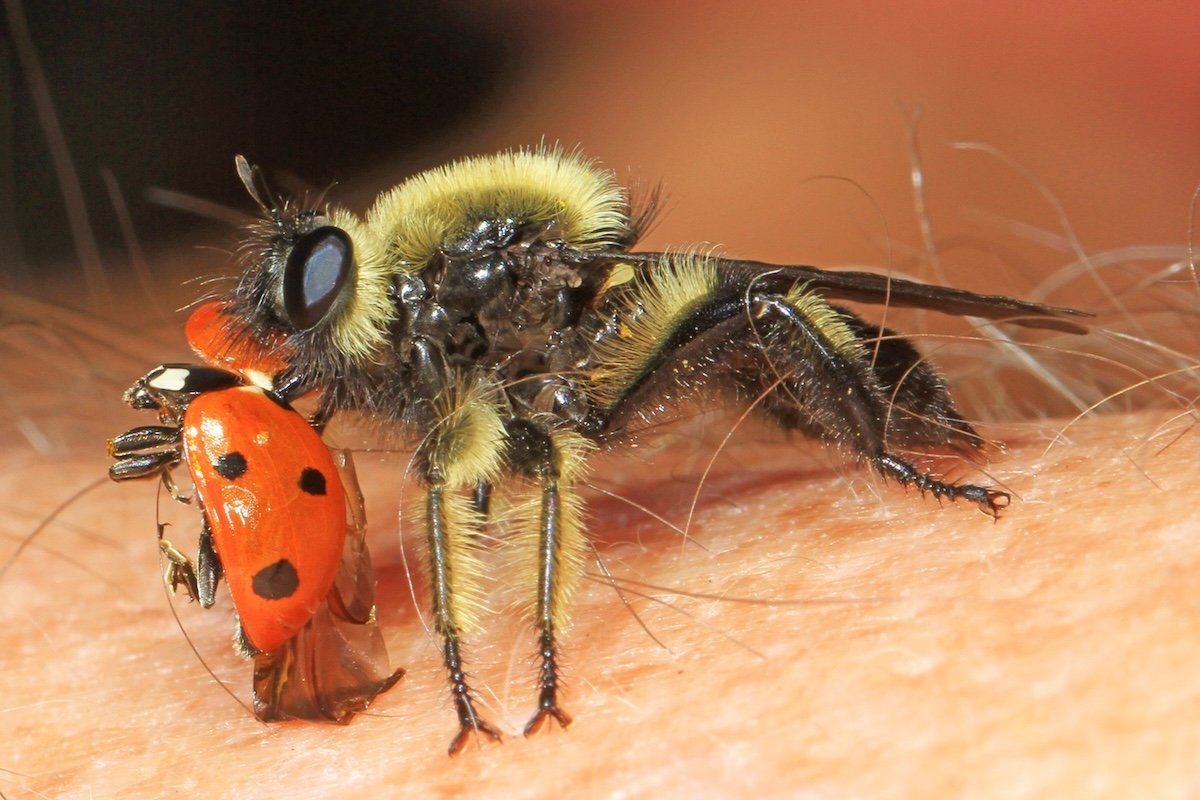
Photo: Laphria affinis robber fly with lady beetle prey, Judy Gallagher
Judy Gallagher
March 2026
I once heard robber flies described as the raptors of the insect world. As the name implies, they are flies, and according to iNaturalist, they are called robber flies because of their expert predatory habits. They usually sit in an open area, watch for insects to approach, fly out to catch them and then return to their perch to finish their meal.
Robber flies typically have a long abdomen and spiny legs which aid in prey capture. Some appear to be humpbacked, and many robber flies have mustaches called mystax, which may help protect the head and face when prey tries to fight back. Their wide-spaced compound eyes give an extensive range of view and they have long, pointed proboscises that they use to inject neurotoxins and digestive enzymes into prey. There are approximately 7,000 robber fly species worldwide, with about 1,000 species in North America.
Microstylum morosum, North America's largest robber fly. Photo: Judy Gallagher
Most robber flies are between 1/2 inch to 3/4 inch long, but North America's largest robber fly, Microstylum morosum, can be 2 inches long, and a species in Madagascar is more than 3 inches long!
Laphria partitor, a bumble bee mimic. Note its impressive mustache (mystax). Photo: Judy Gallagher
Some robber flies are bee and wasp mimics, with black and yellow striped patterns. They sound like bees and wasps, making loud buzzing sounds as they fly. A number of robber flies in genus Laphria resemble bumble bees, and even have yellow fuzz just like bumble bees.
Robber flies mating, while one dines on wasp. Photo: Judy Gallagher
Robber fly males are territorial, chasing away rivals before trying to court the female. Males of some species conduct aerial displays to attract females or offer the female a "nuptial gift" of captured prey. Robber fly females have been known to play dead if they are not interested in the male's advances.
Robber flies that hunt on the ground tend to lay eggs on or in soil, and robber flies that hunt from plants usually lay their eggs in plants. The grub-like larvae live in soil, rotting wood or other decaying materials and, like the adults, are predators.
Robber Fly with Eastern Amberwing (dragonfly) meal. Photo: Judy Gallagher
Most adult robber flies attack prey that is smaller than they are, but there are exceptions, like the robber fly that attacked the dragonfly in this picture. The heavier dragonfly caused the pair to crash on the ground. After the robber fly finished its meal, it flew off, presumably to find another meal.
They consume a significant portion of their body weight each day, but the number of insects consumed depends on the weight of each prey item. Some robber flies specialize in prey like grasshoppers, but most are generalists.
Laphria affinis robber fly with lady beetle prey. Photo: Judy Gallagher
You might wonder if robber flies could be a useful biological control of pest insects. The answer is, "It depends." Yes, they eat pest insects, but they are not always discriminating in their diet, and they eat useful insects like lady beetles too.
Hanging-thief with wasp prey. Photo: Judy Gallagher
Robber flies in genus Diogmites are known as hanging-thieves because, after capturing prey, they feed by hanging from plant stems or leaves suspended by one or both front legs. The other legs hold and manipulate the prey. Hanging-thieves mostly prey on Hymenoptera (wasps, bees, etc.) and can negatively impact honey bee populations. The female lays eggs in the ground, and her ovipositor has spines that aid in covering up the eggs.
Gnat Ogre with prey. Photo: Judy Gallagher
As the name suggests, Gnat Ogres mostly prey on gnats, although the one pictured here has a tiny wasp instead. Most gnat ogres are small, between 1/8 and 3/8 inches long, and perch on vegetation tips to hunt.
Although robber flies are known for their impressive hunting skills, they can also be prey. Robber fly predators include birds, lizards, frogs, bats, jumping spiders, dragonflies and parasitic wasps.
When spring finally arrives, I hope you can observe one of these magnificent hunters in action.
View more of Judy’s articles on A Closer Look: Nature All Around Us (formerly Observations from Meadowood).
A Closer Look: Nature All Around Us, February 2026
Judy Gallagher is an NVBA board member and a regular surveyor of local wildlife who also captures photos of what she sees, in particular the less common species.
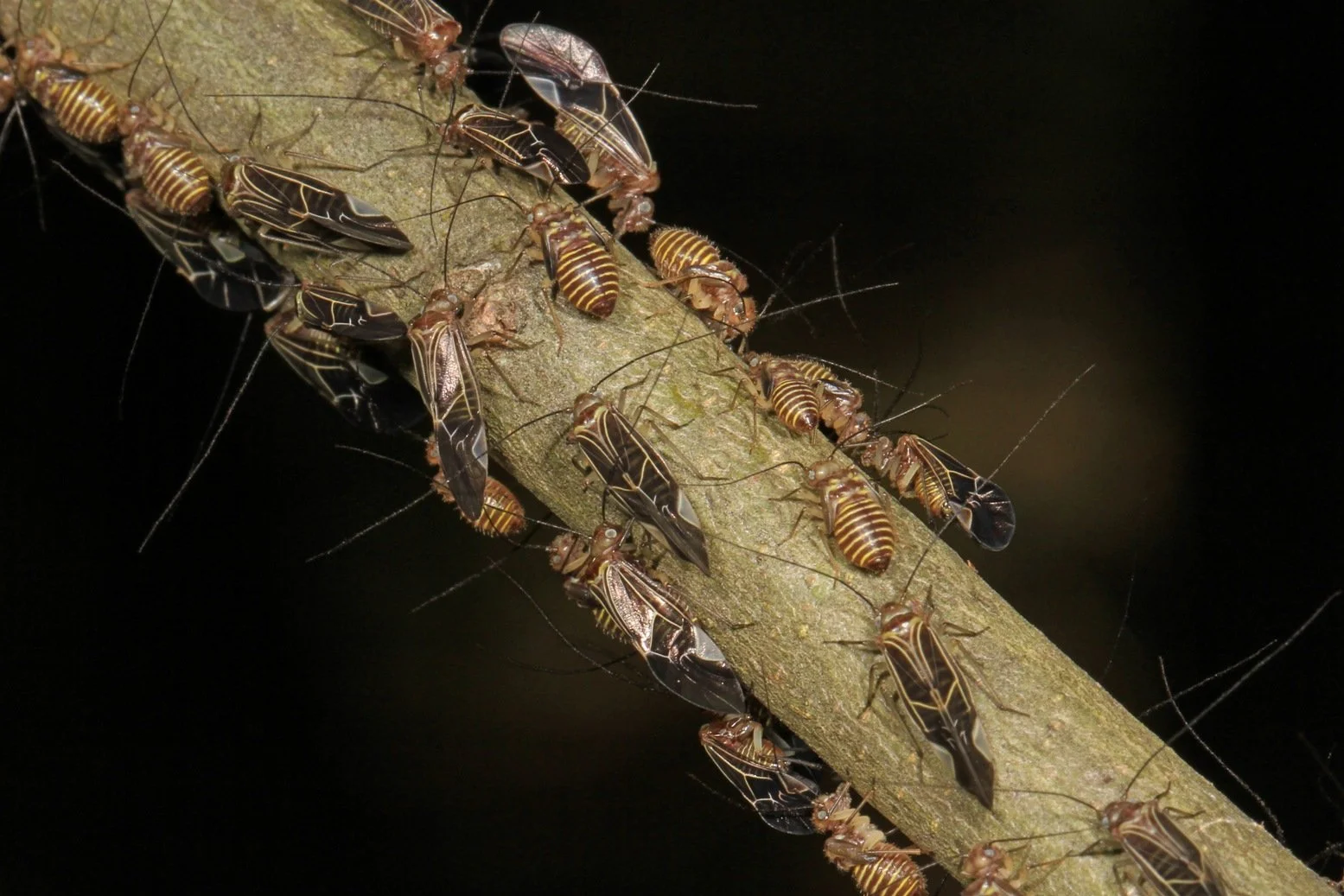
Photo: Tree Cattle, Judy Gallagher
Judy Gallagher
February 2026
It's challenging to find insects at this time of year. Many insects overwinter as eggs or pupa, and the ones that overwinter as adults are typically in hiding, trying to keep warm underneath bark or leaf litter. But I saw several adult barklice recently on a warm January day. They had likely just emerged from a protected spot. Barklice are members of insect order Psocoptera, which also includes booklice and parasitic lice.
Booklice are wingless and are usually found inside homes, where they feed on mold, fungi, grains, insect fragments and starchy materials like glue in the binding of books. They are found in moist environments, and rarely survive when humidity is less than 50%. They are not harmful to humans.
Parasitic lice, as the name implies, are parasites that feed on blood and other secretions of warm-blooded hosts like mammals and birds.
Corrupt Barklouse (Polypsocus corruptus) on my thumb, showing its small size. Photo: Judy Gallagher
But this article is about barklice. There are more than 300 species of barklice in 26 families in North America. They are detritivores, feeding on fungi, algae and lichens, contributing to the recycling of organic material. Barklice normally don't damage the plants they live on, although an Australian species' nymphs bore holes in wood instead of living in existing burrows. Barklice tend to be small and inconspicuous. They have chewing mouthparts and a sort of slender rod extending from the jaw that helps brace the barklouse while it is scraping up its food. Unlike their parasitic cousins that have legs suitable for gripping their host, barklice have legs that are adapted for jumping. Most adult barklice have wings and have two wing-coupling mechanisms, one that joins the forewing and hindwing in flight, and one that keeps the wings in place when the barklouse is resting.
F-winged Barklouse (Graphopsocus cruciatus) with silk. Photo: Judy Gallagher
Some species produce silk from glands in their mouths, and a species that is found in the southern U.S. can swathe large trees with its silk. Some local species produce silk, but not in that volume. The web protects the barklice from predators while feeding, and does not damage the tree. Some barklice species eat the silk when the need for it is done.
Shaggy Barklouse family - Teliapsocus conterminus female with eggs. Photo: Judy Gallagher
Most barklice lay their eggs in small crevices in bark or on foliage, but there are at least two species that have live young. Barklice aren't known to guard their eggs, but the picture above makes me wonder if some do. Eggs and other life stages can be parasitized by tiny wasps.
Some barklice species reproduce asexually (parthenogenesis), and the resulting young are genetically the same as the adult female. Most species also reproduce sexually, and male barklice sometimes do a courtship dance, making sounds with their legs to attract a female.
Barklice undergo incomplete metamorphosis. The young look much the same as the adult, except they don't have wings or reproductive structures. They usually shed their external skeletons about six times before becoming a reproductive adult.
If you look closely at the rear end of the barklouse in the above photo, you can see a yellow hairy anatomical feature called a sensorium or sense cushion. Scientists theorize that the sensorium may be used to detect wind currents, which might help the barklouse when in flight.
Tree Cattle. Photo: Judy Gallagher
A Common Barklice family species, Cerastipsocus venosus, forms herds on smooth-barked trees. The adults have wings, and the nymphs have distinctive yellow and black striped abdomens. They are commonly called Tree Cattle.
Outer Barklice family species Ectopsocus californicus. Photo: Judy Gallagher
Outer Barklice have been found in bird feathers, leading scientists to theorize that they may disperse by hitch-hiking rides on birds.
Lizard Barklouse family species Valenzuela flavidus. Photo: Judy Gallagher
There are a number of other barklouse families including Ancient Barklice, Hairy-winged Barklice, Narrow Barklice, Fateful Barklice, Loving Barklice, and the intriguingly named Lizard Barklice and False Lizard Barklice, which aren't closely related. I couldn't find information on why the family names are so unusual, but the Lizard Barklouse above does not resemble a lizard.
I hope you've learned a little about these intriguing creatures and have enjoyed my louse-y pictures. Sorry, I've never been able to resist a good pun
View more of Judy’s articles on A Closer Look: Nature All Around Us (formerly Observations from Meadowood).
A Closer Look: Nature All Around Us, January 2026
Judy Gallagher is an NVBA board member and a regular surveyor of local wildlife who also captures photos of what she sees, in particular the less common species.
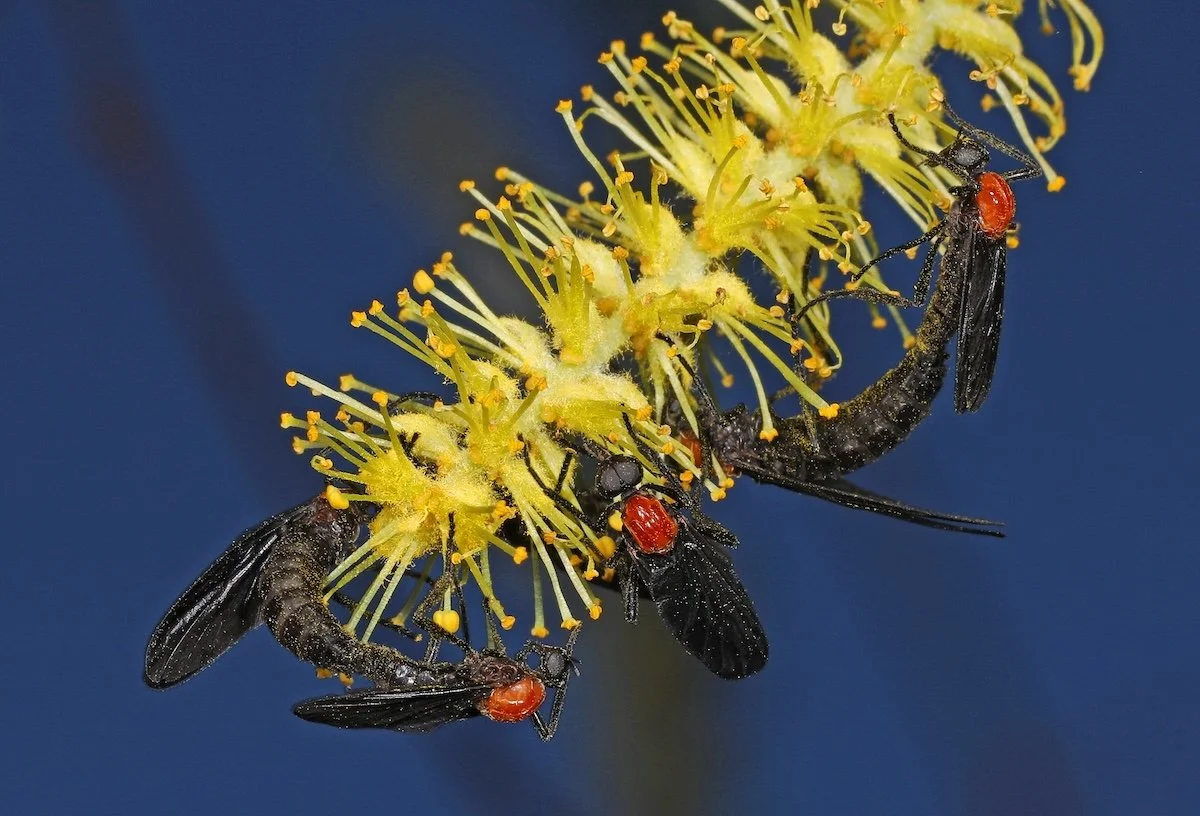
Photo: Lovebugs, Judy Gallagher
Judy Gallagher
January 2026
My late husband Jimmy and I used to travel to north Florida in late May each year. We had to carry an ice scraper and windshield washer fluid so we could periodically pull over and scrape insects called Lovebugs off the windshield. Lovebugs, so called because they are typically found in copula, were so numerous that we couldn't wait until we stopped at a gas station to clean the windshield. Lovebugs have even been known to make cars overheat when radiators become clogged with them.
Lovebugs. Photo: Judy Gallagher
Despite the name, Lovebugs are flies, not bugs, and they are a species in the March Fly family. Lovebug adults only live for a few days, and they are in tandem for the majority of their short adult lives. They are attracted to chemicals found in automobile exhaust, which explains why they are so numerous around roads. Lovebugs are not originally native to Florida, but they spread quickly due to lack of natural control mechanisms. They are now less common in Florida than they once were because natural controls, mostly fungi, have expanded to help with the overpopulation.
Dark Autumn Bibio (male). Photo: Judy Gallagher
We don't have Lovebugs here in northern Virginia, but we have other species in the March Fly family (Bibionidae). Like Lovebugs, March Flies are medium-sized, with slender black, brown or rusty bodies, thick legs and relatively small eyes. The rear legs are long and hang loosely when in flight, so it's pretty easy to recognize them while flying.
Common names like March Fly can be confusing. In Australia, members of fly family Tabanidae are called March Flies. We call them Horse Flies, and they aren't closely related to our March Flies.
Our species are mostly seen in late autumn or early spring, and the fly family is named because a lot of them make an appearance in early March. It's easy for them to find a mate because they emerge en masse and they complete their life cycle before many predators come out. But I did see one, the Dark Autumn Bibio, near the end of November, which was the inspiration for this month's column. Male Dark Autumn Bibios are known to swarm, but, unlike Lovebugs, they aren't attracted to automobile exhaust and don't mess up cars.
Dark Autumn Bibio (female). Photo: Judy Gallagher
Dark Autumn Bibios are sexually dimorphic. The male and female are easy to distinguish because the male is dark (as suggested by the common name), but the female has a red thorax and red on its legs.
Not all March Flies have sexually dimorphic coloring, but all March Flies have eyes that are easily distinguished by sex. Female eyes are smaller than male eyes and are separated from each other as seen above.
Lovebug male. Note the dividing line near the bottom of the compound eye. Photo: Judy Gallagher
The male's eyes are large and touch each other, and each male eye is divided into upper and lower parts that have different visual properties. The larger divided male eyes may help them to see other males above and below them in a mating swarm.
Dilophus species feeding on nectar. Photo: Judy Gallagher
March Fly larvae are usually found in grassy areas. They feed on plant material, sometimes scavenging dead vegetation like decaying wood, and are often found in compost. Like Lovebugs, other March Fly adults don't live very long, and many adults don't eat. But those that do usually rely on nectar. The adults can be good pollinators, and some are the primary pollinators of various orchid species. Larvae help form and accumulate humus in soil. According to an old (1904) publication by the British Museum of Natural History, chickens love to eat March Fly larvae.
My holiday present to myself, a March Fly preserved in amber. Photo: Judy Gallagher
There are only about 700 March Fly species worldwide, but they are the most common flies in the fossil record. It's less than a week before Christmas as I write this column, and I decided to see if there were any affordable March Fly fossils available. I am happy to report that I will soon be the proud owner of a March Fly preserved in amber. Happy New Year to all of you, and to me!
View more of Judy’s articles on A Closer Look: Nature All Around Us (formerly Observations from Meadowood).
A Closer Look: Nature All Around Us, December 2025
Judy Gallagher is an NVBA board member and a regular surveyor of local wildlife who also captures photos of what she sees, in particular the less common species.
Photo: Cynipid Wasp gall on Pin Oak, Judy Gallagher
Judy Gallagher
December 2025
Live insects are challenging to find at this time of year. But signs of them remain in the form of galls, a swelling growth of plant tissue. Galls can also be caused by viruses, fungi, bacteria and mites, but I'm only going to talk about ones that are created by insects.
Elm Cockscomb Aphid Gall. Photo: Judy Gallagher
Insects that produce galls include gall wasps, gall midges, gall flies, leaf-miner flies, aphids, scale insects, psyllids, thrips, gall moths and weevils.
Galls are basically plant tissue that grows abnormally as a result of chemicals in salivary secretions of insects, which cause increased production of plant growth hormones. The abnormal growth envelops the larva and provides a microhabitat until it is ready for adult life. The gall continues to grow as the larva grows inside it. Galls are usually formed during the growing season when plant cell division occurs quickly. At this time of year, I see old galls on fallen leaves.
Gall-making insects have very specific plant preferences and even tissue preferences because their salivary chemicals must be able to stimulate that plant's genetic machinery, and each species' gall is unique. Galls can occur on leaves, stems and twigs, or on flowers or flower buds. Although they can be unsightly, insect galls rarely affect the general health of the plant.
Wool Sower Gall. Photo: Judy Gallagher
Some galls contain multiple larvae. The female Wool Sower Gall Wasp lays multiple eggs in one location, usually on a White Oak, although she can also use Chestnut Oak, Swamp Chestnut Oak and Swamp White Oak. The adult female releases fluids that start the gall-making process. When the eggs hatch, the larvae secrete chemicals that continue the process, and the resulting gall has many chambers, each containing one wasp larva. This wasp makes two types of galls. Wasps that emerge from the Wool Sower Gall make inconspicuous stem galls, and the wasps that emerge from the inconspicuous stem galls make Wool Sower Galls.
Cynipid Wasp (Zopheroteras guttatum) gall on Pin Oak. Photo: Judy Gallagher
This tiny and exquisite gall is formed by larva of another wasp, Zopheroteras guttatum, on Pin Oak.
Spiny Leaf Gall Wasp gall. Photo: Judy Gallagher
Galls are a sort of nursery and provide some protection to the larva. But there are lots of predators who would like to eat tasty larvae, and the larvae can’t move around much due to the constraints of their gall. And there also are insects who eat plant tissue, and the larvae could be accidental victims if the plant tissue containing the gall is eaten. So the Spiny Leaf Gall Wasp has manipulated the genes of its host plant, a wild rose species, to produce a spiny gall that deters predators. To me, this is pretty incredible – a wasp larva secretes substances that force the plant to grow a nursery for it and protect it from predation!
Other gall wasps create galls with concentrations of toxic tannins near the surface to repel predators, or force the gall to secrete sweet plant juices (phloem) to attract ants, bees or yellowjackets who defend their space from other insects.
Ocellate Maple Gall Midge gall. Photo: Judy Gallagher
Here's a gall made by the Ocellate Maple Gall Midge, a small fly that, as the name suggests, produces galls on Maples. It also causes the leaf to develop rings of yellow and red, with Maple pigments normally only seen in the fall. Most gall-making insects leave the gall as an adult, but this midge leaves the gall as a larva and pupates in the leaf litter, where it remains until it emerges as an adult fly the following spring.
Persimmon Psyllids mating. Photo: Judy Gallagher
Although I often see galls, I rarely see the adult insects of gall-making species. Most are quite small and not easily noticed, but I was fortunate enough to see these Persimmon Psyllids mating and, I think, laying eggs. Persimmon Psyllids are True Bugs, about 1/8 inch long, and the larval spit secretions cause Persimmon leaves to become stunted, twisted, and curled. The larvae live in pockets within the twisted structure.
Soldier Beetle coming out of a Phylloxera gall. Photo: Judy Gallagher
I mentioned before that there are insects that like to eat the inhabitants of galls. I observed this Soldier Beetle going in and out of galls. I asked experts what was going on and they speculated that the Soldier Beetle was eating the Phylloxera larvae inside the gall. Insects are fascinating!
View more of Judy’s articles on A Closer Look: Nature All Around Us (formerly Observations from Meadowood).
A Closer Look: Nature All Around Us, November 2025
Judy Gallagher is an NVBA board member and a regular surveyor of local wildlife who also captures photos of what she sees, in particular the less common species.
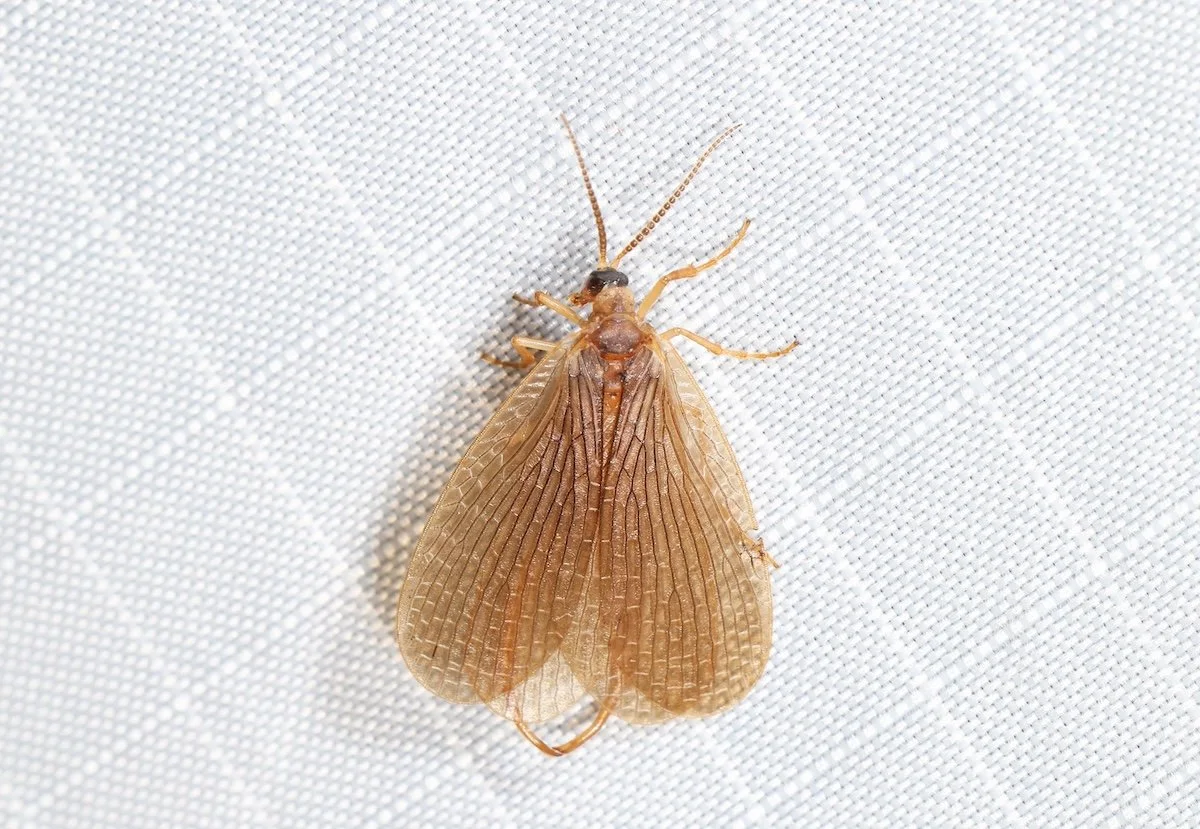
Photo: Forcepfly, Judy Gallagher
Judy Gallagher
November 2025
I was fortunate recently to see a Forcepfly, a species in a family that was previously unknown to me, and that inspired this month’s column. Forcepflies, sometimes called Earwigflies, belong to Order Mecoptera (long wings), which also includes Scorpionflies, Hangingflies, and Snow Scorpionflies. Order Mecoptera is closely related to Siphonaptera (fleas) and slightly more distantly to Diptera (flies).
Members of this order look a bit like flies, with long slender bodies and narrow membranous wings. They have long beak-like mouthparts. They undergo complete metamorphosis with egg, larval, pupal, and adult stages. The larvae mostly feed on plant matter, but most adults are predators or eat dead organisms. Some scientists postulate that early Mecopterans fed on nectar and pollen, but so far fossil evidence has not confirmed this. Analyses of fossilized Mecopteran mouthparts, which didn’t find any iron, suggest that early Mecopterans did not feed on blood.
Forcepfly. Photo: Judy Gallagher
The Forcepfly that I saw recently is one of just three species in Family Meropeidae, and it’s the only species found in North America. Not much is known about this family. No larvae of any species have been found and the adults have never been seen feeding, although there is speculation that they feed on decaying organic matter. They are called Forcepflies because of the forcep-like male genitalia. Their bodies are flat, which enables them to live under tree bark or logs.
The biggest Mecopteran family is Panorpidae, or Scorpionflies. There are about 300 species worldwide, with 54 species in eastern North America. Female scorpionflies lay small masses of eggs in soil. The larvae live in or near the soil-layer before pupating in underground cells over the winter. Both adult and larva are primarily scavengers, eating dead insects and snails, bird droppings, pollen, nectar and fruit juices. Adults often steal prey from spider webs and occasionally also eat the live spiders.
Male Helena’s Scorpionfly (Panorpa helena), showing off its scorpion-like appendage. Photo: Judy Gallagher
Male scorpionflies have genitalia that look like scorpion stingers, which is the reason behind their name. Unlike scorpions, they can’t sting. Each species of scorpionfly has unique genitalia, and this is what is commonly used by entomologists to distinguish between species.
Another male scorpionfly, Panorpa species. Note the slightly different appendage and different wing markings. Photo: Judy Gallagher
Male scorpionflies try to attract females by offering them a dead insect, but if a dead insect isn’t available, they sometimes offer saliva instead. Some female scorpionflies will accept a male suitor only if he brings her a gift of prey, and females tend to prefer males that bring them big prey items. Males are reputed to occasionally mimic females in order to get a free meal. Some male scorpionflies also try to attract a female by issuing chemical signals (pheromones) and waving their wings, accompanied by sounds made by vibrating their abdomen against a solid surface.
Female scorpionfly, Panorpa species. Photo: Judy Gallagher
Female scorpionflies don’t have the scorpion-like appendage.
Female scorpionfly showing different wing markings. Photo: Judy Gallagher
Scorpionflies are usually among the first insects to start feeding on corpses, indicating that the body is at most a few days old, something that is used by forensic investigators to date the approximate age of a corpse. I am grateful that I don’t have pictures to illustrate this!
Hangingfly, Bittacus species. Photo: Judy Gallagher
The final Mecopteran family that occurs regularly in our area is Hangingflies (Bittacidae). They hang by their front and middle legs from low plants, and use their hind legs to capture passing prey. They look a little like Crane Flies, but have the long beak-like mouthparts characteristic of this order. Like scorpionflies, male hangingflies attract females by bringing them insect prey. If the female doesn’t think the prey is big enough, she flies away.
I’ve never seen a snow scorpionfly (family Boreidae). They are adapted to cold climatic conditions, often living on the surface of ice or snow, and may die if exposed to the heat of a human hand. A few individuals have been found in our area, but they typically live further north. My goal is to find one this winter.
View more of Judy’s articles on A Closer Look: Nature All Around Us (formerly Observations from Meadowood).
A Closer Look: Nature All Around Us, October 2025
Judy Gallagher is an NVBA board member and a regular surveyor of local wildlife who also captures photos of what she sees, in particular the less common species.
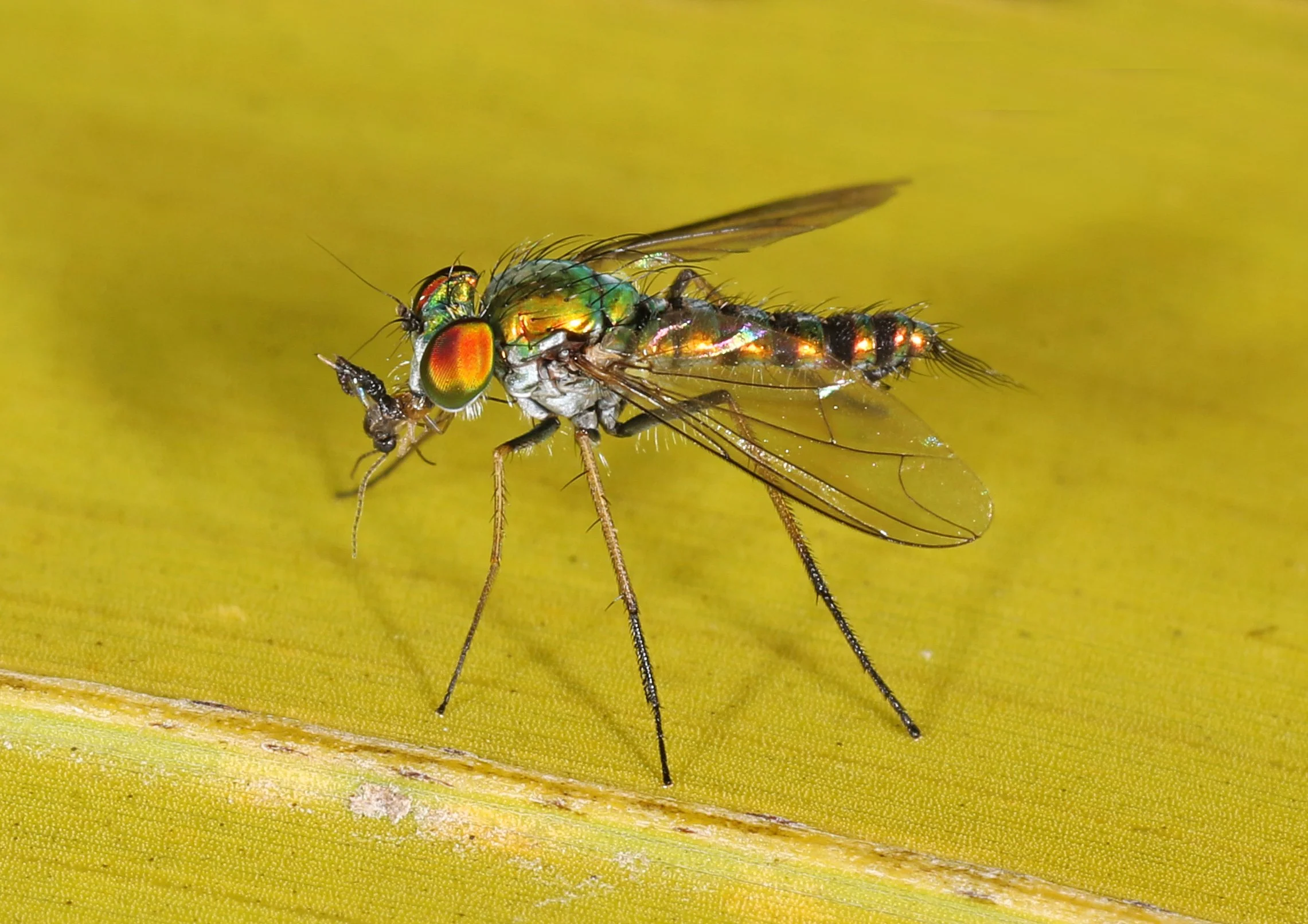
Photo: Long-legged Fly with prey, Judy Gallagher
Judy Gallagher
October 2025
When I was growing up, my mother cautioned me to never let flies touch my food because they ate poop and their feet were likely covered in poop. I assumed that all flies ate feces, and I guess it's not surprising that I grew up disliking them.
Dance Fly with sponging mouthparts. I don't know what substance it is sponging off my fingernail. Judy Gallagher
To understand what adult flies can eat, it is helpful to know about their mouthparts. Some adult flies have piercing-sucking mouthparts, while others have sponging mouthparts. In either case, food must be liquid or very finely grained in order to be sucked or sponged up. If a fly lands on or preys on solid food, it can regurgitate a drop containing digestive enzymes, which dissolves the food so that it can be eaten by the fly.
Golden Dung Fly with fly prey, Judy Gallagher
One would think that Dung Flies would eat dung. Larvae of some species do, but the adults mostly eat other insects, especially other flies, injecting them with digestive enzymes to liquefy them, and occasionally eating dung or nectar to get extra nutrition.
There is another fly family, Lesser Dung Flies, whose larvae also feed on dung and rotting seaweed. The larvae feed on other things too, as suggested by an alternate name, Lesser Corpse Fly. I was unable to find studies detailing what the adult flies eat.
At least three different species of Blow Flies on dead catfish, Judy Gallagher
Adult Blow Flies like Bluebottle and Greenbottle Flies sometimes eat dung. They also dine on liquids from rotting garbage or carrion. It's easy to be disgusted by these flies' eating habits, but the flies play an important role in the ecosystem. They consume rotting organic matter and poop, which recycles nutrients back into the environment. They also help prevent the accumulation of rotting vegetation, dead bodies and waste.
Eastern Treehole Mosquito showing signs of a recent blood meal, Judy Gallagher
As I'm sure you're all aware, some adult flies, especially mosquitoes, drink blood. In most cases, only the female bites, and she needs the proteins in blood to develop her eggs. But there are a few species, including the Stable Fly, where both males and females feed on blood. Scientists are studying anticoagulants secreted by blood-feeding flies, looking for medical applications in preventing blood clots, so some human good may come out of this annoying feeding strategy.
Elephant Mosquito male feeding on nectar, Judy Gallagher
Male mosquitoes mostly feed on nectar, and don't feed on blood. But a recent study on male mosquitoes preserved in amber suggests that male mosquitoes also may have fed on blood in the distant past. Hover Flies and many other adult flies feed on nectar, and often pollinate flowers while they're looking for a meal. Fruit Flies love the yeast and bacteria in overripe or fermenting fruits, and also feed on decaying vegetables and other sugary waste.
Robber Fly with Eastern Amberwing dragonfly, Judy Gallagher
I previously mentioned the Golden Dung Fly, a predator on other flies. There are several fly families that specialize in eating other invertebrates. The most famous are Robber Flies, who catch their prey in the air. They usually fly back to a perch with their prey, inject digestive enzymes to liquefy it, and eat while perched. This Robber Fly took down an Eastern Amberwing dragonfly, prey that was bigger and heavier than the Robber Fly, and the weight of the prey caused them to crash on the beach at Leesylvania State Park. After a short while, presumably sated, the Robber Fly extricated itself and flew off.
Long-legged Fly with prey, Judy Gallagher
Long-legged Flies also are predators. Some species in this family specialize in mosquito larvae and are useful as a control of pests.
Flies and their food choices play an important role in our environment. It's ironic that I was brought up to think of flies as being dirty, yet without flies, the world would be a much dirtier place. Let's hear it for the flies!
View more of Judy’s articles on A Closer Look: Nature All Around Us (formerly Observations from Meadowood).
A Closer Look: Nature All Around Us, September 2025
Judy Gallagher is an NVBA board member and a regular surveyor of local wildlife who also captures photos of what she sees, in particular the less common species.
Photo: Horse Fly eyes, Judy Gallagher
Judy Gallagher
September 2025
Our eyes determine how we see the world. This is an oversimplification of human vision, but human eyes have a single lens that focuses light onto the retina, which has photoreceptors called rods which help us see in low light and cones that help us see colors. It's easy to assume that other species see things the same way we do, but that is not the case.
Most adult insects have compound eyes, which are made up of many individual lenses called ommatidia that allow them to see a wide field of view and detect movement. The number of individual lenses can vary from 6 in worker ants to more than 25,000 in dragonflies.
Nearctic Carpenter Ants. The worker ants are the ones with the smaller heads. Judy Gallagher
Evolution favors traits that benefit a species in some way. It's possible that visual acuity is not that important to worker ants who stay close to the colony and use other senses like smell and touch.
Russet-tipped Clubtail dragonfly, Judy Gallagher
Dragonflies, on the other hand, need good vision. They have a greater number of light-sensitive proteins in their eyes than we do and likely have great color vision. Their range of view is almost 360 degrees and they can see up to 200 images per second, enabling them to track motion easily. They are aerial predators, catching all their prey in flight. Their excellent vision and flight prowess are responsible for them catching up to 95% of the prey they target.
There are two basic types of compound eyes. Apposition compound eyes produce multiple images, one for each ommatidium. The vision is likely not as sharp as our single-lens eyes, but movement is tracked more easily.
Black Witch Moths, with their light-sensitive superposition eyes shining, Judy Gallagher
Most nocturnal insects have superposition compound eyes, which form a single image. This allows increased light sensitivity, but it's at the expense of resolution.
Many insects can distinguish between polarized light (coming directly from the sun) and unpolarized light. That enables them to detect the sun’s position and use it as an orientation cue even when the sun is obscured by clouds. Many insects can “see” light in the ultraviolet range. But they often can't see red. Bees and butterflies have good color vision, but many insects don't.
Western Honey Bee with pollen on its hairy eyeballs, Judy Gallagher
Speaking of bees, Western Honey Bees have hairy compound eyes, which allows them to capture pollen there when the bee is foraging.
Chinese Mantis, Judy Gallagher
Some insects like the Praying Mantis have good vision. An area of their eye is slightly flattened and the ommatidia in the flattened zone are larger than in the rest of the eye. The flattening allows more ommatidia to receive light from a spot and therefore provides higher resolution.
Horse Fly eyes, Judy Gallagher
Female horse flies are attracted to linearly polarized light when searching for animals to bite. Scientists speculate that this helps them to locate dark host animals in sunlit vegetation because the vegetation and the animal reflect light differently. This suggests that wearing light colored clothing while outside might help you avoid being a horse fly target.
Eastern Hornet Fly showing Ocelli, Judy Gallagher
Most flying insects also have simple eyes called ocelli that may help them maintain a balanced course. They are pretty unassuming relative to the compound eyes. But there are a few flying insects that don’t have ocelli; for instance, some horse flies.
Intractable Quaker caterpillar - the little black dots on its head are stemmata. Judy Gallagher
Stemmata are simple eyes found on most larvae of insects that undergo complete metamorphosis. They can detect motion and sometimes polarized light. They are located where the compound eyes will be when the larva transforms into the adult form.
Antlion, showing its amazing eyes, Judy Gallagher
My favorite insect eyes are on members of the Neuroptera order. Adult lacewings, ant lions and mantidflies have mesmerizing eyes. But I couldn't find any research that detailed why. This may be a topic for a future article!
View more of Judy’s articles on A Closer Look: Nature All Around Us (formerly Observations from Meadowood).
A Closer Look: Nature All Around Us, July-August 2025
Judy Gallagher is an NVBA board member and a regular surveyor of local wildlife who also captures photos of what she sees, in particular the less common species.
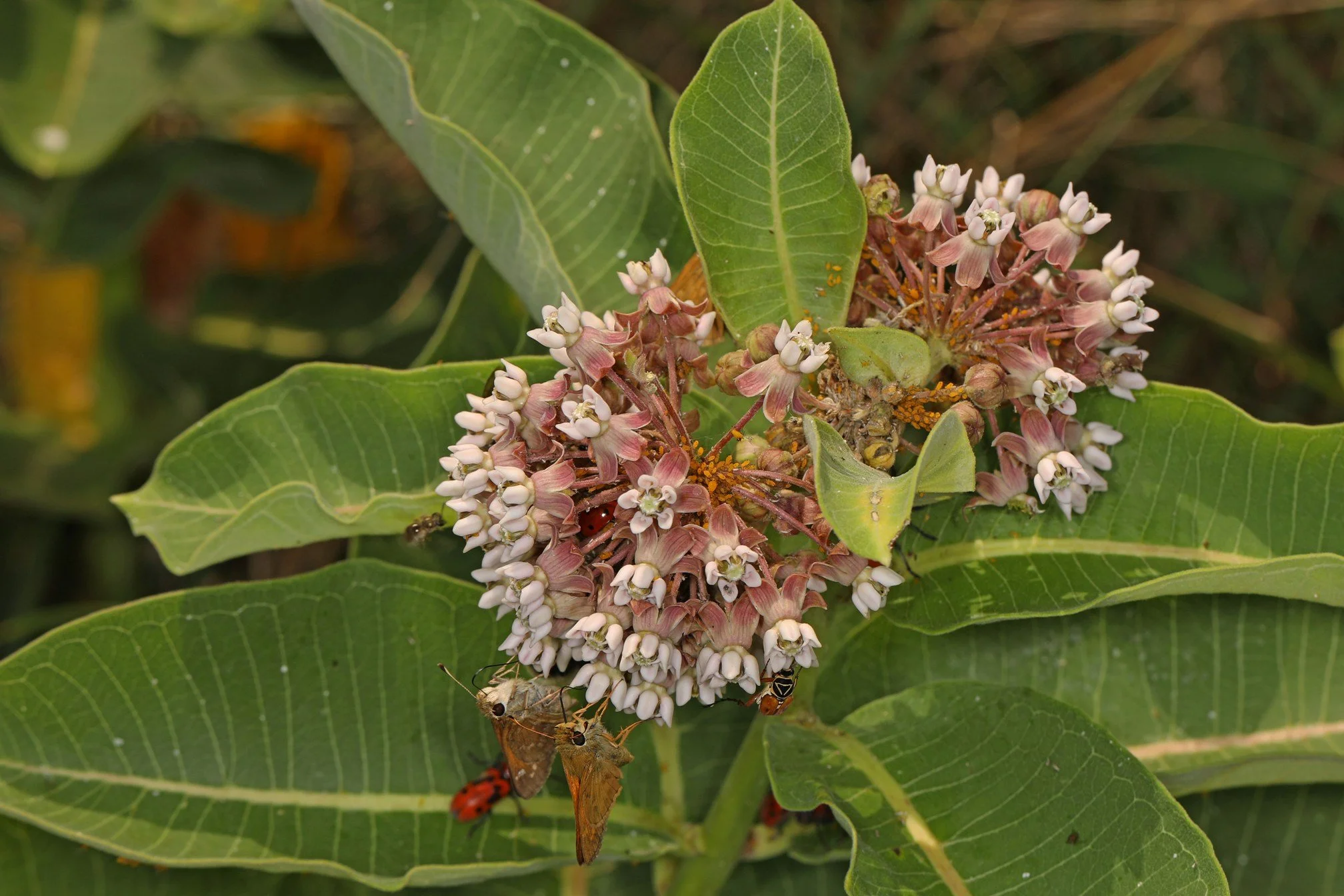
Photo: Common Milkweed with multiple insects on flowers, Judy Gallagher
Judy Gallagher
July-August 2025
I am fascinated by the concept that plants and insects have co-evolved. Many plants rely on insects to pollinate them and disperse their seeds, and most insects rely on plants for food, either directly, or indirectly by eating other insects that have eaten plants. But it isn't in the plant's best interest to have all its vegetation eaten, and plants have evolved strategies to ensure that they survive the hordes of hungry insects.
Common Milkweed with multiple insects on flowers, including Sachem Skippers, Oleander Aphids, Delta Flower Scarab Beetle, Small Carpenter Bee and Seven-spotted Lady Beetle , Judy Gallagher
Members of the Milkweed family produce chemicals called cardenolides which are toxic to most invertebrates, thereby preventing them from eating Milkweed's foliage. But a few insects, including the Monarch butterfly caterpillar, Small and Large Milkweed Bugs, Milkweed Longhorn Beetles, Milkweed Stem Weevil, Milkweed Tussock Moth caterpillars, three aphid species, a leaf-mining fly and the Swamp Milkweed Beetle have developed a tolerance to these chemicals. Some of these insects eat the leaves, at least one eats the roots, and Milkweed Bugs eat the seeds. The ingested cardenolides then protect most of these insects from predation by birds and other vertebrates. Milkweed's toxins aren't found in the flowers, so most insects can dine on nectar and pollinate the plants without being affected.
Monarch caterpillars, Judy Gallagher
Although the insects mentioned above can eat Milkweed, Milkweed still has some defense against them. The undersides of Milkweed leaves are hairy, and these inedible hairs make it challenging for insects like newly hatched Monarch or Milkweed Tussock Moth caterpillars to access edible leaf tissue. The caterpillar must remove the hairs from an area of leaf before biting into the leaf, and many new caterpillars die of dehydration before they have removed enough hairs to get to the edible part of the leaf.
Milkweed Stem Weevil with mouthparts clogged with latex, Judy Gallagher
Up to 60% of the caterpillars that get this far die after their first bite of Milkweed, which has another defense mechanism of gummy white latex. If the latex isn’t removed quickly, it will seal an insect's mouth closed, preventing further feeding. Milkweed tolerant insects compensate for that by chewing through small sap-carrying veins, forming a trench around an area of leaf tissue. This cuts off the flow of sap into that part of the leaf, and the insect can eat without encountering latex.
Red Milkweed Beetle adult with latex on its head. Fortunately for it, the latex is not clogging its mouthparts. The beetle's bright color advertises that it is toxic. Judy Gallagher
Many Milkweed-tolerant insects are brightly colored. This is called aposematic coloring, and it advertises to predators like birds that the insect is unpalatable. Red Milkweed Beetle larvae burrow into the soil and feed on milkweed roots. Like the leaves, milkweed roots have toxic cardenolides; however, unlike the leaves, they aren’t protected by latex. But they do have another defense. When attacked, milkweed roots release volatile chemical compounds that attract soil-dwelling non-segmented worms called nematodes, which then prey upon the beetle larvae. Red Milkweed Beetle adults feed on Milkweed leaves and flowers.
Milkweed Leaf Beetle, Judy Gallagher
The Milkweed Leaf Beetle is sometimes found on Common Milkweed but more commonly on Swamp Milkweed. It can also process Milkweed’s toxic cardenolides but does not keep the toxins in its body. It is somewhat protected from predation by its warning coloration which resembles that of insects that are toxic.
Small Milkweed Bug eating another Small Milkweed Bug, Judy Gallagher
Large and Small Milkweed Bugs feed on Milkweed seeds, inserting their long proboscises into the seeds, injecting enzymes to liquefy the seeds' contents, and then sucking out the juice. The seeds have more cardenolides than the leaves, and both Milkweed Bugs sequester them and advertise their unpalatability with bright colors. Small Milkweed Bugs aren't as picky about their food as some other Milkweed-dependent insects. When Milkweed is scarce, they can also feed on Honey Bees, Monarch caterpillars and pupae, Large Milkweed Bugs, Dogbane Beetles, and each other.
Ants tending Aphids on Milkweed, Judy Gallagher
At least three aphid species feed on Milkweed. Some aphids are tended by ants, who like the sugary waste that aphids excrete. In exchange for the sugary waste, called honeydew, the ants protect the aphids from predation. But too many aphids could hurt the Milkweed plant, and it responds by producing more cardenolides. If the aphids' honeydew contains too high a concentration of cardenolides, ants won't eat it and won't protect the aphids. This tends to reduce the aphid population to a level that doesn't harm the Milkweed plant too much.
Nature is so complex! I hope you have a chance to observe insects on Milkweed this season.
View more of Judy’s articles on A Closer Look: Nature All Around Us (formerly Observations from Meadowood).
A Closer Look: Nature All Around Us, June 2025
Judy Gallagher is an NVBA board member and a regular surveyor of local wildlife who also captures photos of what she sees, in particular the less common species.
Photo: Green Mantidfly, Judy Gallagher
Judy Gallagher
June 2025
I went to North Carolina recently, searching for early season dragonflies. We searched for dragonflies by day, but at night we set up a black light to see what other insects we could attract. The highlight was a Pleasing Lacewing, an insect I had only seen once before, and it is the inspiration for this month's column.
Pleasing Lacewings are a family in order Neuroptera, or nerve wings. This is the oldest insect order that undergoes complete metamorphosis. Other members of the order include Antlions, Owlflies, Mantidflies and additional families of Lacewings. Adults in this order have four membranous wings with many veins, and chewing mouthparts. Most Neuropteran larvae are voracious predators. Some adults are also predators, but many feed on nectar or don't feed at all as adults.
Pleasing Lacewing - Nallachius americanus, Judy Gallagher
There are about 70 species in the Pleasing Lacewing family, only one of which occurs in our area. Pleasing Lacewing larvae prey upon beetle larvae that are under bark, and scientists aren't sure what the adults eat.
Golden-eyed Lacewing - Chrysopa oculata (member of Green Lacewing family), Judy Gallagher
There are several other Lacewing families, including Green Lacewings, Brown Lacewings, and Beaded Lacewings. There are at least 1,300 Green Lacewing species in the world, and they are the ones we see most commonly in our area. Male Green Lacewing adults vibrate their abdomens and send a signal out on the plant they are resting on, and females can feel these vibrations and respond. Each Green Lacewing species song is unique. Adult lacewings in subfamily Chrysopinae can detect the sound of bats with auditory organs in the large veins of their front wings. Some species are called Stink Flies because they release a stinky odor when threatened.
Green Lacewing larva with discarded body parts of its prey, Judy Gallagher
I mentioned before that Neuropteran larvae are predators. Some Green Lacewing larvae use discarded body parts of their prey to disguise themselves. Some decorate themselves with lichen, also as a disguise, but other larvae don't bother concealing themselves from predators. Green Lacewing larvae are particularly effective predators of aphids, and are used as a biological control. They're sometimes referred to as Aphid Lions or Aphid Wolves.
Lacewing larva preying on aphids, Judy Gallagher
Brown Lacewing larvae and adults also eat aphids. Confusingly, not all adults of the Brown Lacewing family are brown. Some are green, and some adult Green Lacewings are brown. This presents a challenge when I try to identify lacewings to species.
Antlion - Brachynemurus abdominalis, Judy Gallagher
Antlion larvae are, as the name suggests, predators of ants. But they're not too picky about prey and will eat almost anything. Some species build funnel-shaped pit traps in the ground. The Antlion larva, also known as a Doodlebug, settles at the bottom of the trap with its jaws projecting upwards. Prey that slips into the trap goes right into the Doodlebug's mouth. The arrival of food is unpredictable, and Antlion larvae have slow metabolisms so that they can survive when prey is unavailable. Adult Antlions are nocturnal, and they don't live very long.
Green Mantidfly - Zeugomantispa minuta, Judy Gallagher
My favorite members of order Neuroptera are the Mantidflies, which look like a cross between a Lacewing and a Praying Mantis. Despite their resemblance to Praying Mantises, they aren't closely related. The larva of many Mantidfly species are specialized predators of spider eggs. They find and either penetrate egg sacs, or hitch a ride on an adult spider. Adults prey on small moths and other insects. Green Mantidfly larvae penetrate spider egg sacs, chewing through the silk casing with their specialized jaws.
Say's Mantidfly - Dicromantispa sayi, Judy Gallagher
Mantidfly species that can't chew their way inside spider egg sacs climb onto a female spider and wait until she lays her eggs. The larva gets wrapped up with the eggs in the egg sac. If the Mantidfly larva climbs onto a male spider, it switches to the female while they are mating, or, even better, when the male spider is being eaten by the female spider. There also are some Mantidfly species larvae that prey on beetle larvae, bee or wasp larvae and caterpillars.
I am fascinated by the way species interact with their environment. I hope you get to see some Neuropterans interacting this summer.
View more of Judy’s articles on A Closer Look: Nature All Around Us (formerly Observations from Meadowood).
A Closer Look: Nature All Around Us, May 2025
Judy Gallagher is an NVBA board member and a regular surveyor of local wildlife who also captures photos of what she sees, in particular the less common species.
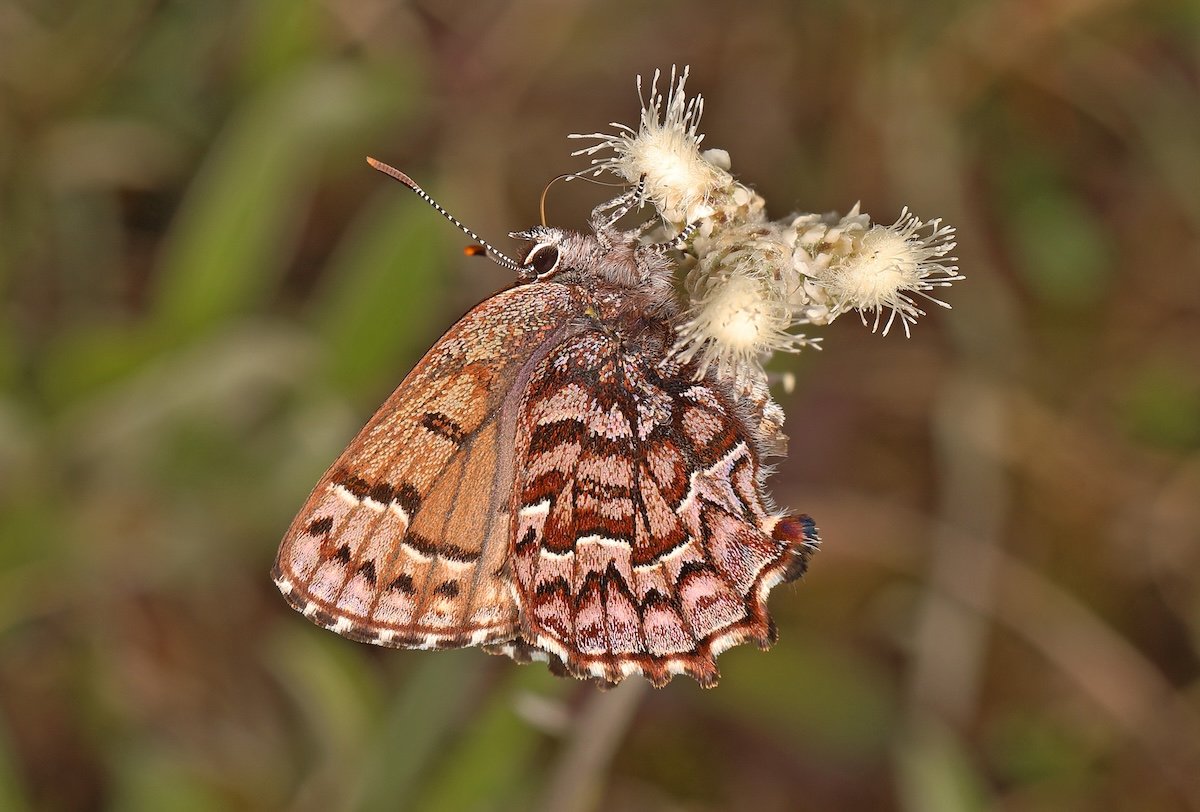
Photo: Eastern Pine Elfin, Judy Gallagher
Judy Gallagher
May 2025
I look forward to spring's arrival each year, and particularly to the start of butterfly season. Elfins are among the first butterflies to emerge each spring. They are small with about a 1-inch wingspan, are furry looking, and have brown, gray and black markings. They look drab unless you look at them really closely. Elfins are part of a larger butterfly group called "hairstreaks," so named because of the fine, hair-like marking extending across the under surface of the hind wings. Elfins generally don't fly as fast as other butterflies, and they only have one brood, so you won't see them later in the year.
Eastern Pine Elfin, beautiful in its muted colors, Judy Gallagher
When not visiting flowers or moist soil, Eastern Pine Elfin males rest on pine foliage to await females. They are the only butterflies that use pine as a host plant. Early instar caterpillars eat pine needle sheaths and are the same reddish-brown color as the sheaths. Later instar caterpillars are green to match the pine needles that they feed on. The pupae overwinter in leaf litter beneath pine trees.
Eastern Pine Elfin showing its colorful scales, Judy Gallagher
Like other elfins, it looks brown and uninteresting until viewed closely. But look intently at its scales - there are reds, blues and greens in there, and the whole wing looks like it's gently washed with pink. This is a really hard butterfly to see intentionally. But examine flowers near pine woods, and you may be fortunate enough to see one.
Frosted Elfin, Judy Gallagher
Frosted Elfins are considered imperiled in Virginia, and we've only seen one once in our wildlife survey circle. Caterpillars feed on lupine and wild indigo flowers and developing seed pods, which are most common in habitats that are regularly burned, not a common environment in our area. The loose cocoons are found in the leaf litter at the base of the plants.
Henry's Elfin, Judy Gallagher
Henry's Elfin tends to be found in woods. There are at least six host plants for Henry's Elfin caterpillars, with American Holly being the preferred host species in our area. Henry's Elfins in the Piedmont feast on redbud. In other areas, caterpillars eat Persimmon, coastal holly species, blueberries and huckleberries and Maple-leaf Viburnum.
Henry's Elfin showing greenish color, Judy Gallagher
Henry's Elfins found near the northern edge of their range tend to be darker than southern individuals, and coastal Henry's Elfins often have strong green highlights. Males frequently perch during daylight hours, often just beyond the reach of my camera lens. The young caterpillars feed on buds (holly or redbud in our area) and young leaves. They pupate in about a month and overwinter in leaf litter.
While Henry's Elfins are pretty common, they aren't seen very often, partly because they are small and brown, and partly because they blend in well in the woods they frequent.
Other elfins found in Virginia are the Hoary Elfin and Brown Elfin, but they aren't common in our area.
Henry's Elfin soaking up the sun, Judy Gallagher
Macro photography of elfins is challenging. They are small and fly erratically, and they always seem to perch at an angle where I can't get the butterfly all in focus. As it turns out, there is a reason for this. These early season butterflies align themselves to soak up as much of the sun's rays as possible, which is why they are so rarely in a good position for me to take their picture.
Henry's Elfin with hairy eyeballs, Judy Gallagher
I was astonished when I took this picture and discovered that Henry's Elfin has hairy eyeballs. According to a study at Harvard University, several insect species have ocular hairs evenly spaced between the individual units of their compound eyes. Studies with wind tunnels show that the ocular hairs reduce airflow at the eye's surface and also reduce particle deposition without significantly reducing vision, much like our eyelashes protect our eyes. Nature never fails to delight me!
View more of Judy’s articles on A Closer Look: Nature All Around Us (formerly Observations from Meadowood).
A Closer Look: Nature All Around Us, April 2025
Judy Gallagher is an NVBA board member and a regular surveyor of local wildlife who also captures photos of what she sees, in particular the less common species.
Photo: Humped Beewolf, Judy Gallagher
Judy Gallagher
April 2025
While researching something recently, I read that bees were descended from Crabronid or Square-headed Wasps, and I thought that the wasps would be an interesting topic for this column.
As you might have guessed, Square-headed Wasps are named for their large and square heads. They are solitary hunting wasps, and their prey includes aphids, bees, beetles, butterflies and moths, cicadas, cockroaches, crickets, flies, grasshoppers, hoppers, mantids, and spiders. Several species are kleptoparasitic, stealing prey captured by other wasps. The prey serves as live food for the wasp's larvae, and the adults mostly feed on nectar. There are more than 60 Square-headed Wasp species found in Virginia.
Eastern Cicada Killer with Cicada, Judy Gallagher
With a length of almost 2 inches, the Eastern Cicada Killer is one of our largest local wasps. As the name suggests, the female Cicada Killer catches cicadas, usually in flight, and stings them to keep them immobile. She digs a nest in the ground with 9 or 10 chambers, and provisions each chamber with one or more paralyzed cicadas. She then lays an egg on the cicadas. Male eggs get one cicada, but female eggs require two or more. Several females may use the same burrow, but they will each provision their own cells.
Velvet Ants or Mutillid Wasp females sometimes lay eggs in Cicada Killer nests. The Cicada Killer larva eats its cicada and grows and when it pupates, the Velvet Ant larva eats the Cicada Killer pupa.
Horse Guard Wasp, Judy Gallagher
The Horse Guard Wasp is slightly smaller than the Eastern Cicada Killer, but it's still a big wasp. Its prey is horseflies. Female wasps fly around horses, often flying up and down the horses' legs, or even flying backward in front of the horse looking for horse flies. When she finds one, she stings it to paralyze it and puts it into burrows for her larvae. She actively hunts while the larva is growing, feeding it new horse flies as necessary, and resealing the nest between visits so that no parasites can enter the nest. The Horse Guard Wasp is an important biological control of horse flies, so if you're riding a horse and see something that looks like a hornet, please leave it alone and let the Horse Guard Wasp do its job.
Organ-pipe Mud Dauber nest, Judy Gallagher
The Organ-pipe Mud Dauber is known for its mud nests that look like organ pipes. The female picks a nest site near a supply of mud. She picks up the mud with her mouthparts, rolls it into a ball, and then flies back to her nest site. She mixes the mud with her saliva, and then smears the mud mixture in long strips as you see above.
Organ-pipe Mud Dauber with spider, Judy Gallagher
She then captures an orbweaving spider, stings it to paralyze it, and fills the nest with between five and twenty spiders. She mates at the nest, lays an egg on the spiders, then seals the nest with mud. While the female is hunting for spiders, the male sometimes guards the nest to prevent the spiders from being stolen or used by other parasitic wasps or flies
Humped Beewolf, Judy Gallagher
The Humped Beewolf preys on bees and wasps, with the most common prey being Sweat Bees. The adult female smears her nest with Streptomyces bacteria from glands in her antennae. The wasp larva uses the bacteria in its cocoon, and that protects it from fungi and bacteria in the soil. When a female wasp emerges from its cocoon, she picks up the bacteria from the cocoon, and the bacteria colonize her antennal glands, starting the cycle anew.
Bicolored Mole Cricket Hunter, Judy Gallagher
The Bicolored Mole Cricket Hunter doesn't build a nest. The female stings a Mole Cricket to temporarily immobilize it, and lays an egg on the Mole Cricket on the thorax between its legs. The wasp first checks to ensure that there aren't any other wasp eggs there, and, if there are, she chews it off before laying her egg. When the wasp larva hatches, it slowly eats the Mole Cricket, even as the Mole Cricket continues to go about its business.
One-toothed Sand Wasp, Judy Gallagher
The One-toothed Sand Wasp feeds its larva scavenged, dead and stolen prey. The only time that prey is alive is if it is stolen.
It is intriguing that vegetarian Bees are a sister group to these magnificent predators. We should be grateful that we have so many Square-headed Wasps to keep other insect lines under control!
View more of Judy’s articles on A Closer Look: Nature All Around Us (formerly Observations from Meadowood).
A Closer Look: Nature All Around Us, March 2025
Judy Gallagher is an NVBA board member and a regular surveyor of local wildlife who also captures photos of what she sees, in particular the less common species.
Photo: Aplos simplex nymph, Judy Gallagher
Judy Gallagher
March 2025
Have you ever seen a small insect with a fiber-optic-like tail? If so, you've probably seen a planthopper nymph.
Aplos simplex nymph (family Issidae), Judy Gallagher
Planthoppers are True Bugs, members of insect order Hemiptera. There are twenty Planthopper families world-wide, with twelve families in North America north of Mexico, so it's quite a diverse group of insects. There are over 900 species reported in the U.S. and Canada. They range in size from 0.08 inches to 4 1/2 inches, but most of our local planthoppers are on the smaller end of the range.
Delphacid Planthopper (family Delphacidae) showing the bulbous antenna projection (the little circle under its eye), Judy Gallagher
There are other kinds of hoppers: leafhoppers; froghoppers and treehoppers. Planthoppers can be distinguished from those by their wing venation and their antennae, which are below the eye and have a bulbous projection. Unlike other hoppers, planthoppers have two face segments that separate their simple eyes or ocelli. Some planthopper species have both full-winged and short-winged adults. The short-winged adults can't fly, but the full-winged adults can, and they often occur in the same population. But they often hop rather than fly, and both adults and nymphs can hop up to 100 times their body length.
Most local planthoppers have between one and three generations a year, but some tropical species can have up to 12 generations in a year. Adults feed on plant juices, but some nymphs feed on fungus or mosses. Some species are host-specific, feeding on one plant or several related plants, while others can feed on many different plants.
Spotted Lanternfly (family Fulgoridae), seen here on an NVBA field trip to Cape May, on board member Tom Wood's shoe, Judy Gallagher
Most local planthoppers don't cause much damage to plants. There are a few crop-damaging planthoppers found outside our area, like the Brown Planthopper, a significant pest of rice. The invasive Spotted Lanternfly is a problem for both fruit and forest industries in our area. It's bigger than most of our local species. It sucks out plant juices, wounding the plant, and excretes a sugary fluid that causes sooty mold, which can further damage the plant. The Spotted Lanternfly is a member of family Fulgoridae. Species in this family have elongated snouts, and folklore has it that these snouts illuminate at night, hence the name Lanternfly.
Some plant-damaging planthoppers can help control invasive plants. The Waterhyacinth Planthopper has been released in Florida to help control Water Hyacinth, which tends to clog waterways.
Big Bluet damselfly eating a Northern Flatid Planthopper (family Flatidae), Judy Gallagher
Planthoppers are a significant source of food for anything higher up on the food chain.
Aplos simplex (family Issidae) nymph (The black thing near the tail is a Pincer Wasp parasitoid), Judy Gallagher
And they are also preyed upon by parasitoids. Pincer Wasps (family Dryinidae) are parasitoids of planthopper and other hopper nymphs, with rates of parasitism of 20% or more, and they are an important biological control of planthoppers.
Aplos elliptica or bullata (family Issidae) parasitized by Planthopper Parasite Moth (the white thing protruding from the rear end of the planthopper), Judy Gallagher
One of the more bizarre parasitoids is a Moth. The Planthopper Parasite Moth is the only local member of a Moth family, Epipyropidae, whose caterpillars are all carnivorous. The adult moth lays its eggs on plants, and the caterpillars find an adult planthopper, attach themselves to it, and feed on the planthopper's bodily fluids.
Two-striped Planthopper nymph (family Acanaloniidae) showing off its waxy tail, Judy Gallagher
You might have been wondering why planthopper nymphs have those fiber-optic tails. The tails are made of wax secreted from abdominal glands, and some tropical planthopper nymphs have tails that are several inches long. The tails can deter predators by either camouflaging the planthopper or acting as a physical barrier against predators and parasites. Planthoppers secrete sugary waste called honeydew that is prone to fungal attacks, and the tails may also help protect the nymphs from the fungus. But a recent study proved another benefit of the tails. As I mentioned before, wingless planthopper nymphs can jump long distances. If the nymph lands in an unfavorable body position, it is susceptible to predation. The tails serve an aerodynamic self-righting function, allowing the nymphs to have a stable, controlled descent. Planthopper nymphs with waxy tails land in a good position 98.5% of the time, while tail-less planthopper nymphs only land in a good position 35.5% of the time.
I hope you find some cool planthoppers this season, but no Spotted Lanternflies!
View more of Judy’s Closer Look (formerly Observations from Meadowood) articles here.
A Closer Look: Nature All Around Us, February 2025
Judy Gallagher is an NVBA board member and a regular surveyor of local wildlife who also captures photos of what she sees, in particular the less common species.
Photo: Juniper Hairstreak on Fleabane, Judy Gallagher
Judy Gallagher
February 2025
I'm looking out my window at freshly fallen snow, trying to appreciate the season. But my thoughts keep wandering to spring, and right now I'm dreaming of butterflies fluttering erratically from flower to flower.
Ocola Skipper with pollen on its face, Judy Gallagher
When a butterfly lands on a flower to drink nectar, pollen sometimes rubs off on the butterfly. The pollen may be transferred as it visits other flowers. We usually think of bees as our key pollinators. But although they lack specialized structures for collecting pollen, butterflies and their moth cousins are also pollinators.
Juniper Hairstreak on Fleabane, with pollen on its abdomen and proboscis, Judy Gallagher
Butterflies like flowers with a landing platform, perhaps a daisy or fleabane, and they gather pollen as they wander around the flower clusters. They may not be as efficient pollinators as bees, but they visit an amazing number of flowers each day. Scientific studies have shown that butterflies like nectar with lots of amino acids, which appears to help them lay more eggs. They like brightly colored flowers, and unlike most bees, butterflies can see red. Many sense odors through chemoreceptors in their antennae, and so can smell sweet floral scents from a distance. Butterflies tend to fly farther than bees, and can potentially pollinate a larger area than bees.
Common Buckeye with Milkweed pollinia stuck to its foot, Judy Gallagher
Milkweed flowers are unusual in that their pollination structures and pollen are hidden inside the flower. The only way an insect can get to the pollen is to accidentally get its foot stuck inside the flower. When it extracts its foot, a mass of pollen grains called a pollinia may be attached, shown here (above and below) on a Common Buckeye.
Common Buckeye with pollinia detail , Judy Gallagher
Here's a closer look, above, at the Common Buckeye's feet. The pollinia are the yellow, elongated structures. Pollination occurs if the butterfly gets its foot with attached pollinia stuck in a different milkweed flower.
Great Spangled Fritillary on Flame Azalea with pollen on its wings, Judy Gallagher
Butterflies are the most important pollinator of Flame Azaleas. The anthers and stigmas of flame azalea flowers are widely separated, and large butterflies like Great Spangled Fritillaries and Eastern Tiger Swallowtails have wings that brush against the flowers, thereby collecting or depositing pollen. Scientists designed experiments to see how effective the butterflies were as Flame Azalea pollinators. When all pollinators were prevented from pollinating, or all pollinators except butterflies were allowed to pollinate, pollination rates were very low. When the butterflies were allowed in, pollination rates were ten times higher.
Eastern Tiger Swallowtail on Tiger Lily, Judy Gallagher
Butterfly wings can also pollinate Tiger Lilies, as this Eastern Tiger Swallowtail is demonstrating above.
Butterflies pollinate some commercial crops. They are the primary pollinators of Macadamia Nut trees in Brazil. They also can pollinate cotton. In a recent study, scientists catalogued the insects that visited cotton flowers. There were 40 bee species, 16 fly species and 18 butterfly species. Bees tended to visit the inner flowers, and flies and butterflies landed on outer flowers. This meant that 50% more flowers were visited than if bees were the only pollinators, and flies and butterflies were responsible for about one third of the pollination.
Butterfly with pollen on its face and eyes, Judy Gallagher
Here's an extreme close-up of a butterfly's head. Note the pollen grains scattered through its scales, and there are even a couple of grains on its eye. Do you know what popular butterfly this is?
I thought about not giving you the answer until next month's column, but leaving you in suspense would be cruel. Plus, I might forget by next month that I had promised to give you the answer. This pollinator is a Monarch.
Spring will be here before long. I hope you can spend quality time appreciating our butterfly pollinators.
View more of Judy’s Closer Look (formerly Observations from Meadowood) articles here.