
A Closer Look: Nature All Around Us, March 2026
Photo: Laphria affinis robber fly with lady beetle prey, Judy Gallagher
Judy Gallagher
March 2026
I once heard robber flies described as the raptors of the insect world. As the name implies, they are flies, and according to iNaturalist, they are called robber flies because of their expert predatory habits. They usually sit in an open area, watch for insects to approach, fly out to catch them and then return to their perch to finish their meal.
Robber flies typically have a long abdomen and spiny legs which aid in prey capture. Some appear to be humpbacked, and many robber flies have mustaches called mystax, which may help protect the head and face when prey tries to fight back. Their wide-spaced compound eyes give an extensive range of view and they have long, pointed proboscises that they use to inject neurotoxins and digestive enzymes into prey. There are approximately 7,000 robber fly species worldwide, with about 1,000 species in North America.
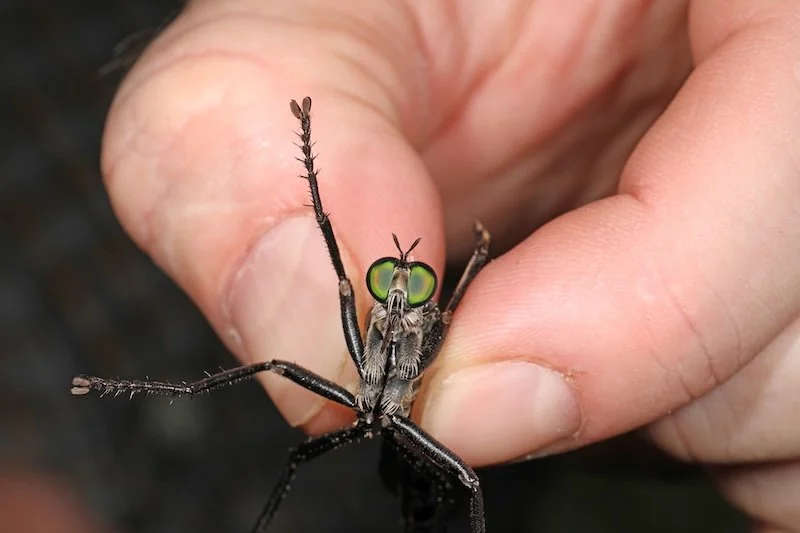
Microstylum morosum, North America's largest robber fly. Photo: Judy Gallagher
Most robber flies are between 1/2 inch to 3/4 inch long, but North America's largest robber fly, Microstylum morosum, can be 2 inches long, and a species in Madagascar is more than 3 inches long!
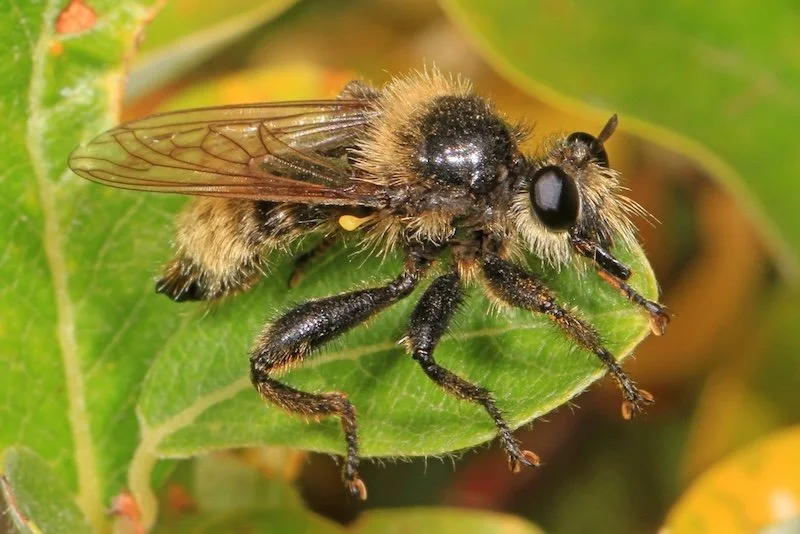
Laphria partitor, a bumble bee mimic. Note its impressive mustache (mystax). Photo: Judy Gallagher
Some robber flies are bee and wasp mimics, with black and yellow striped patterns. They sound like bees and wasps, making loud buzzing sounds as they fly. A number of robber flies in genus Laphria resemble bumble bees, and even have yellow fuzz just like bumble bees.
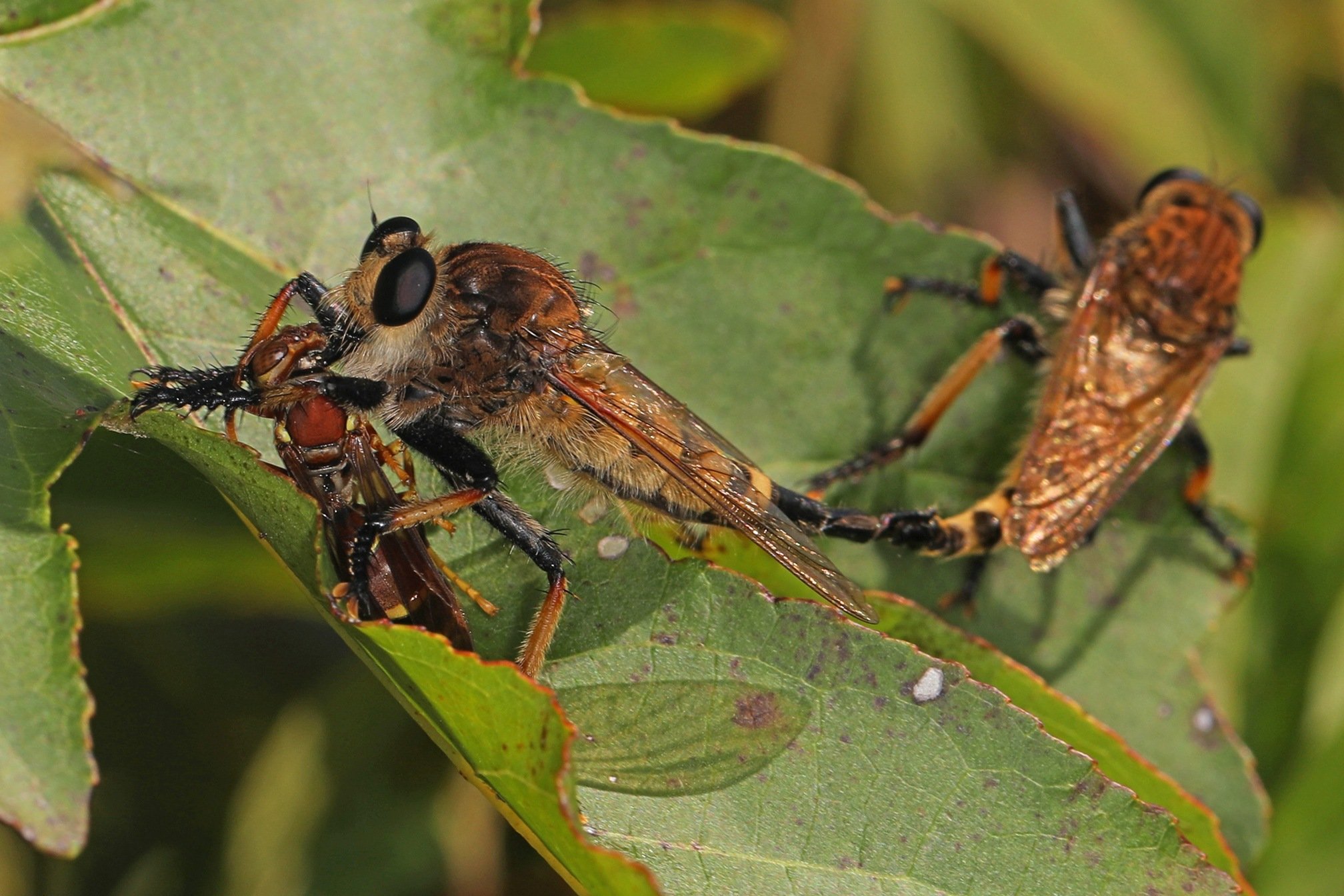
Robber flies mating, while one dines on wasp. Photo: Judy Gallagher
Robber fly males are territorial, chasing away rivals before trying to court the female. Males of some species conduct aerial displays to attract females or offer the female a "nuptial gift" of captured prey. Robber fly females have been known to play dead if they are not interested in the male's advances.
Robber flies that hunt on the ground tend to lay eggs on or in soil, and robber flies that hunt from plants usually lay their eggs in plants. The grub-like larvae live in soil, rotting wood or other decaying materials and, like the adults, are predators.
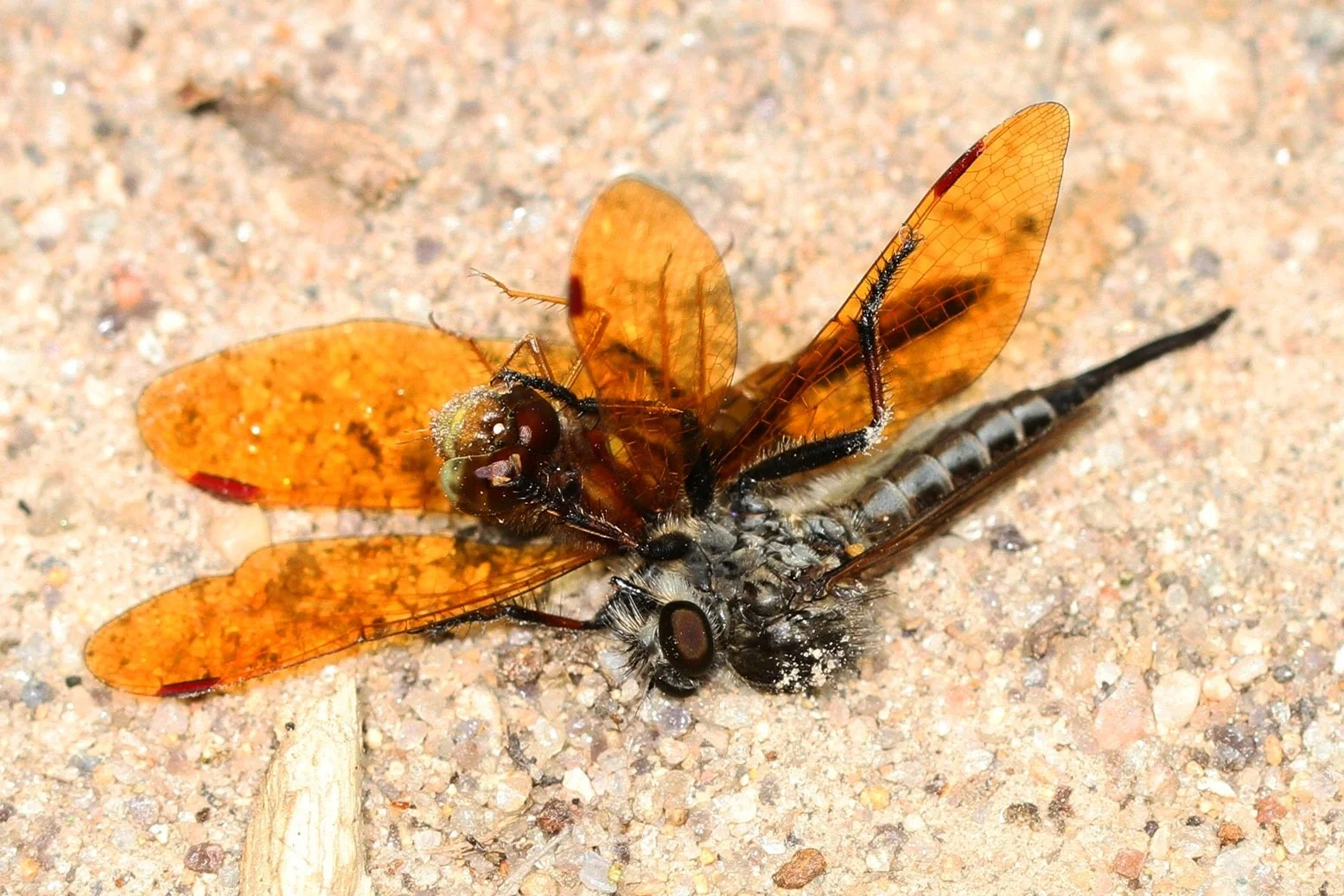
Robber Fly with Eastern Amberwing (dragonfly) meal. Photo: Judy Gallagher
Most adult robber flies attack prey that is smaller than they are, but there are exceptions, like the robber fly that attacked the dragonfly in this picture. The heavier dragonfly caused the pair to crash on the ground. After the robber fly finished its meal, it flew off, presumably to find another meal.
They consume a significant portion of their body weight each day, but the number of insects consumed depends on the weight of each prey item. Some robber flies specialize in prey like grasshoppers, but most are generalists.
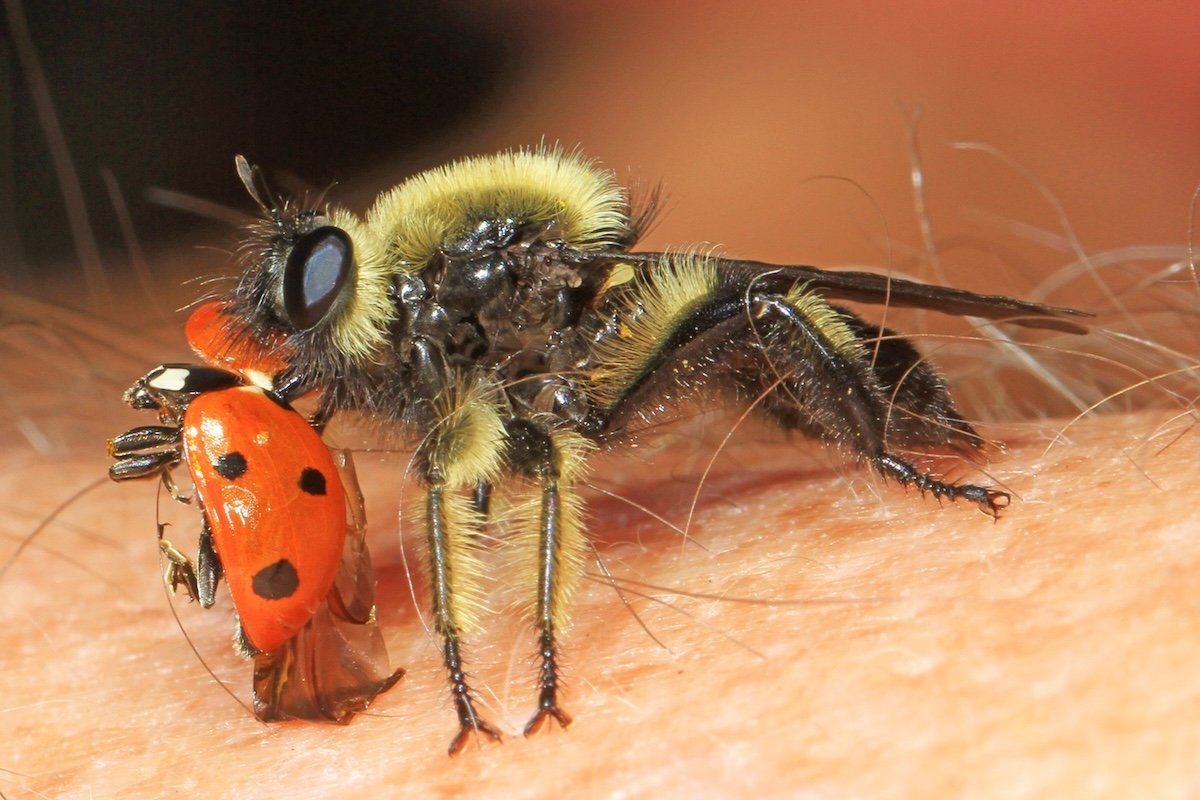
Laphria affinis robber fly with lady beetle prey. Photo: Judy Gallagher
You might wonder if robber flies could be a useful biological control of pest insects. The answer is, "It depends." Yes, they eat pest insects, but they are not always discriminating in their diet, and they eat useful insects like lady beetles too.
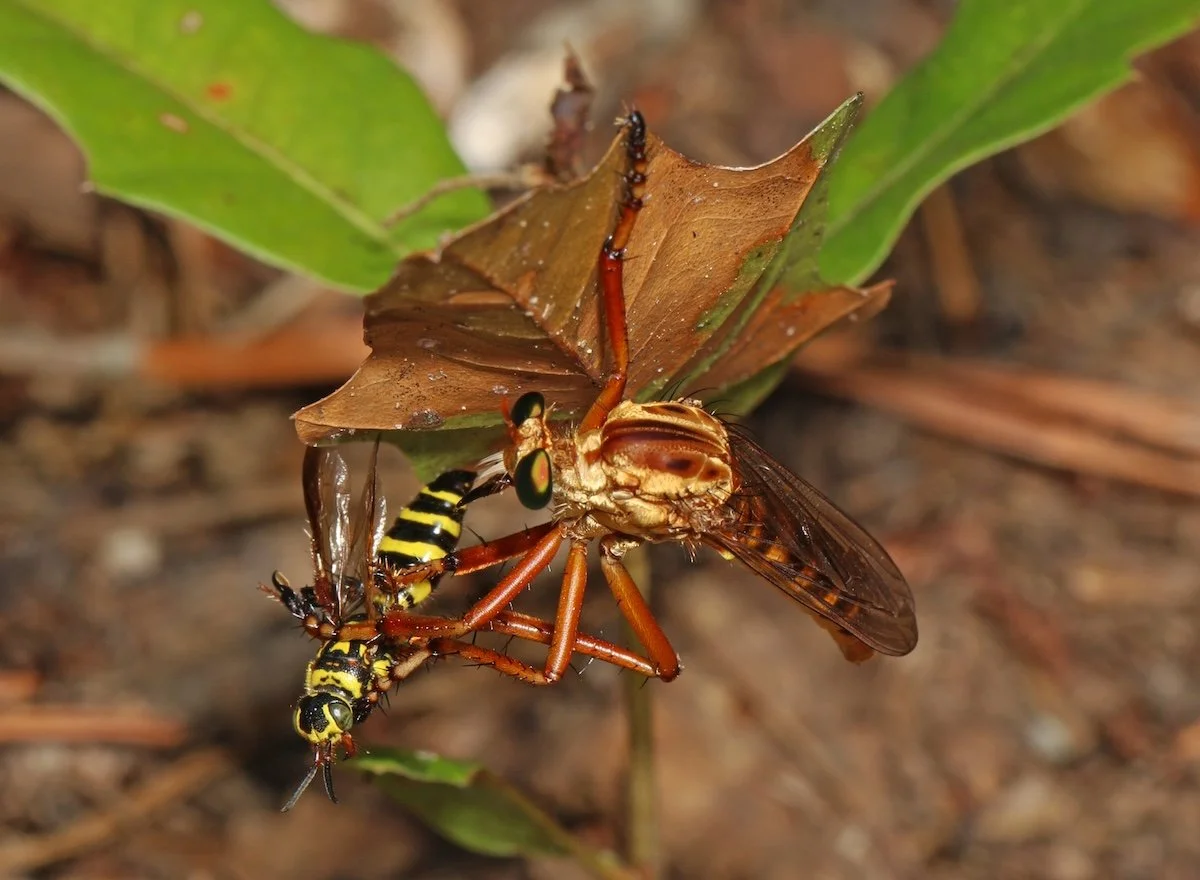
Hanging-thief with wasp prey. Photo: Judy Gallagher
Robber flies in genus Diogmites are known as hanging-thieves because, after capturing prey, they feed by hanging from plant stems or leaves suspended by one or both front legs. The other legs hold and manipulate the prey. Hanging-thieves mostly prey on Hymenoptera (wasps, bees, etc.) and can negatively impact honey bee populations. The female lays eggs in the ground, and her ovipositor has spines that aid in covering up the eggs.
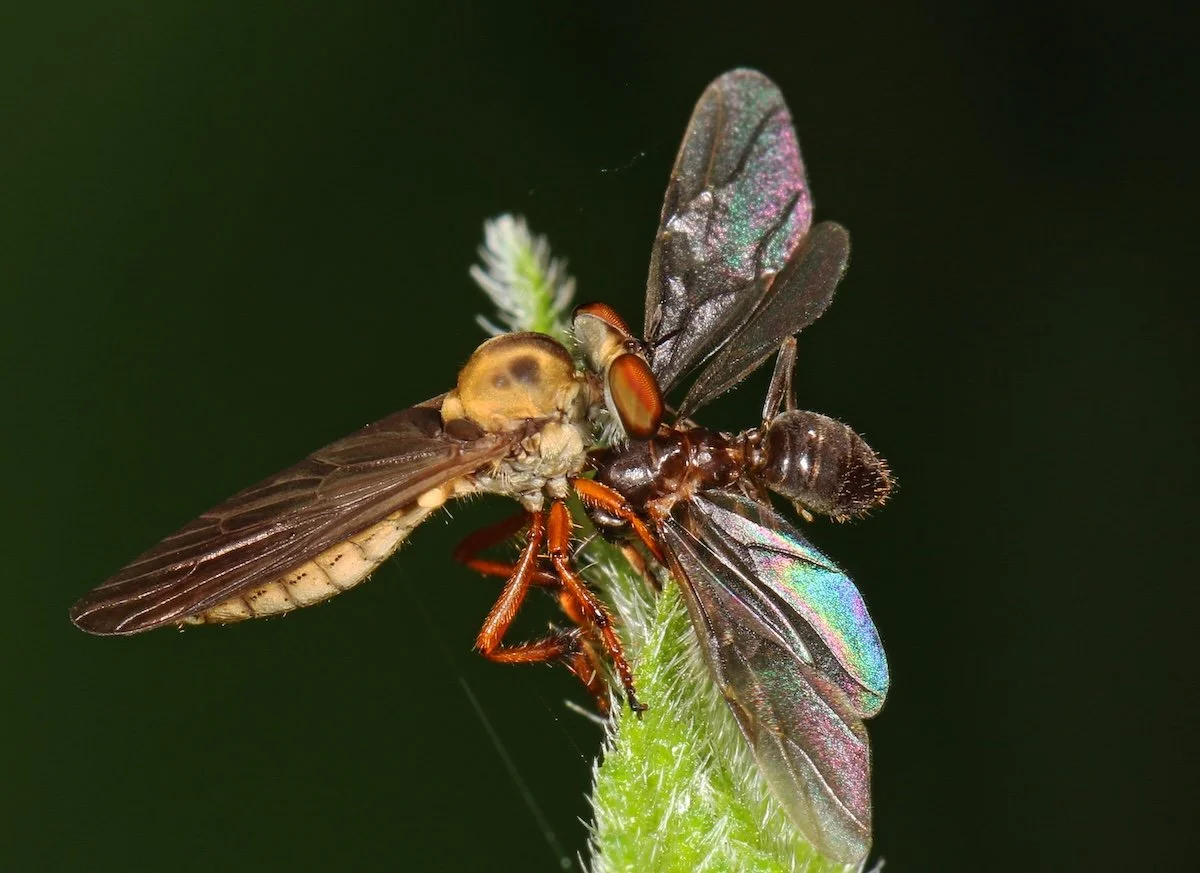
Gnat Ogre with prey. Photo: Judy Gallagher
As the name suggests, Gnat Ogres mostly prey on gnats, although the one pictured here has a tiny wasp instead. Most gnat ogres are small, between 1/8 and 3/8 inches long, and perch on vegetation tips to hunt.
Although robber flies are known for their impressive hunting skills, they can also be prey. Robber fly predators include birds, lizards, frogs, bats, jumping spiders, dragonflies and parasitic wasps.
When spring finally arrives, I hope you can observe one of these magnificent hunters in action.
View more of Judy’s articles on A Closer Look: Nature All Around Us (formerly Observations from Meadowood).