
Wildlife Sanctuary Almanac: Love Our Mighty Oaks
Photo: Swamp Chestnut Oak, Betsy Martin
Eileen Ellsworth
Native species of oak trees are abundant across our region. Northern Red Oaks and White Oaks in particular are among our most dominant keystone species, contributing to the ecosystem in ways that are mighty indeed.
Doug Tallamy has written and spoken extensively about oaks. Like all large canopy trees, they scrub air-borne pollutants, capture carbon dioxide, provide oxygen and shade, manage stormwater runoff and produce life-supporting leaf litter. But oaks are noteworthy in their ability to nurture insects – a form of life that E. O. Wilson called “the little things that run the world.” Without caterpillars, there would be no terrestrial food webs. Pause for a moment to take that in.
Tallamy estimates that oak trees are hosts for hundreds if not thousands of species of caterpillars. A full third of our native moths depend on oaks to reproduce. He estimates that only 14% of native plants produce 90% of caterpillar food, which is the reason he considers oak trees to be “keystone” to biodiversity. Caterpillars eat the oak leaves, and birds feed the caterpillars to their nestlings – many thousands of them during just one breeding season. If you want to attract a wider diversity of nesting birds on your property, plant an oak.
Oak trees provide food for wildlife in winter as well. Many small birds such as chickadees, titmice, and Golden-crowned Kinglets can be seen flitting through the canopy on the coldest days of the year. What are they doing? To find out, Bernd Heinrich, a research scientist and biology professor at the University of Vermont, examined the crops of Golden-crowned Kinglets in Maine, in January. He discovered they were filled with geometrid moth caterpillars, commonly known as inchworms. Remarkably, these caterpillars produce a kind of antifreeze that enables them to survive freezing cold temperatures. Even in the dead of winter, our native oaks support caterpillars that drive the food web.
Oaks also drop fat- and protein-rich acorns, of course, and many tons of them during a “mast year.” A single oak can produce up to 3 million acorns during its lifetime. Squirrels, deer, and chipmunks all eat acorns, as do many species of birds such as Wild Turkeys, Red-headed Woodpeckers, Red-bellied Woodpeckers, flickers, titmice, towhees, Wood Ducks, and Blue Jays.
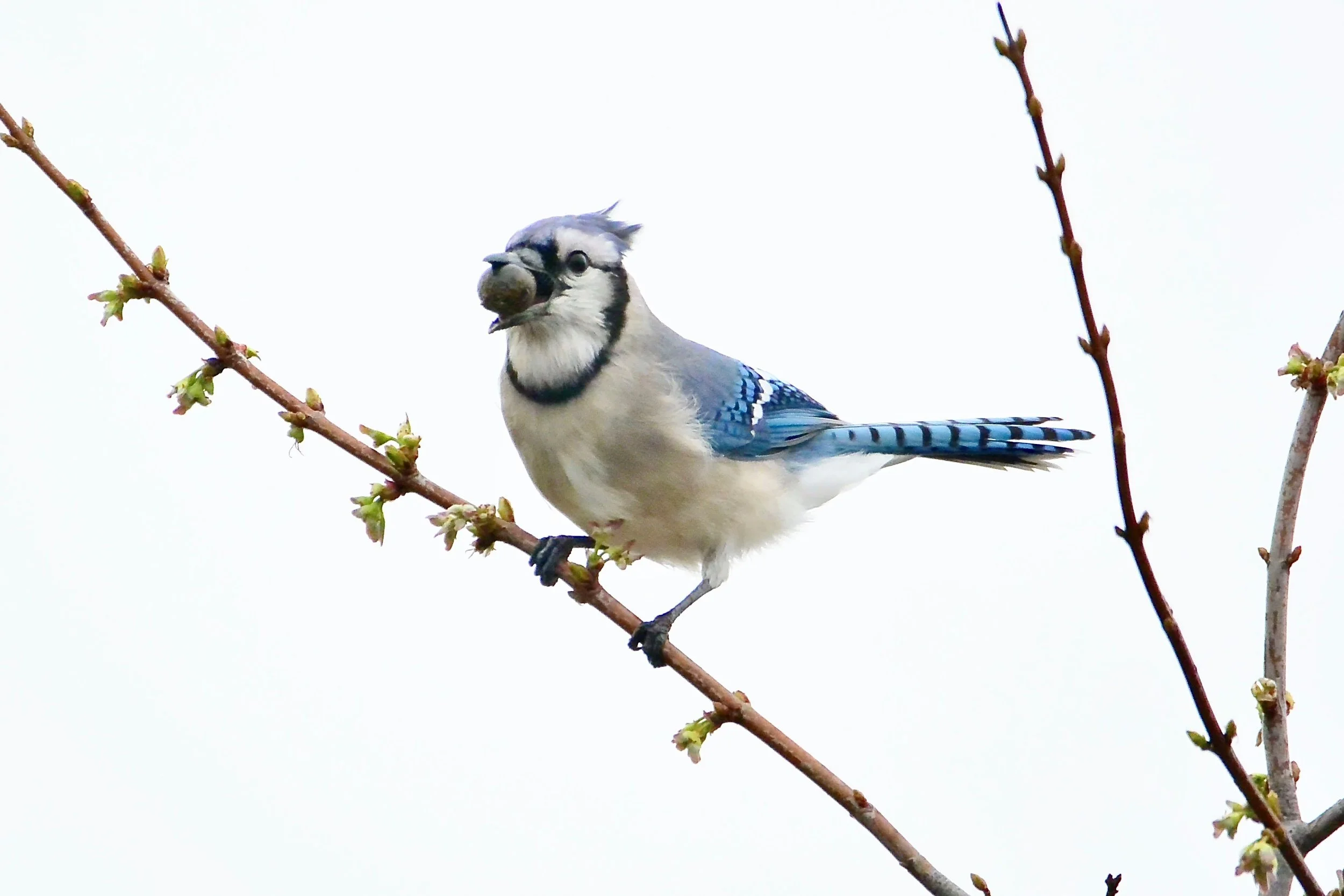
Blue Jay with acorn, Seth Honig
Jays of all kinds enjoy a particularly ancient and beneficial relationship with acorns. They cache them. A single jay will fly up to a mile to bury an estimated 4,500 acorns each fall, only remembering where 1 in 4 are buried. They are therefore planting 3,300 oaks a year, turning oak trees into the “fastest moving” deciduous trees in the world.
The decline of our older oaks that has been going on for decades came to a head a few years ago. (See Chamberlin, Oak Decline in Virginia.) The early wet weather in 2018 and 2019, followed by summer heat and drought and winters with unusual temperature swings, stressed many tree species, but especially oaks. The combination opened the door to ambrosia beetles and other pests. Many mature oak trees died across the region. As our older oaks die off, it is important that we actively replace them with young ones.
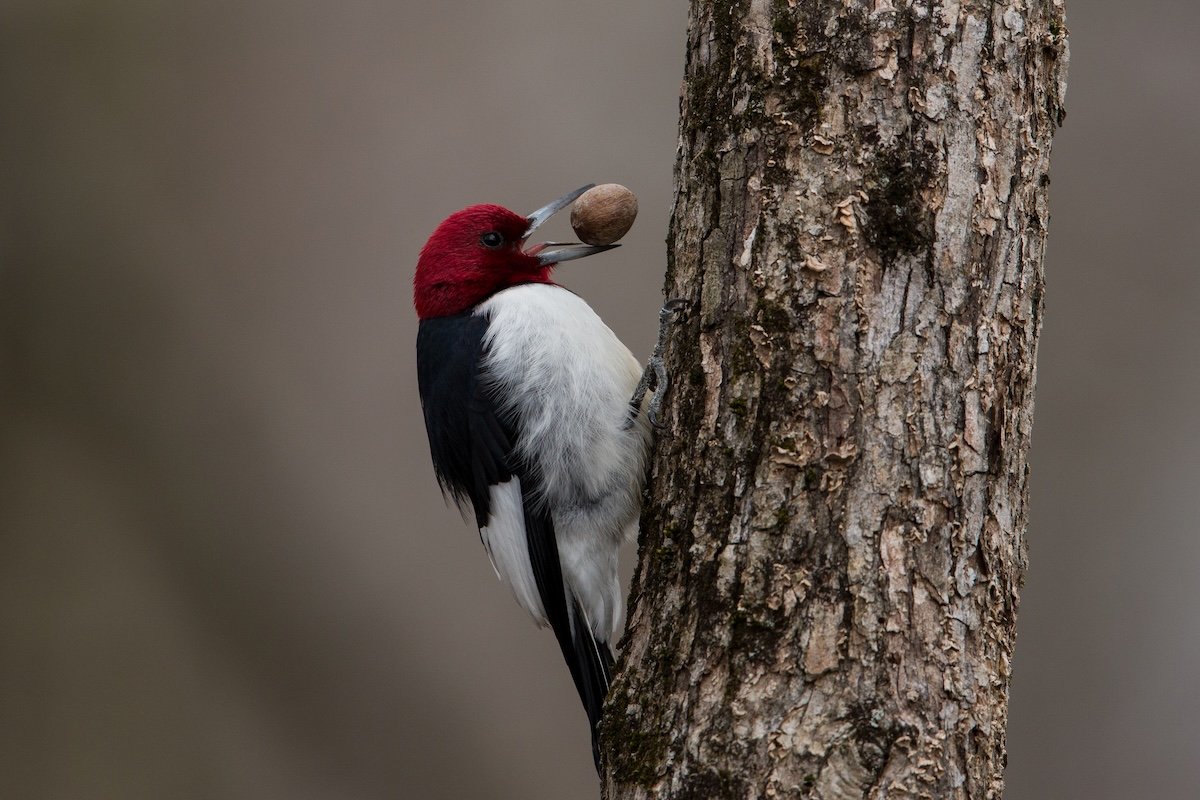
Red-headed Woodpecker, Gary Robinette/Audubon Photography Awards
The single best way to turn your yard into a sanctuary for wildlife is to plant an oak, making sure to pick a spot where it can grow unimpeded by powerlines above ground and waterlines and other infrastructure below ground. Based on research by Tallamy and his colleagues, we tell clients that 70% or more of the plant material in a yard should be native for the yard to support wildlife effectively. A single oak can meet that standard as it grows.
When you plant a single oak tree, or spare an existing one, you will help capture carbon, protect water quality, protect insect populations, and support birds and other wildlife. You can use the Plant NOVA Natives plant finder app to find an oak (or other native tree or plant) suitable for the conditions in your yard.
Catch up on past Wildlife Sanctuary Almanac articles here.