
NVBA NEWS BLOG
Welcome to the blog for Northern Virginia Bird Alliance, a wealth of resources about northern Virginia birds, wildlife, habitat conservation and restoration, native plants, wildlife-friendly gardening, advocacy and more.

Letter to Our Members
As each November rolls around, I try to review the past year in order to acknowledge and honor the many things for which I am thankful.
Photo: Bald Eagle, Matt Felperin
Libby Lyons
As each November rolls around, I try to review the past year in order to acknowledge and honor the many things for which I am thankful.
I often have said that volunteers are the lifeblood of NVBA. Beyond that, I have learned over the last four years just how fortunate NVBA is to be based in an area with such a wealth of highly educated, capable, articulate and dedicated federal employees, along with the many contractors who support their work and our government’s programs.
Therefore, I take this opportunity to send out a huge THANK YOU to all those federal workers for:
All the important work you do and have been doing in positions related to science, conservation and environmental regulation throughout the federal government--Your work protecting our wildlife, our natural places and our quality of life is important and greatly valued.
Devoting your time as a volunteer, whether you are still working, in retirement (voluntary or otherwise) or in furloughed status--NVBA greatly appreciates the expertise and passion you bring to our work bolstering environmental conservation.
Joining NVBA activities as active and joyful participants in bird walks, invasive pulls, classes and much more. We celebrate your participation in these important community events.
If you are not yet volunteering with NVBA, let me add that we welcome federal workers and all others, young and old, as volunteers in a wide range of roles. We have just rolled out an updated volunteer webpage that makes it easier for you to find ways to help.
Let me also encourage all of you to participate in any of our upcoming activities. I find it uplifting and restorative, especially these days, to be on a bird walk, helping with a boots-on-the-ground conservation project or learning about nature in an in-person or online NVBA class. So, if you need more of those kinds of positive and hope-affirming experiences, please join us. Here is a link to our calendar.
And finally, I am eagerly looking ahead to next year. We have planned many activities that are exciting and designed to have a positive impact, activities that will serve the needs of our communities and require their support. As our year-end fundraising begins, we ask for your financial support, recognizing that this year not everyone in our community will be able to make their typical financial donation. We hope those more fortunate in our region might extend their generosity to help fill any gaps in our fundraising efforts.
If you have not yet joined NVBA, please consider becoming a member. Your dues and any additional donations will help us continue our activities to serve you and the wildlife in our area. Because NVBA is an independent chapter of the National Audubon Society (NAS), NVBA membership includes membership in NAS. More information on member benefits and becoming a member of NVBA is available on our membership page.

Birds, Belief and Balance: Native Wisdom for Modern Birders
Long before modern birding, native peoples across North America watched, listened, and learned from the birds that shared their homelands. For them, birds were not merely part of the scenery: they were kin, teachers and messengers between worlds.
Photo: Common Loon (Maang), Benjamin Olson/Audubon Photography Awards
Jo Doumbia, NVBA Director and Chair, Diversity and Inclusion
Each November, during Native American Heritage Month, we are reminded that our connection with nature did not begin with field guides or binoculars. Long before modern birding, native peoples across North America watched, listened, and learned from the birds that shared their homelands. For them, birds were not merely part of the scenery: they were kin, teachers and messengers between worlds.
Among the Cherokee, the vulture is said to have shaped the mountains with its mighty wings. To the Lakota, the eagle soars higher than any other creature, carrying prayers and hopes to the Creator. The Anishinaabe call the Common Loon Maang, a spirit guide whose haunting call drifts across northern lakes, linking the seen and unseen worlds. Each of these stories reflects a deep and enduring respect for birds as sacred beings who reveal the patterns of life itself.
For native communities, birds also provided practical guidance. Their migrations marked the rhythm of the seasons, signaling when to plant, harvest, or prepare for winter. Bird calls forecasted weather changes, and nesting behaviors told when the rivers would rise. What we now call traditional ecological knowledge arose from generations of careful observation and reciprocity, a way of learning that listens as much as it teaches.
That same wisdom still speaks to us today. As birders, we, too, are listeners. Every time we pause to identify a song in the trees or note the first flash of migration overhead, we join a continuum of watchfulness that reaches back millennia. But birding can also be an act of gratitude. Planting native trees and flowers, protecting nesting sites and learning the indigenous names of local birds are small yet powerful ways to honor the birds and the peoples who have long cared for this land.
Across the continent, indigenous birders and conservation leaders continue that legacy. In Manitoba, the Indigenous Birding Club brings together students, elders and community members to blend traditional teachings with modern science. In the American Southwest, tribal conservation programs restore wetlands vital to migratory birds. These efforts remind us that caring for birds is inseparable from caring for community, language and place.
When we listen carefully to the song of a wren or the cry of a hawk circling above, we hear more than sound: we hear memory. We hear the same voices that guided those who walked this land long before us. Birds connect us, across cultures, across generations and across the thin space between earth and sky.
This November, as we celebrate Native American Heritage Month, may we carry forward that sense of reverence. To watch a bird is to practice attention. To protect a bird is to practice respect. And to listen to a bird is to remember: every feather carries a story, and every story is a path back to balance.

Virginia’s Data Centers and Our Environment
The Commonwealth’s nearly 600 data centers make it one of the largest concentrations in the world. It is estimated that 70% of the world's internet traffic passes through Virginia.
Photo: Loudoun County Data Center, Hugh Kenny/Piedmont Environmental Council
John Barth
The Cloud, which stores our documents and photographs, is not a puff of water vapor floating across the sky but a massive concrete building housing thousands of computer servers. And the chances are good that it is in Virginia. The Commonwealth’s nearly 600 data centers make it one of the largest concentrations in the world. It is estimated that 70% of the world's internet traffic passes through Virginia.
Northern Virginia is the epicenter of that concentration. The area around Herndon and Ashburn – known as Data Center Alley – is home to approximately 260 data centers. They currently consume more than a quarter of the electricity generated in the state. One facility there tops out at 1,000,000 square feet. Many are sited near parks, playgrounds, and residential areas.
The current push to create artificial intelligence (AI) is accelerating the development of additional data centers to manage the numberless searches and calculations it requires. The new computer chips that make those calculations possible use five times the electricity their predecessors needed.
The rapid increase in data centers raises a number of environmental concerns. One among them is noise. Residents who live near data centers report a constant, audible hum from the cooling fans atop the buildings. Of interest to NVBA members is a recent research report from the University of Florida showing that anthropogenic noise creates stress among birds and interferes with breeding cycles, further reducing reproduction rates for a population already in decline. See Yue Liu, Effects of Anthropogenic Noise on Reproduction in an Urban Population of Eastern Bluebirds.
A second concern is water use. We know generally that data centers use significant amounts of water for cooling. But specific, accurate information on their water use is more difficult to secure. Many data center operators consider information about their cooling systems to be proprietary and balk at detailed reporting.
The issue of most pressing immediacy is electricity demand. The rapid expansion of data centers to meet the requirements of AI are pushing the already taxed power grid to its limits. Meta is developing a data center “supercluster” in Louisiana that will use almost twice as much electricity as the entire city of New Orleans. Dominion Energy’s projections of energy demand over the next decade expect residential use to remain stable. However, commercial use, driven by data centers, will increase dramatically. The independent monitor for PJM Interconnection, a regional collaborative to facilitate power sharing in response to peaks in demand across 13 states, including Virginia, recently reported that its members are at capacity.
The voracious appetites of data centers for electric power can only be met by increasing generating capacity. This means that the retirement of coal and methane powered generating plants, scheduled to be phased out to reduce greenhouse gas emissions, will be delayed, and the construction of new generation facilities is inevitable. Because they are the cheaper and quicker option, additional methane fueled plants are likely.
Throughout the current year, electricity costs across the country, including Virginia, have been rising. The costs of the infrastructure to meet data center driven demand – generating plants, transmission lines, substations – will be passed on to all customers in the form of higher utility bills.
NVBA is represented in the Virginia Data Center Reform Coalition, a group of environmental organizations in northern Virginia seeking to increase state oversight of data centers, require regular reporting to public officials and the public on electricity and water usage and revise rate structures so that the data centers responsible for the soaring demand for electricity and not residential customers pay the lion's share of the infrastructure costs to meet that demand.

A Winter Resident Returns: The Yellow-bellied Sapsucker
The return of Yellow-bellied Sapsuckers in northern Virginia coincides with the re-appearance of Halloween decorations in mid-October, and, like the trick-or-treaters who arrive October 31, they seek sweets.
Photo: Yellow-bellied Sapsucker, Michael Fogleman/Audubon Photography Awards
Summer Delehanty
With fall come shorter days and cooler weather, a welcome respite from the sweltering Virginia heat. As autumn foliage spreads south, so do waves of birds–first, some migrating shorebirds and warblers, passing through on the way to the tropics, followed by our winter residents.
The return of the Yellow-bellied Sapsuckers (Sphyrapicus varius) in northern Virginia coincides with the re-appearance of Halloween decorations in mid-October, and, like the trick-or-treaters who arrive October 31, they seek sweets. The Yellow-bellied Sapsucker is the only East Coast woodpecker that migrates, returning from a summer in Canada, New England or the slopes of the Appalachian Mountains.
October’s thinning tree canopy provides the perfect opportunity to see sapsuckers, northern Virginia’s seventh woodpecker species. Superficially similar in appearance to a Downy or Hairy Woodpecker, Yellow-bellied Sapsuckers sport the same black-and-white attire. Their pattern is the easiest way to identify them. Adult sapsuckers have bold white facial stripes: one above the eye, the other zig-zagging from the beak to the shoulder. A vertical white patch marks the edge of the folded wing. The yellowish wash on the belly is deceptively only present on some birds, though all sapsuckers have pale underparts. Males are differentiated by their bright red throats, with both males and females wearing matching red crowns. Juveniles are a browner, muddier version of their adult counterparts, their markings less defined but still identifiable.
Though taxonomically part of the woodpecker family (Picidae), Yellow-bellied Sapsuckers, along with their western cousins, differ from other woodpeckers by drilling for sap instead of bugs. They satisfy their sweet tooth by searching for tree sap high in sugar content. Once they find a suitable tree, they peck and maintain rows of shallow wells to ensure sap flows continuously. They tend to prefer sick or injured birch, maple, or hickory trees. While sap-drilling is more of a spring pastime, when deciduous trees are sprouting new growths, evergreen trees produce sap year-round and are an off-season favorite of Yellow-bellied Sapsuckers. They also can supplement their diet by catching insects and foraging for fruit. In the winter, they’re less selective about their habitat, occupying hardwood forests from sea level to as high as 10,000 feet in elevation. Their wintering range spreads from the coastal Mid-Atlantic through the Southeast and stops at South America.
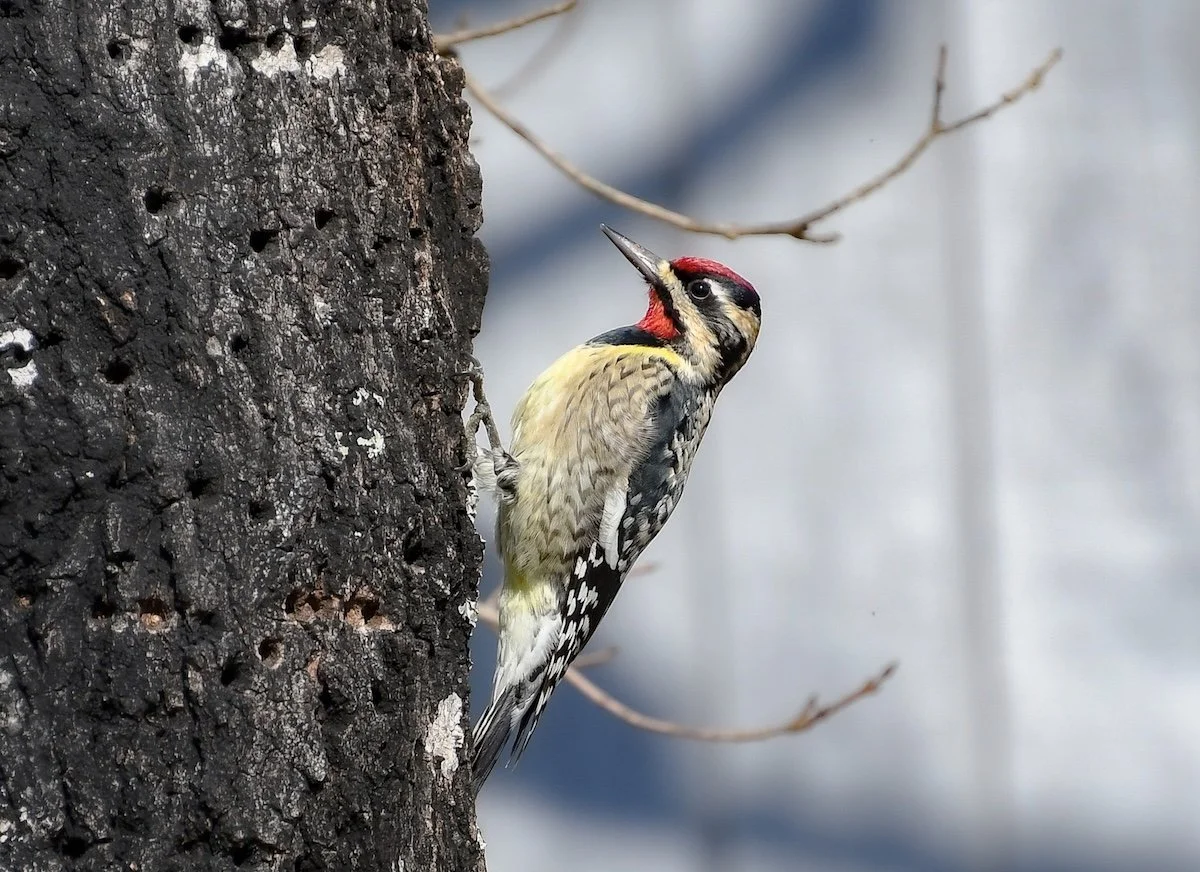
Yellow-bellied Sapsucker. Photo: Fraida Gutovich/Audubon Photography Awards
Sapsuckers were once considered pests from the damage they caused to orchards. While their drilling can make trees more vulnerable to insects or disease, these sapwells are an important food source for other animals. In some parts of Canada, Ruby-throated Hummingbirds are so reliant on sap that they time their spring migration to match that of the sapsuckers. Bats, other birds and porcupines also will visit sapwells.
Often motionless and silent, woodpeckers can be hard to spot, and the Yellow-bellied Sapsucker is no exception. Look for them flush against tree trunks, easiest to find when they’re ascending or flying from tree to tree. When birding by ear, listen for their drumming, which is distinct from that of other woodpeckers in its irregularity, or a “mewing” similar to that of a Gray Catbird. They peck in short bursts, often of three, rather than continuously. In addition to feeding, they do this to mark territory, so will sometimes pound on man-made objects—like metal signs—to sound louder. They may be easier seen than heard in the winter.
Luckily, as their population grows, they should only get easier to spot. Yellow-bellied Sapsuckers have a stable and increasing population, according to the North American Breeding Bird Survey. Although they are not typical feeder birds, you may be able to attract them to your yard by offering suet or mealworms. Like most woodpeckers, they benefit from healthy forests with plenty of trees—the best way to support them is through general habitat restoration and protection.
Yellow-bellied Sapsuckers will stick around long after the Halloween candy and Thanksgiving leftovers run out. They stay in northern Virginia until springtime, typically leaving around April and May to fly back north. While indulging in holiday sweets, be sure to think of these sugar-loving sapsuckers and get a glimpse of one before they leave!
Additional Resources:
https://www.allaboutbirds.org/guide/Yellow-bellied_Sapsucker/id
https://www.audubon.org/field-guide/bird/yellow-bellied-sapsucker
https://ebird.org/species/yebsap
https://feederwatch.org/learn/common-feeder-birds

“Junk Trees” and the Native Understory
Berries that grow on native trees and shrubs are wildlife powerhouses. Despite that, some of the best producers are labeled “junk trees” in today’s gardening and landscaping industries because they aren’t someone’s idea of what a yard tree should look like.
Photo: Closeup of the flowers of Devil’s Walking-stick, USGS Bee Inventory and Monitoring Lab from Beltsville, Maryland, USA, Public domain, via Wikimedia Commons
Eileen Ellsworth
Take a moment to stand in the scaly shoes of a migrating songbird along the Atlantic Flyway this fall. Passing through Virginia, you will still have a long way to go before reaching your southern wintering grounds. Imagine your relief when, after an entire night of flying, you find a stopover habitat to rest and refuel before the next leg of the journey. And what is your favorite food from the on-site offerings? Berries that grow on native trees and shrubs, all of which are wildlife powerhouses. Despite that, some of the best producers are labeled “junk trees” in today’s gardening and landscaping industries because they aren’t someone’s idea of what a yard tree should look like.
To show how far afield we have drifted in our plant-think, consider the results of this 2022 study by the Center for Conservation Biology (CCB). Researchers working on the eastern shore of Virginia analyzed the nutritional content of several native plant berries to discover which ones provide the biggest energy boost for migrating birds. Next, they measured levels of berry removal from plants during the fall migration to determine which berries were most preferred. Considerable overlap existed between the most nutritious and the most popular native plant berries, as follows:
The most nutritious native tree berries, starting with the best, were
Sassafras
Bayberry
Virginia Creeper
Pokeweed
Devil’s Walking-stick
American Beautyberry
Hackberry
Wild grapes.
The most preferred native plant berries, starting with the most popular, were
Sassafras
Devil’s Walking-stick
Pokeweed
Virginia Creeper
American Beautyberry
Bayberry
Hackberry
American Holly.
These plants are not just profuse berry producers. They are classic native understory shrubs and trees that have been disappearing from our landscapes in modern times. White-tailed deer have over-browsed the understory. Non-native invasives outcompete the natives. Plant diseases proliferate as the climate warms. And humans persist in calling some native plants “junk” and discourage their purchase. It is a perfect storm of destructive pressures and wrong thinking. At least the thinking part is something we can reverse along with the behavior that flows from it.
Let us ditch the “junk tree” label and take a closer look at three rock star “treasure trees” included in the CCB study.
Sassafras: Sassafras berries were rated #1 in the study for both nutritional value and bird popularity. Who knew? Woodpeckers, mockingbirds, catbirds, flycatchers, phoebes, vireos, Wild Turkeys, and Yellow-throated Warblers all enjoy the feast. The tree also provides excellent support for squirrels, rabbits, and other mammals and hosts some very cool moth species such as the Imperial, Promethea, Cecropia, and Io moths as well as the remarkably handsome Spicebush Swallowtail caterpillar.
Sassafras grows very fast and reaches heights of 30-60 feet in ideal conditions. You’ll need to plant more than one if you want berries, as only the female trees produce them. White-tailed deer relentlessly browse the tree, so some fencing is recommended for the first few years. Flower and berry production begins at ten years, and the abundant clusters of yellow flowers in April and May are simply spectacular. The fruit ripens in September, just in time for the fall migrations. The berry’s appearance has been likened to a blue-black egg sitting atop a bright red golf tee. Its leaves are just as unique. Three distinct leaf shapes - the mitten, the three-lobe, and the oval - all grow on the same tree and turn bright yellow, orange, and red in the fall.
Its wildlife value and unique features say it all.

Devil’s Walking-stick berries. Photo: GlacierNPS, Public domain, via Wikimedia Commons
Devil’s walking-stick: The CCB study rated Devil’s Walking-stick berries as #5 for nutritional value and #2 in popularity. Cedar Waxwings, Wood Thrushes, White-throated Sparrows, Swainson's Thrush, American Robins, Gray Catbirds, Northern Mockingbirds, Rose-breasted Grosbeaks, Dark-eyed Juncos, and various migrating warblers are all avid consumers.

The distinctive red berries of Devil’s Walking-stick. Photo: Margaret Fisher
Another fast grower, the tree/shrub reaches heights of 10-30 feet, making it ideal for yards and gardens where larger canopy trees can’t fit. It also reproduces quickly by suckering roots and often forms colonies in open fields, wood margins, and moist woods. You only need to purchase and plant one specimen to set fruit, and berries appear as early as year three or four.
Devil’s Walking-stick is a native plant that looks positively exotic. Spot it once and you will never forget it. Prominent thorns grow along the trunk, stems, and leaf stalks (thus, the label “junk”). The thorns give the plant its name while also discouraging most deer browse. Small white or creamy white flowers appear in mid-to-late summer and form showy, fragrant canopies above the huge compound leaves, attracting many pollinators. When dark purple berries appear in the fall, they hang on stalks that have turned a vivid burgundy or lacy red.
This plant is just plain crazy beautiful.
American Beautyberry: We mention this even though it is native further south but not in northern Virginia, because we would like to warn people not to buy the wrong species by mistake, which happens commonly. The CCB study rates American beautyberry #6 for berry nutrition and #5 for bird popularity. While Sassafras and Devil’s Walking-stick rarely appear on landscaping plans, American Beautyberry is a frequent choice and never designated “junk” in anyone’s book.
In spring and summer, the plant looks ordinary with unremarkable leaves and inconspicuous flowers. Come the fall, however, the plant transforms itself as tight clusters of bright purple berries ripen along the entire length of the stem. Those berries last for weeks, but their taste improves as they age and ferment on the stems, making them a fan favorite for migrating birds. American Robins, mockingbirds, cardinals, towhees, thrashers, Gray Catbirds, and finches are known customers among 40 species relying on the tree for late season food.
American Beautyberry also grows fast to reach a mature size of up to about 8 feet. Deer eat it, so fencing is recommended until it is well established.
Here is the warning. When purchasing American Beautyberry, be aware that Asian cultivars are often sold under the name “Beautyberry” and can be confused with the straight native. Only purchase Callicarpa americana. Mislabeling is common even then. Devil's Walking-stick (Aralia spinosa) also has an invasive look-alike (Aralia elata).
When we label a native plant as “junk,” it is often because of thorns, poor-quality wood, or aggressive growth and spread. But the label also reflects our severed connection with nature. A “junk" tree or "brush" shrub may or may not please us, but it is a migrating bird’s vital food source, an uncommon moth’s host plant, and a native bee’s essential nectar source. For more suggestions, see the Plant NOVA Trees website.
One person’s junk has always been another’s treasure. Let’s value what matters.
A Closer Look: Nature All Around Us, November 2025
Judy Gallagher is an NVBA board member and a regular surveyor of local wildlife who also captures photos of what she sees, in particular the less common species.
Photo: Forcepfly, Judy Gallagher
Judy Gallagher
November 2025
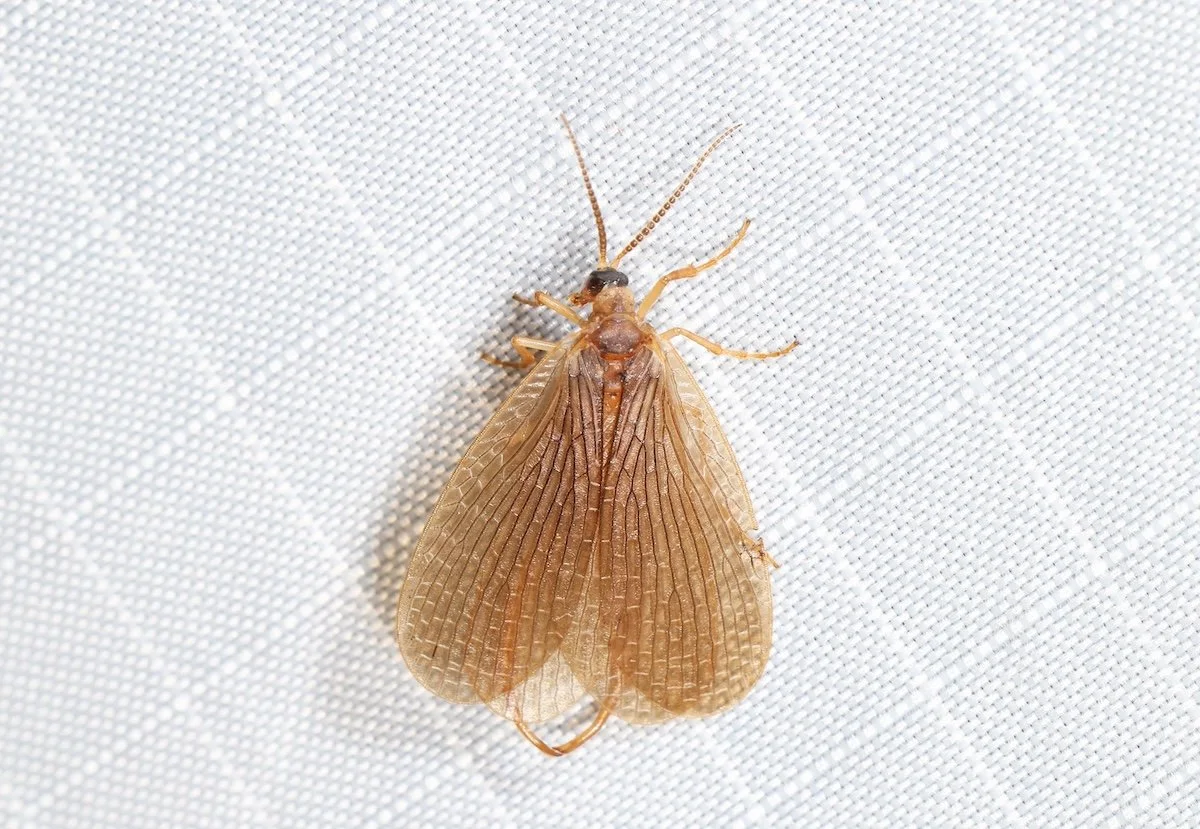
I was fortunate recently to see a Forcepfly, a species in a family that was previously unknown to me, and that inspired this month’s column. Forcepflies, sometimes called Earwigflies, belong to Order Mecoptera (long wings), which also includes Scorpionflies, Hangingflies, and Snow Scorpionflies. Order Mecoptera is closely related to Siphonaptera (fleas) and slightly more distantly to Diptera (flies).
Members of this order look a bit like flies, with long slender bodies and narrow membranous wings. They have long beak-like mouthparts. They undergo complete metamorphosis with egg, larval, pupal, and adult stages. The larvae mostly feed on plant matter, but most adults are predators or eat dead organisms. Some scientists postulate that early Mecopterans fed on nectar and pollen, but so far fossil evidence has not confirmed this. Analyses of fossilized Mecopteran mouthparts, which didn’t find any iron, suggest that early Mecopterans did not feed on blood.
Forcepfly. Photo: Judy Gallagher
The Forcepfly that I saw recently is one of just three species in Family Meropeidae, and it’s the only species found in North America. Not much is known about this family. No larvae of any species have been found and the adults have never been seen feeding, although there is speculation that they feed on decaying organic matter. They are called Forcepflies because of the forcep-like male genitalia. Their bodies are flat, which enables them to live under tree bark or logs.
The biggest Mecopteran family is Panorpidae, or Scorpionflies. There are about 300 species worldwide, with 54 species in eastern North America. Female scorpionflies lay small masses of eggs in soil. The larvae live in or near the soil-layer before pupating in underground cells over the winter. Both adult and larva are primarily scavengers, eating dead insects and snails, bird droppings, pollen, nectar and fruit juices. Adults often steal prey from spider webs and occasionally also eat the live spiders.

Male Helena’s Scorpionfly (Panorpa helena), showing off its scorpion-like appendage. Photo: Judy Gallagher
Male scorpionflies have genitalia that look like scorpion stingers, which is the reason behind their name. Unlike scorpions, they can’t sting. Each species of scorpionfly has unique genitalia, and this is what is commonly used by entomologists to distinguish between species.

Another male scorpionfly, Panorpa species. Note the slightly different appendage and different wing markings. Photo: Judy Gallagher
Male scorpionflies try to attract females by offering them a dead insect, but if a dead insect isn’t available, they sometimes offer saliva instead. Some female scorpionflies will accept a male suitor only if he brings her a gift of prey, and females tend to prefer males that bring them big prey items. Males are reputed to occasionally mimic females in order to get a free meal. Some male scorpionflies also try to attract a female by issuing chemical signals (pheromones) and waving their wings, accompanied by sounds made by vibrating their abdomen against a solid surface.

Female scorpionfly, Panorpa species. Photo: Judy Gallagher
Female scorpionflies don’t have the scorpion-like appendage.

Female scorpionfly showing different wing markings. Photo: Judy Gallagher
Scorpionflies are usually among the first insects to start feeding on corpses, indicating that the body is at most a few days old, something that is used by forensic investigators to date the approximate age of a corpse. I am grateful that I don’t have pictures to illustrate this!
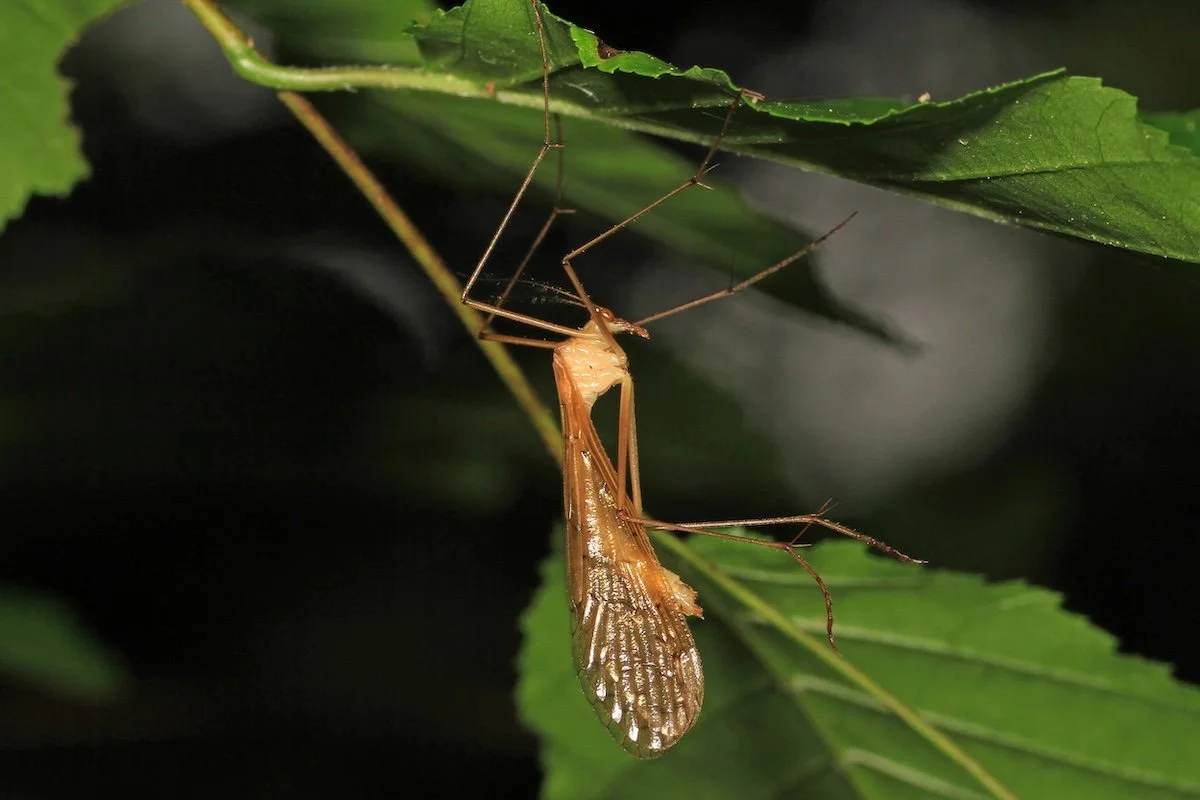
Hangingfly, Bittacus species. Photo: Judy Gallagher
The final Mecopteran family that occurs regularly in our area is Hangingflies (Bittacidae). They hang by their front and middle legs from low plants, and use their hind legs to capture passing prey. They look a little like Crane Flies, but have the long beak-like mouthparts characteristic of this order. Like scorpionflies, male hangingflies attract females by bringing them insect prey. If the female doesn’t think the prey is big enough, she flies away.
I’ve never seen a snow scorpionfly (family Boreidae). They are adapted to cold climatic conditions, often living on the surface of ice or snow, and may die if exposed to the heat of a human hand. A few individuals have been found in our area, but they typically live further north. My goal is to find one this winter.
View more of Judy’s articles on A Closer Look: Nature All Around Us (formerly Observations from Meadowood).

Wildlife Sanctuary Almanac: Grow a Winter Bird Feeder
Now is the time to clean and fill the feeders to help birds make a living when other food sources are scarce. It’s also time to think about providing next year’s winter bird food by planting more native plants, including native grasses, wildflowers, and woody plants, such as shrubs, vines and trees, that provide sustenance all winter long.
Photo: American Goldfinch, Barb D’Arpino/Audubon Photography Awards
Elizabeth Martin
Now that fall migration is winding down, the resident birds who stayed behind will be foraging and scrounging for food to survive the winter. Now is the time to clean and fill the feeders to help birds make a living when other food sources are scarce. It’s also time to think about providing next year’s winter bird food by planting more native plants, including native grasses, wildflowers, and woody plants, such as shrubs, vines and trees, that provide sustenance all winter long.
American Goldfinch feeding on seeds of New England Aster (Symphyotrichum novae angliae). Photo: Barb D’Arpino/Audubon Photography Awards
Mourning doves survive almost entirely on grain, including seeds from native grasses such as little bluestem and Indian grass. Native grasses provide high quality, carbohydrate-rich grain for birds in winter. Sparrows and dark-eyed juncos also eat grass seeds.
Many of the best winter food sources for birds are produced by members of the sunflower family (Asteraceae). Asters, sunflowers, black and brown-eyed Susans, goldenrods, ironweeds and others all produce highly nutritious seed that ripens late in the season. Some plants produce large seed, and others produce small seed, and so different bird species are attracted to feed on them. For example, Northern Cardinals love large sunflower seeds, while finches and sparrows feed on the smaller seeds of brown-eyed Susans and goldenrods. By planting a variety of wildflowers, you’ll attract a greater variety of bird species looking for winter food. Goldfinches, chickadees, and titmice also feed on wildflower seeds.
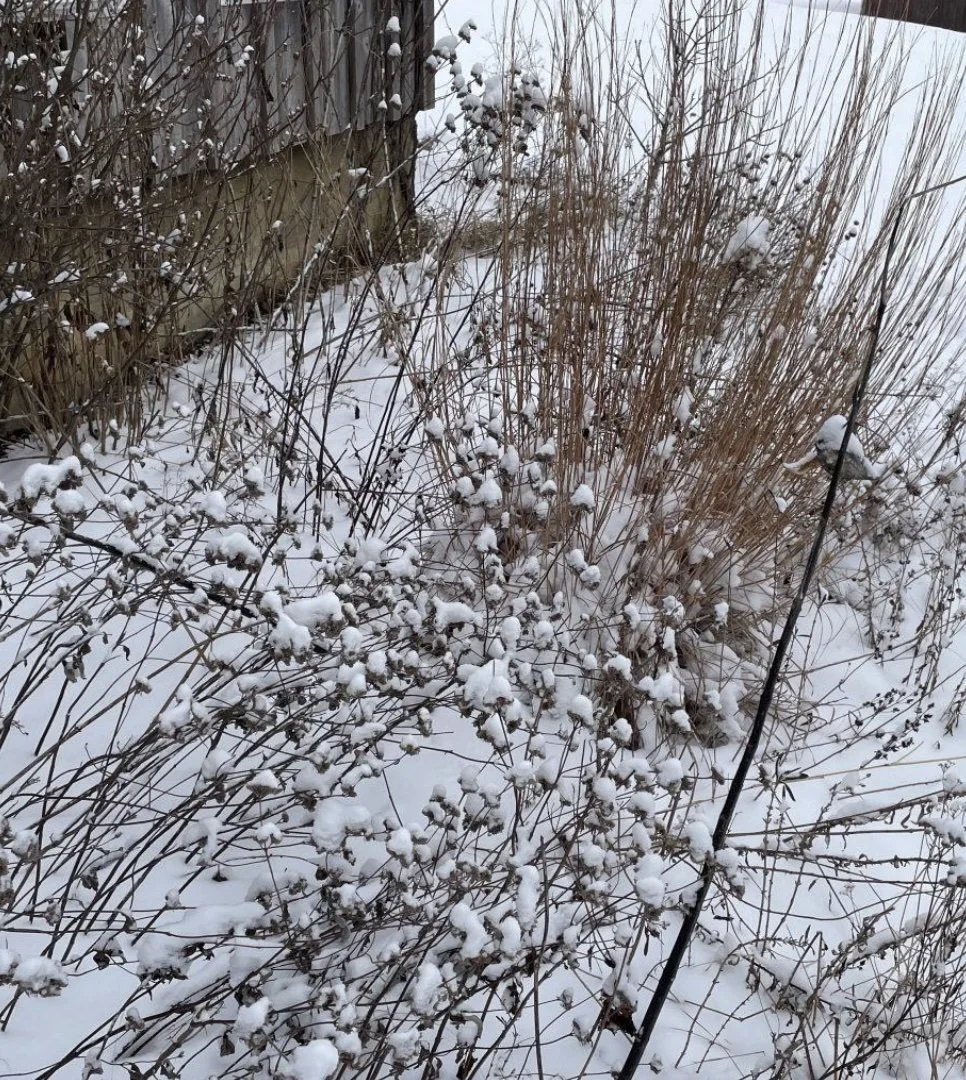
A variety of dormant native grasses and herbaceous flowering plant stems left standing in winter. Avoid cutting them down until spring, if you can. They provide many ecological benefits, including food for many birds. Photo: Brandon Everett
To preserve this source of bird food, don’t deadhead or cut down dried grasses and wildflowers when they go dormant in fall. Not only will the seeds feed the birds, but the dried stems and stalks provide shelter and overwintering sites for insects, butterflies, and other little critters.
Finally, the fruits of many native trees, shrubs and vines provide winter food for birds, especially the fruit-lovers (frugivores) like woodpeckers, American Robins, Northern Mockingbirds, Cedar Waxwings and Blue Jays. For example, Coral honeysuckle (Lonicera sempervirens) is a semi-evergreen vine which produces clusters of red berries that support finches and robins. This plant’s dense growth also provides good nest sites and shelter for birds, and its red trumpet-shaped flowers attract hummingbirds in summer—it is truly a plant for all seasons. Berries on Virginia creeper (Parthenocissus quinquefolia) cling to the vine into winter and are favored by woodpeckers. Winterberry (Ilex verticillate), a deciduous holly shrub, and the evergreen American holly tree (Ilex opaca) produce starchy drupes that are not initially palatable and are only eaten later in winter, after they have gone through several freeze and thaw cycles. When the holly drupes are finally ripe, birds may show up in large flocks and completely strip a holly tree or shrub in a matter of minutes. By the time they’re eaten, the drupes have fermented, so you may see tipsy birds staggering unsteadily in your backyard after their feeding frenzy.
Drunken birds? You can’t get a show like that with a birdfeeder.

Northern Mockingbird feeding on Winterberry (Ilex verticillata). Photo: Barbara Driscoll/Audubon Photography Awards
Catch up on past Wildlife Sanctuary Almanac articles here.

Fake Spiderwebs: A Hidden Halloween Hazard for Birds
As Halloween approaches, one decoration deserves to stay on the store shelf: synthetic spiderwebs. While these stretchy strands might seem like harmless fun, they're creating a serious threat to birds in our communities
Photo: Synthetic spiderweb decorations, Sebastian Schuster via Unsplash
As Halloween approaches, one decoration deserves to stay on the store shelf: synthetic spiderwebs. While these stretchy strands might seem like harmless fun, they're creating a serious threat to birds in our communities.
Why Spiderwebs Are So Dangerous

Natural spider silk will break under pressure, but artificial webbing holds firm. Photo: Chelsea Marques via Unsplash
When a bird encounters fake webbing, the outcome is often tragic. The synthetic material is engineered to be strong and sticky—qualities that make it perfect for decorating but lethal for wildlife. A bird that brushes against these fibers quickly becomes trapped, and their instinct to struggle only tightens the grip. Unlike natural spider silk that breaks under pressure, artificial webbing holds firm.
The danger doesn't end when Halloween is over. Wind carries loose strands into trees and vegetation where they persist for months, creating invisible traps in the very places birds need most. In urban and suburban areas where natural habitat is already limited, blocking off trees and shrubs with webbing eliminates crucial shelter and feeding spots.
A Better Way to Decorate
Here's the good news: you can still embrace the spooky season while protecting birds. Keep those synthetic webs indoors, or better yet, apply them directly to your windows. When placed on glass, they serve double duty by creating your Halloween aesthetic while making windows visible to birds.
Fall migration is in full swing right now, with millions of birds passing through our region. Window collisions kill hundreds of millions of birds annually in the United States, and simple visual markers can dramatically reduce these deaths. Spooky decals, washable window markers, or even DIY paper cutouts transform your windows into both festive displays and lifesaving signals.
Starting a Friendly Conversation
If you notice a neighbor using fake spiderwebs, a kind approach can make all the difference. Start with a compliment about their decorations, then share what you've learned about the risks to birds. Most people simply don't know about the danger and are happy to make a change once they understand. Offer specific alternatives like window application or indoor use. Keep it light and positive; frame it as a way to keep their display just as festive while being wildlife-friendly. You might be surprised how many neighbors become advocates themselves once they know.
This Halloween, choose decorations that celebrate the season without harming the wildlife that makes our neighborhoods special. Your yard can still be the spookiest on the block, just without the collateral damage.
If you do see an injured bird, please reach out to local wildlife rehabbers for assistance. We recommend AERO and Wildlife Rescue League for more information!

Fall 2025 Cape May Field Trip Recap
On Saturday, October 4, 22 birders awoke before sunrise, loaded into vans, and began our journey from Northern Virginia to Cape May, NJ, our eyes set on this faraway destination perfectly aligned with the Atlantic Flyway, one of the four “avian superhighways” in North America.
Photo: Cape May Lighthouse, Alan Kotock via Pixabay
McKenzie Ingram

Driving to Cape May. Photo: Ajani Simmons
Saturday morning was anything but cozy, sleepy, fall vibes for our birders chasing the thrill of fall migration. 22 birders, including experienced guides Tom Wood, Herlitz Davis, and Judy Gallagher in tow, awoke before sunrise, loaded into vans, and began our journey from Northern Virginia to Cape May, NJ! Our eyes were set on this far away destination because of its geography. This peninsula is perfectly aligned with the Atlantic Flyway, one of the four “avian superhighways” in North America, making it a world-renowned birding hotspot.

Our group after arriving in Cape May via the ferry. Photo: Ajani Simmons
After our drive from Virginia, we crossed into New Jersey from Delaware via the Cape May–Lewes Ferry, which offered scenic views and unique birding opportunities along the way. Aboard the ferry, we saw Laughing Gulls, Forster's Terns, a pair of Brown Pelicans, and many other water-loving birds. Many species are in their non-breeding plumage this time of year, making identification trickier but rewarding.
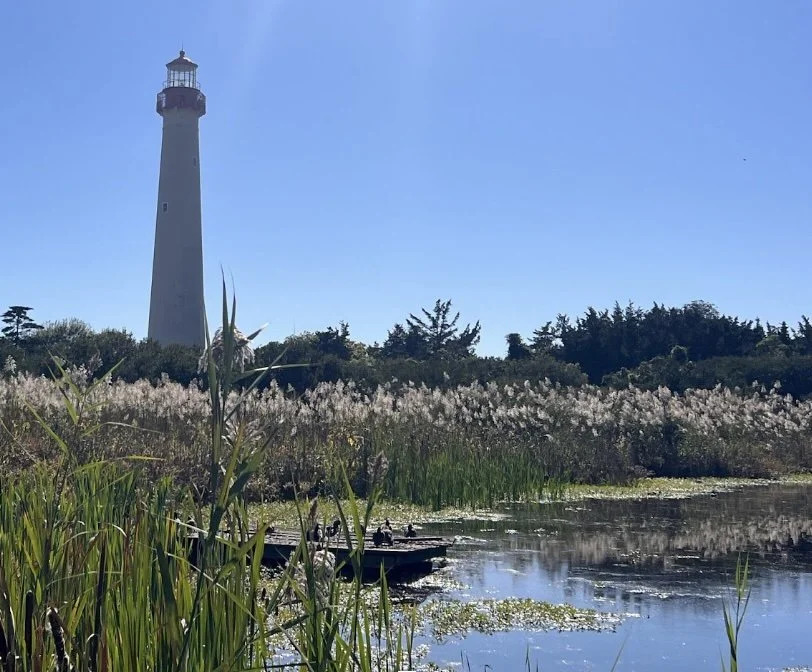
Cape May Lighthouse. Photo: McKenzie Ingram
Once in Cape May, we hurried to the nearby Cape May Point State Park , where we enjoyed a quick lunch before an afternoon of birding fun under the observation of the nearby 157-foot-tall Cape May Lighthouse which has overlooked the entire peninsula since it was first lit in 1859.
When you hear “fall migrants” one might expect to only see avian migrants such as warblers, the infamously colorful tiny birds that flood the skies on their migrations every spring and fall. However, a plethora of species are also on their way to warmer temperatures or waters this time of year - something we quickly learned during our time at the park. At Cape May Point, Monarch butterflies and dragonflies stop briefly in the park along their migration to gain their strength before crossing the Delaware Bay.
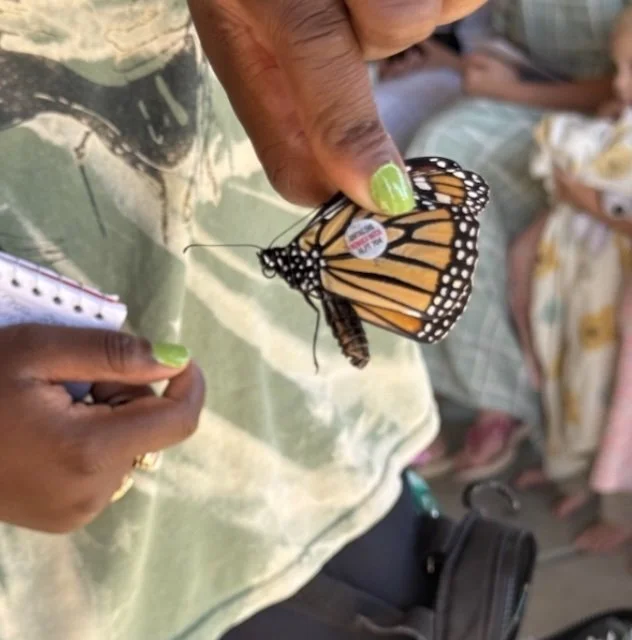
Monarch butterfly sporting a band. Photo: Jenn Crawford
These Monarch butterflies are part of what researchers call “the monarch super generation.” Unlike their close relatives, these monarchs' reproductive cycles are on hold. They do not complete their life cycle in a mere four weeks, and they are migrating south, the opposite of what their parents or grandparents did. Some fly over fifty miles a day on their way to their winter homes in Mexico! Some guests even had the pleasure of watching a butterfly banding demonstration provided by the Monarch Monitoring Project while visiting the park.
This monitoring project is hosted under the Cape May Bird Observatory (CMBO) founded in 1976 by NJ Audubon. The CMBO is a beacon for migratory species research such as annual counts, censuses of species, and other environmental education projects. For instance, the park’s nearby Cape May Hawkwatch, is one of many birding attractions that also conducts conservation-driven studies through the CMBO. We were especially grateful for the expert advice given by the seasonal naturalist hired by NJ Audubon. The naturalist happily answered our questions and aided us in bird identification. On the platform we saw a male Belted Kingfisher, American Kestrels, and a Peregrine Falcon, among others.
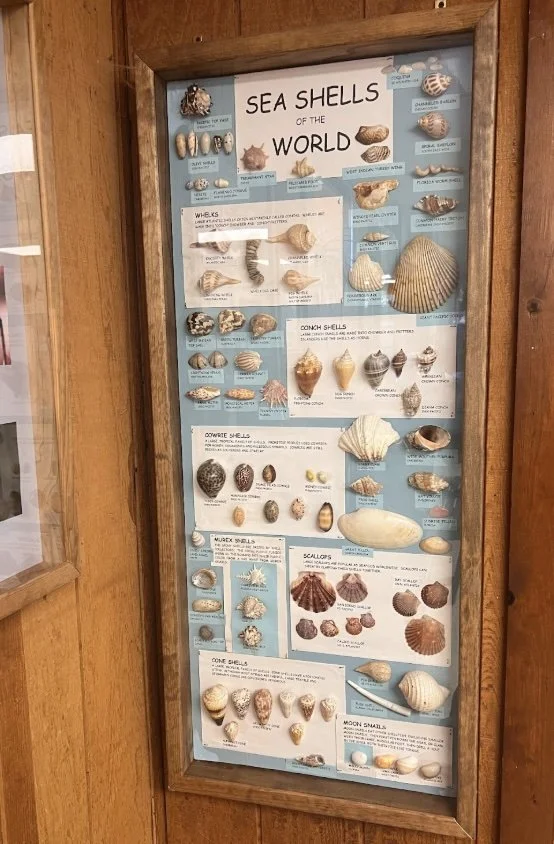
Sea Shells of the World exhibit at the CMBO Nature Center. Photo: McKenzie Ingram
The park’s Nature Center and Museum provided us with more educational opportunities such as seashell exhibits, live reptiles, and other information relevant to visitors. Onsite there were several trails for us to take that gave up-close views of woodland habitats, marshlands, ponds, beaches, dunes, and other habitats critical for migrants. One group even saw a Black Snake consuming a juvenile squirrel on the side of the trail. While the snake was enjoying his meal, the nest of squirrels made warning calls from the pine tree above, making this an especially memorable sighting.
After leaving Cape May Point State Park, we traveled up to Ocean City, NJ where we enjoyed dinner at the nearby boardwalk full of Saltwater taffy shops and attractions before calling it an early night.
The next morning we drove back down to the Avalon Seawatch. This site was chosen by NJ Audubon for its location because the northern tip of Avalon extends a mile farther out into the ocean than the coastline to the north. Southbound seabirds that are following the coastline pass very close to this beachfront. According to their webpage, there are an average of almost 800,000 seabirds counted here annually, with around 70% of all the migrant seabirds passing in a mere five week period in the fall.
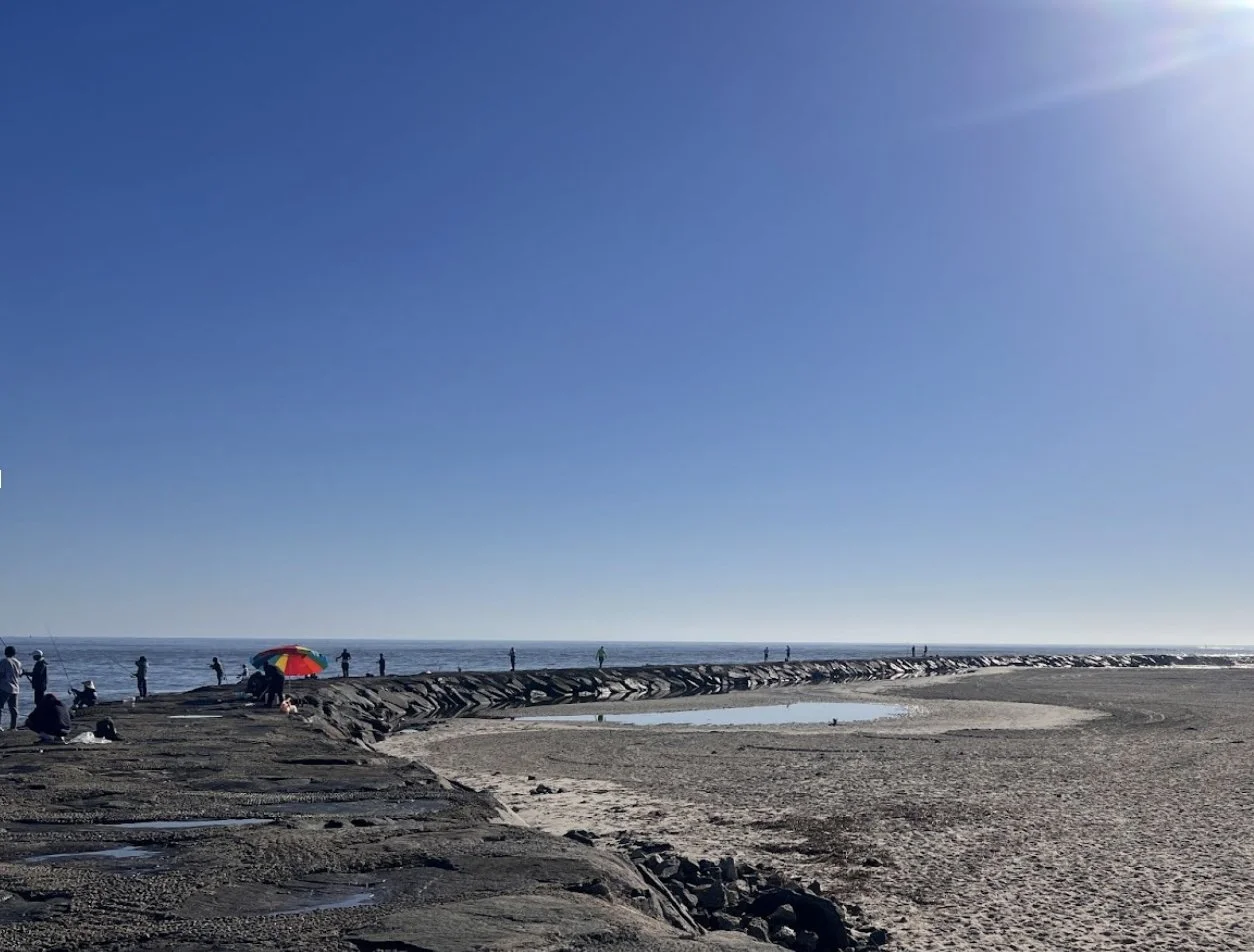
Avalon Seawatch. Photo: McKenzie Ingram
On day two we were accompanied by another seasonal naturalist and local guides who are experts in identifying both local and migrant species that frequent Avalon. While there, we watched Royal Terns fly above the water while about seventy Sanderlings sat on the jetty, completely exhausted from their latest leg of their migration journey.
Here our guide Judy discussed the importance of coastal marshlands and shared her knowledge on the highly invasive marsh reed known as Phragmites australis, that line the trails and beaches we visited almost the entire journey.

Our guide Judy Gallagher addressing the group at Avalon Seawatch. Photo: McKenzie Ingram
Our next stop was the 200-acre South Cape May Meadows preserve established by the Nature Conservancy. Along the one-mile trail loop, we saw several fall migrants such as Common Yellowthroats, Gray Catbirds, Ospreys, and more. Along the way our guides shared detailed identification tips while local guides provided historical information on the restoration projects in the region.
For our final stop, we made our way to the CMBO Northwood Center. Here there is a plethora of field guides from around the world, birding books, spotting scopes, binoculars of all kinds, and other birding goodies available for purchase to fundraise for such programs and projects.
From here, the group rode back across the Delaware Bay to catch last glimpses of seabirds and ponder the many brilliant sights we left behind in NJ.
This trip was made possible in part to the Virginia Department of Wildlife and grant funding provided to support new birders enjoying the nature around us. As a result of that program, over half of our group were new birders who have never had a chance to see a migration hotspot.
At the trip’s conclusion, we spotted over forty species of birds. These species, along with the butterflies, plants, and everything in between, reminded us that even in the midst of life’s biggest journeys, some more challenging than we ever anticipated, there are still many moments of connection, amazement, community, humor, joy, and more to look forward to. And that, to me, is what made our Fall Field Trip to Cape May, NJ truly special.

The 2025 NVBA Cape May crew. Photo: Tom Woods
Letter to Our Members
One of the perks of editing the Potomac Flier is access to National Audubon Society’s photo archive, which includes years’ worth of images from the photography awards.
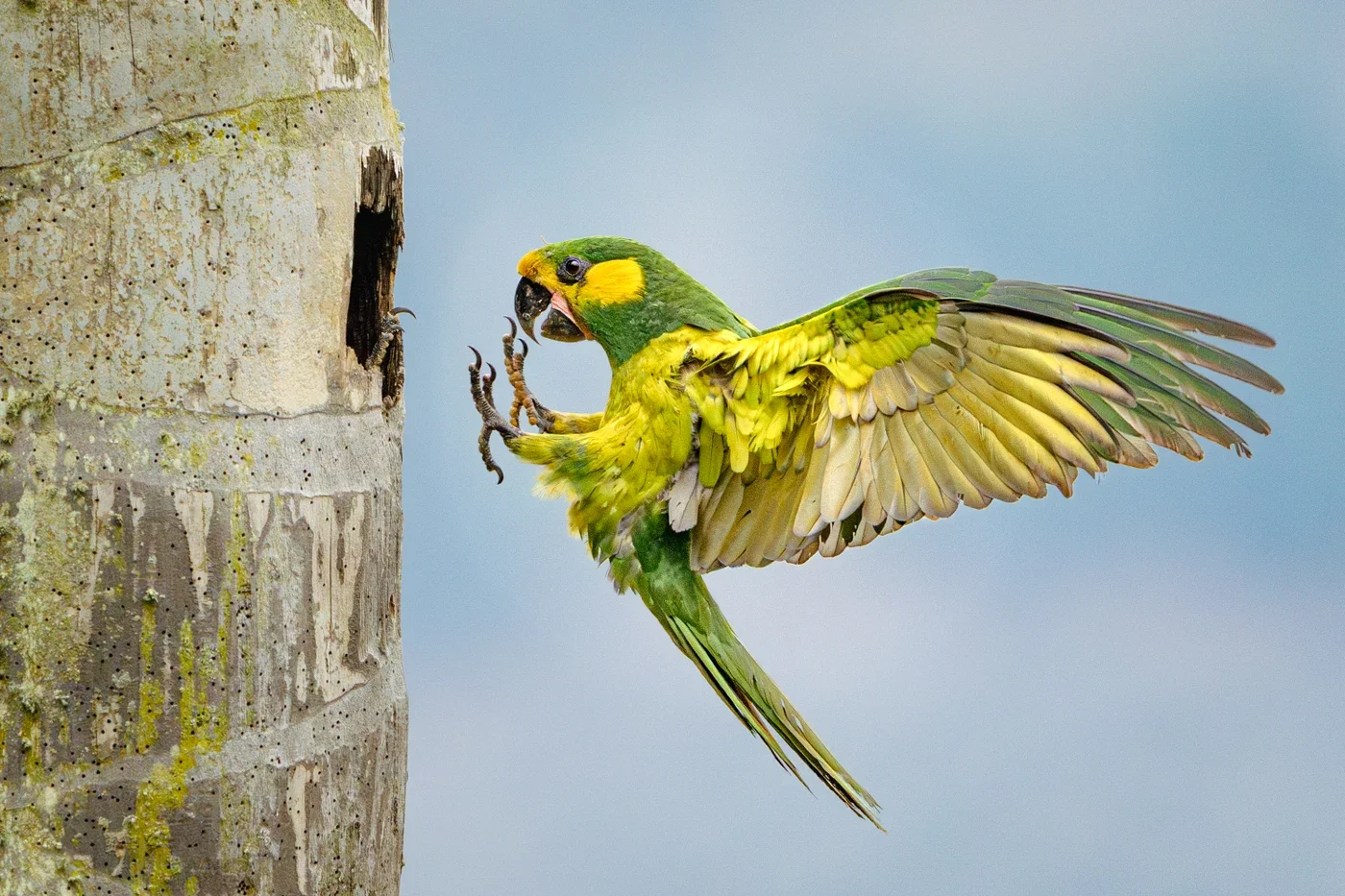
Photo: Yellow-eared Parrot, León Felipe Jimenez/Audubon Photography Awards
Connie Ericson
One of the perks of editing the Potomac Flier is access to National Audubon Society’s photo archive, which includes years’ worth of images from the photography awards. Every month I browse the archive for photos to illustrate the articles, one of the best parts of this job. I’m not a photographer myself, but I appreciate the artistry and dedication required to produce the stunning images. Take a few minutes today to review this year's "top 100" photographs, including the winners and honorable mentions.
Yellow-eared Parrot, León Felipe Jimenez/Audubon Photography Awards
I always try to pick a “favorite” photo from the array, a ridiculous exercise because I end up with so many favorites. But from this year’s contest I thought I would feature León Felipe Jimenez’s Yellow-eared Parrot, a photograph from the entries from photographers in Chile and Colombia, a new category in the annual competition. I picked it for several reasons:
It’s noteworthy that the photo is from the contest’s new category, which highlights the importance of conservation across the American hemispheres. Conservation of the birds we see in North America relies on efforts in both hemispheres because of seasonal migration.
The photo captures movement and tells a story. One of a pair is returning to the nest for the night, and you can pick out just one claw from the other bird, already in the nest.
The photo also highlights an important conservation lesson about habitat. The photographer explains that the birds nest almost exclusively in dead wax palms, Colombia’s national tree. That habitat is at risk from deforestation, monoculture plantations, and cattle ranching, making the work of farmers who protect these palms essential.
Of course, it’s also impossible not to recognize the clarity of the image and the beauty of the bird.
There are many ways people come to bird photography. Some photographers start out photographing landscapes and then start focusing on the landscape’s inhabitants. Many a birdwatcher started out as a photographer, and some birdwatchers gravitate to photography to help identify a bird they see in the field but can’t yet identify. A good image, downloaded and magnified on a computer screen, can show features with clarity that binoculars may not always provide. Photographs also help citizen science records, verifying the identification of a bird, particularly if it’s reported as a rarity in an area. And some birdwatchers enjoy keeping track not just of the birds they have seen, but the birds they have photographed. If you’re interested in starting to photograph birds, or increase your skills, you can check out tips and recommendations from National Audubon's website.
Before leaving this subject, I also want to acknowledge the efforts of our local photographers. Many of the photographs in this monthly newsletter and most of the photographs from our annual report come from local photographers who generously allow us to use them. And, if you haven’t looked at our monthly columns yet, take a few moments to review the helpful photographs of native plants featured in the Wildlife Sanctuary Almanac and the unbelievably detailed photographs of insects that Judy Gallagher includes in her column, A Closer Look: Nature All Around Us.

Birding is for Every Body: Birdability Week, October 20-26
Have you ever paused to think about how many people might want to join us in birding but can’t?
Photo: Birdwatching from a wheelchair, USFWS Headquarters, Public domain, via Wikimedia Commons
Jo Doumbia
Have you ever paused to think about how many people might want to join us in birding but can’t? Not because they lack interest, but because the trail is too rough for a wheelchair, the signage is too small for someone with limited vision, or the group atmosphere doesn’t feel welcoming to someone living with anxiety. That’s where Birdability comes in.
Founded by Virginia Rose, a birder and wheelchair user, Birdability is a nonprofit with a powerful vision: birding should be welcoming, inclusive, safe, and accessible for everybody and every body. Its mission goes far beyond removing barriers on trails. It’s about creating community, dignity, and joy for people of all abilities.
Birding is often seen as one of the most accessible hobbies: you can do it anywhere, at any age, with very little equipment. But in reality many opportunities are closed to people living with mobility challenges, sensory disabilities, chronic illness, or neurodivergence. That means a vast number of potential birders and future conservation allies are left out.
When we design programs with accessibility in mind, we don’t just help others: we strengthen our own community. Accessible trails and viewing platforms mean families can bird together. Clear communication and welcoming environments make first-time birders feel at home. Inclusion helps us live out the truth that birds belong to everyone.
Birdability offers tools to make this possible. Its crowdsourced Birdability Map, created by National Audubon Society in association with Birdability, helps birders of all abilities know what to expect at birding sites. Resource documents on Birdability’s website guide leaders on inclusive practices and respectful communication. And each October, Birdability Week shines a light on accessible birding with events, workshops, and celebrations across the country.
As birders, we can be part of this change. We can start by noticing where barriers exist, sharing reviews of our favorite spots, and experimenting with accessible outings. Most of all, we can open our doors wider and welcome people who may not have thought birding was for them.
Accessibility isn’t just a checklist: it’s a mindset. It’s choosing to see birding not as an exclusive hobby, but as a shared language of wonder and joy that everyone deserves to speak. By embracing Birdability’s vision, we can open the door to new members, new friends, and new advocates for the birds and habitats we cherish.
Let’s make sure birding is truly for everybody.

My Time at Hog Island Camp
I’m looking forward to sharing all that I’ve learned with the educators that I support in Arlington Public Schools and applying new strategies with my students.
Photo: Atlantic Puffins, Michael Schmitt/Audubon Photography Awards
Deborah Hammer, Autism and Low Incidence Specialist, Arlington County Schools, Winner of NVBA’s 2025 Scholarship
Have you ever felt nostalgic for the fun you had as a child at summer camp and wished to re-experience it -- the arts and crafts, music, hiking, meeting new friends, and the sense of wonder at having new adventures? I have, and thanks to the generosity of NVBA, I got to make that wish come true. I attended Sharing Nature: An Educator’s Week at Hog Island Audubon Camp in Breman, ME. The camp, which is run by the National Audubon Society under the Seabird Institute, has several special sessions open to anyone, including children and families, who are interested in birds and nature.
The camp experience began when I arrived in Bremen. I joined a group of enthusiastic campers, where we were met by some of our counselors and took a short boat ride to Hog Island. We were assigned our cabins, all of which are well over a century old, and began decorating our name tags. After some icebreaker activities, where I met my fellow campers from across the country, we sat down for the first of our many gourmet, locally sourced meals. While dining, we had a chance to get to know each other better. Although we came from diverse educational backgrounds - public schools, state parks, nature centers, preschool up to university – we all shared a life-long love of learning and playing in nature.
Morning activities started early, with most campers rising at dawn to birdwatch, meditate, or write in a nature journal, either alone or in groups with counselors. Most of the sessions were designed with an eye on strategies we could bring back to our students. For example, we learned a mindfulness strategy that utilized breathing like different animals and another that utilized different senses.
After breakfast, we often had a choice of classes we could take, such as cyanotype printing, nature photography, seaweed pressing, or poetry. We also received instruction on becoming better birders, the history and ecology of Hog Island, and tips for translating our instruction into practice.
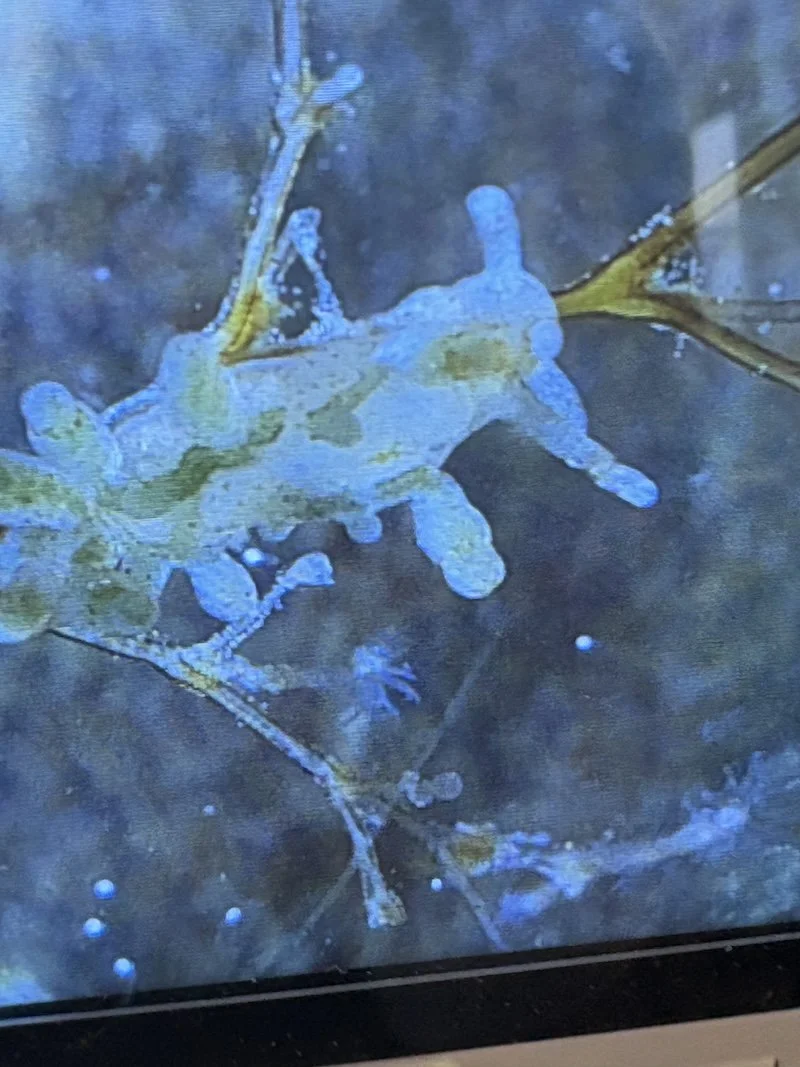
A view of intertidal creatures through the microscope. Photo: Deborah Hammer
One of my favorite activities was examining the intertidal zone for the many creatures who hide and thrive there. Some, like sculpins, lobsters, sea squirts, sponges, and crabs, we could examine right on the beach. Others, we took back to the lab to view under a microscope, including fetal horseshoe crabs, tunicates, tardigrades, baby mussels and flatworms. The lab was an adventure in itself. It had a vast book and specimen collection, including a passenger pigeon.
A highlight for everyone was a visit from Dr. Steve Kress, founder of Project Puffin, who told us about the challenges he faced when bringing Atlantic Puffins back to their ancient home along coastal Maine. He has since replicated his techniques all around the world to help others preserve or reestablish vulnerable species of birds. The following day, we took a boat ride to Easter Egg Rock where we could see puffins, eiders, guillemots, and other birds.

Atlantic Puffin, Kevin VandeVusse/Audubon Photography Awards
Hikes throughout the week helped us learn about other aspects of coastal Maine, including the geology, flora, and mycology. We had a chance to lie on the soft moss and take in the scent of spruce and ocean, while terns, Laughing Gulls, and American Crows called all around us.
One memorable night involved music from a band comprised of staff members and volunteers who played for us while we learned contra dancing. On the last night, we were treated to a feast with a festive dessert of Cream Puffin, the only type of puffin that humans should eat! Like campers worldwide, we also spent the last night singing, exchanging contact information, and bemoaning that we had to return to the “real” world in the morning.
I’m looking forward to sharing all that I’ve learned with the educators that I support in Arlington Public Schools and applying new strategies with my students.
I would highly recommend that my fellow educators apply for the chance to experience Hog Island Audubon Camp next summer.

Help Our Migrating Songbirds
We’re in the middle of fall migration season. For birdwatchers, fall migration can be challenging because the warblers are drabber, but, of course, it’s even more challenging for the birds!
Photo: Common Yellowthroats, Gary Robinette
Tom Blackburn
We’re in the middle of fall migration season. For birdwatchers, fall migration can be challenging because the warblers are drabber, but, of course, it’s even more challenging for the birds! A recent study published in Global Change Biology by scientists with the National Audubon Society identifies fall migration as the most dangerous time for warblers.
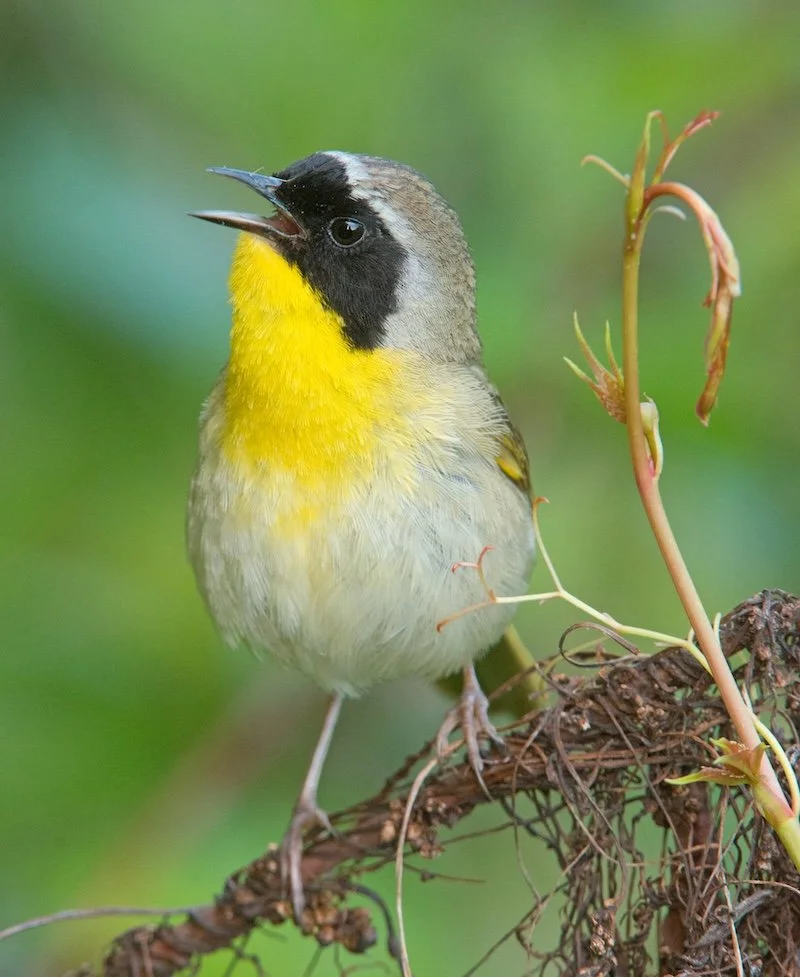
Common Yellowthroat, Randy Streufert
Southbound migration in the fall is perilous for warblers and other songbirds for multiple reasons. There are many juvenile bids that are inexperienced in migration. And the birds take longer routes back to their wintering grounds compared to the quicker and more efficient northward journeys. The longer southbound journeys expose them to more of the hazards that can weaken or kill them, such as light pollution and developed landscapes. National Audubon reports that some of the declining species closely associated with harm from light pollution and landscapes include the Common Yellowthroat, Connecticut Warbler and Prairie Warbler, all of which migrate through northern Virginia.
That report reminds us of important measures all of us can take to help the warblers and other birds passing through northern Virginia during the fall. Because most of them fly at night, they can be disoriented by bright lights from tall buildings and sky glow from light pollution. Some crash into the buildings and are injured or die. Other birds fly around the lights, exhausting themselves.
So, for the more than 160 million birds migrating through our area this fall, take a few simple steps to reduce some of those light hazards. If you live in a detached home or townhome
Turn off interior lighting at night, especially on upper floors
Close curtains or blinds
Down-shield exterior lighting or limit lights to the ground level
Turn off exterior decorative lighting
If you live in an apartment or condominium, or work in a multi-story building, turn off those interior lights at night and close your curtains or blinds. You also can help by contacting building managers and encouraging them to down-shield exterior lighting, turn off exterior decorative lighting, reduce lobby and atrium lighting, and extinguish spotlights and floodlights.
Let’s help our struggling birds so that we can welcome them back in the spring. If you have questions about other ways you can help, please contact our BirdSafe NoVA team at advocacy@nvbirdalliance.org.

Be Very Brave: Plant a New Native Shrub This Fall
So, it's the right time of year to plant, and native plants are easier to find than ever before. But . . . something is still stopping you. Hmm. What could that be?
Photo: Native shrubs, Margaret Fisher
Eileen Ellsworth
Fall is the perfect time of year to add new plants to your landscapes and gardens, especially shrubs. They anchor a garden or a landscape for many years and are an ideal choice for fall planting. It may seem counterintuitive to invest in any new plants with cooler weather on the way. But the winter to come is what provides the advantage, allowing the roots to get established well before being hit by the next summer’s heat. If you install the plants properly and faithfully water for the first few weeks, they will grow and thrive beyond expectations for years to come.
Purchasing new native plants, shrubs, and trees has never been easier. Several local nurseries specialize in native plant offerings. Thanks to the grass-roots efforts of Plant NOVA Natives and its many partners, traditional sellers and garden centers now offer a far wider array of native plants than ever before. As consumer demand has risen, plant sellers also willingly participate in native plant labeling programs to help their customers more easily identify them.
So, it's the right time of year to plant, and native plants are easier to find than ever before. But . . . something is still stopping you. Hmm. What could that be?
FEAR! You’re convinced you don’t know enough about native shrubs to pick the right one. You believe there is too much to learn and to decide between now and mid-month, so best to just let it be. You’ve imagined that the life of this shrub, upon which the biodiversity of your entire yard will no doubt depend, is doomed in your neglectful hands. On all counts, you are wrong.
Remember, we’re talking about native plants here. (It’s all we ever talk about here.) And native plants have lived in northern Virginia about 100 million years longer than humans have been alive on the planet. They know exactly what they’re doing, even if we don’t. We can trust that just about any native shrub we plant will grow, so long as its light and water requirements are more or less met. These plants are very old and quite resilient. They can adjust and adapt in surprising ways non-natives can’t. They evolved in local soil under local climate conditions. Water them a bit more during very hot or dry spells, and all will be well. They’ve got this. You are three simple decisions away from success.
First decision – Where to plant the shrub. Look for an empty spot, or one that currently contains a non-native species you’ve been meaning to remove. About how many hours of direct sun does the spot get? Does it collect water, or does it drain well? Consider whether there is room for some growth, because native shrubs can grow with considerable vigor. You can always prune them back – a lot, if necessary. Pick the spot, then say to yourself, “New shrub will live here.” Done. Time for the second decision.
Second decision – What kind of native shrub to buy. Winterberry, Red Chokeberry, Highbush Blueberry, Spicebush, Buttonbush, Arrow-wood Viburnum, Virginia Sweetspire, Wild Hydrangea. These, and many others, are listed and discussed on the Plant NOVA Natives “Native Shrubs” webpage. They are all wildlife powerhouses, and yes, there are many.
But here’s the most important thing to remember when making this decision: It doesn’t matter what species you choose, and you can’t make a wrong choice. Any new native shrub will contribute to biodiversity, strengthen the food web, act as a host for some native insect species, and stabilize the soil. Many species will only set fruit if you plant two of them, in which event you’re also helping to attract and feed the birds. (It’s always best to purchase the second shrub from a different grower or seller so they are genetically divergent and not clones of each other.) Some other resources you can use to choose a shrub include
the Plant NOVA Natives newly improved Plant Finder App, and
the Plant NOVA Natives Native Plant Plants for Northern Virginia guide, available in print or as a free download.
Spend no more than an hour browsing the lists, choose the one you like, then say to yourself, “I will plant this shrub, and I’m not changing my mind.” Done. Time for the third decision.
Third decision: Where will I buy the shrub. This is the easiest one of all. Plant NOVA Natives lists fall native plant sales, native plant garden centers, and participating conventional garden centers. In the case of the one-day native plant sales, you may want to call the grower or seller a couple of days in advance and ask them to make sure they will be bringing the shrub you are seeking. If not, many folks will work with you directly to make sure you get what you want, even if that means picking it up directly from their native plant nursery. Done. All done.
So, let’s be brave. Let’s make these three decisions, buy and plant the shrub, and water it appropriately. Despite our worries, chances are excellent that next spring we will find ourselves chatting up and getting to know a new, glorious, happy, fruitful, flowerful native shrub that is anchored in our soil and smiling at the sun.
We may know nothing about native shrubs, and yet we have everything we need: joy, meaning, commitment, resolve, centeredness, and the support of a like-minded community of earth-loving native plant gardeners.
And, of course, we have the native plants themselves, who figure it all out anyway, with or without us.

Remember to Vote for Conservation
It’s important to keep up with the actions (or inaction) of our federal lawmakers, but it’s equally important to take care to vote for conservation in the upcoming Virginia races.
Photo: Virginia State Capitol Building, Wikimedia user Skip Plitt via CC BY-SA 3.0
It’s important to keep up with the actions (or inaction) of our federal lawmakers, but it’s equally important to take care to vote for conservation in the upcoming Virginia races. Decisions made at the local and state level have significant consequences for our environment and natural resources.
So, take a moment to review the voting record of your Virginia legislators. A helpful guide is available from Virginia’s League of Conservation Voters, which has published the 2025 General Assembly Conservation Scorecard, available here. Each year, the LCV ranks all 140 Virginia lawmakers based on their votes for or against the environment and a healthy democracy. LCV has published the Scorecard every year since 2000. Advocates look to it as a valuable tool to determine whether their lawmakers are standing up for Virginia’s environment at the General Assembly.
Another useful tool for preparing for next year’s General Assembly is the Virginia Conservation Network’s Common Agenda, with details on issues that a coalition of conservation organizations works on during the annual session of the General Assembly. NVBA works with VCN during every session.
Let’s work together to help the birds and other wildlife in Virginia!
A Closer Look: Nature All Around Us, October 2025
Judy Gallagher is an NVBA board member and a regular surveyor of local wildlife who also captures photos of what she sees, in particular the less common species.
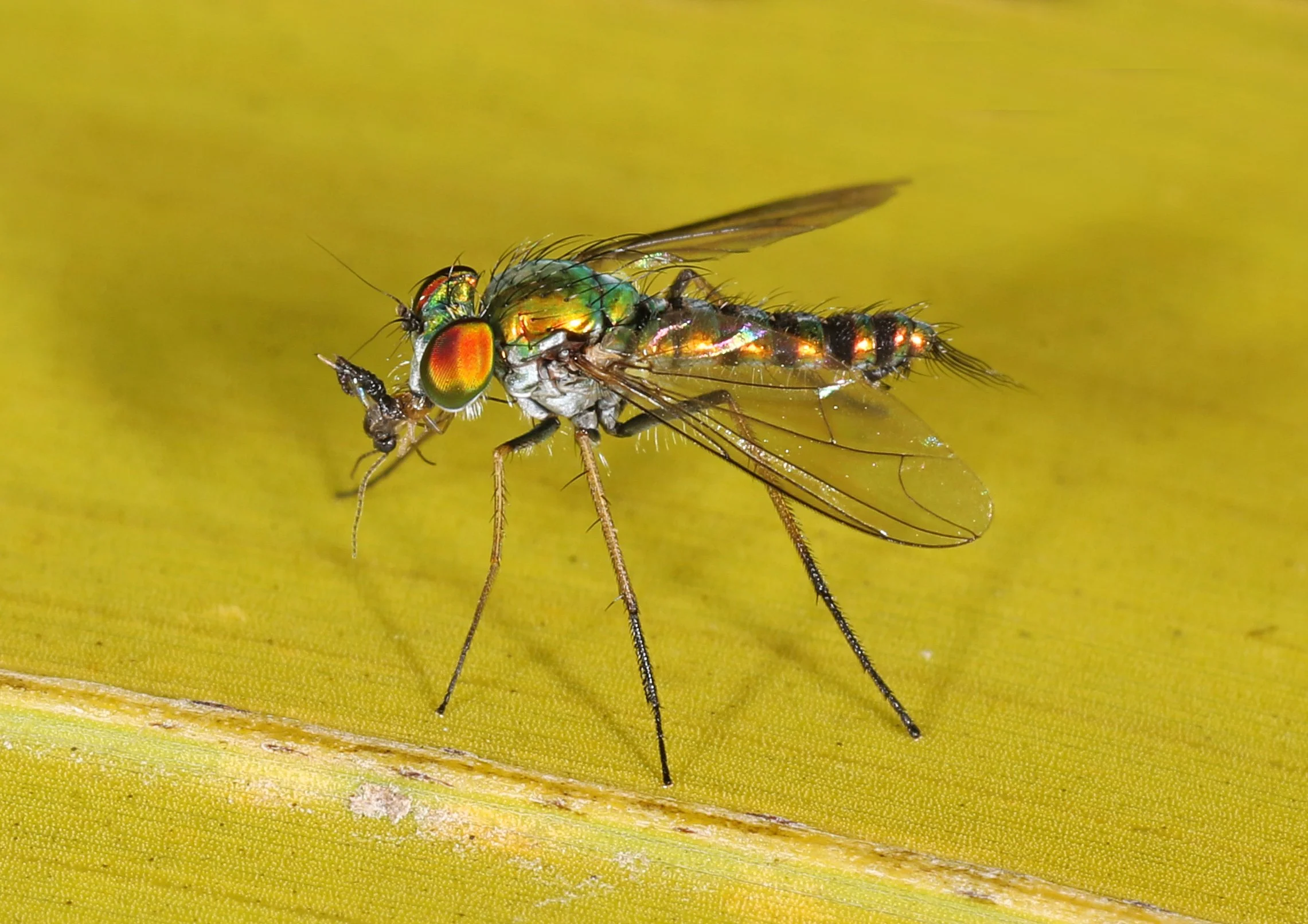
Photo: Long-legged Fly with prey, Judy Gallagher
Judy Gallagher
October 2025
When I was growing up, my mother cautioned me to never let flies touch my food because they ate poop and their feet were likely covered in poop. I assumed that all flies ate feces, and I guess it's not surprising that I grew up disliking them.

Dance Fly with sponging mouthparts. I don't know what substance it is sponging off my fingernail. Judy Gallagher
To understand what adult flies can eat, it is helpful to know about their mouthparts. Some adult flies have piercing-sucking mouthparts, while others have sponging mouthparts. In either case, food must be liquid or very finely grained in order to be sucked or sponged up. If a fly lands on or preys on solid food, it can regurgitate a drop containing digestive enzymes, which dissolves the food so that it can be eaten by the fly.
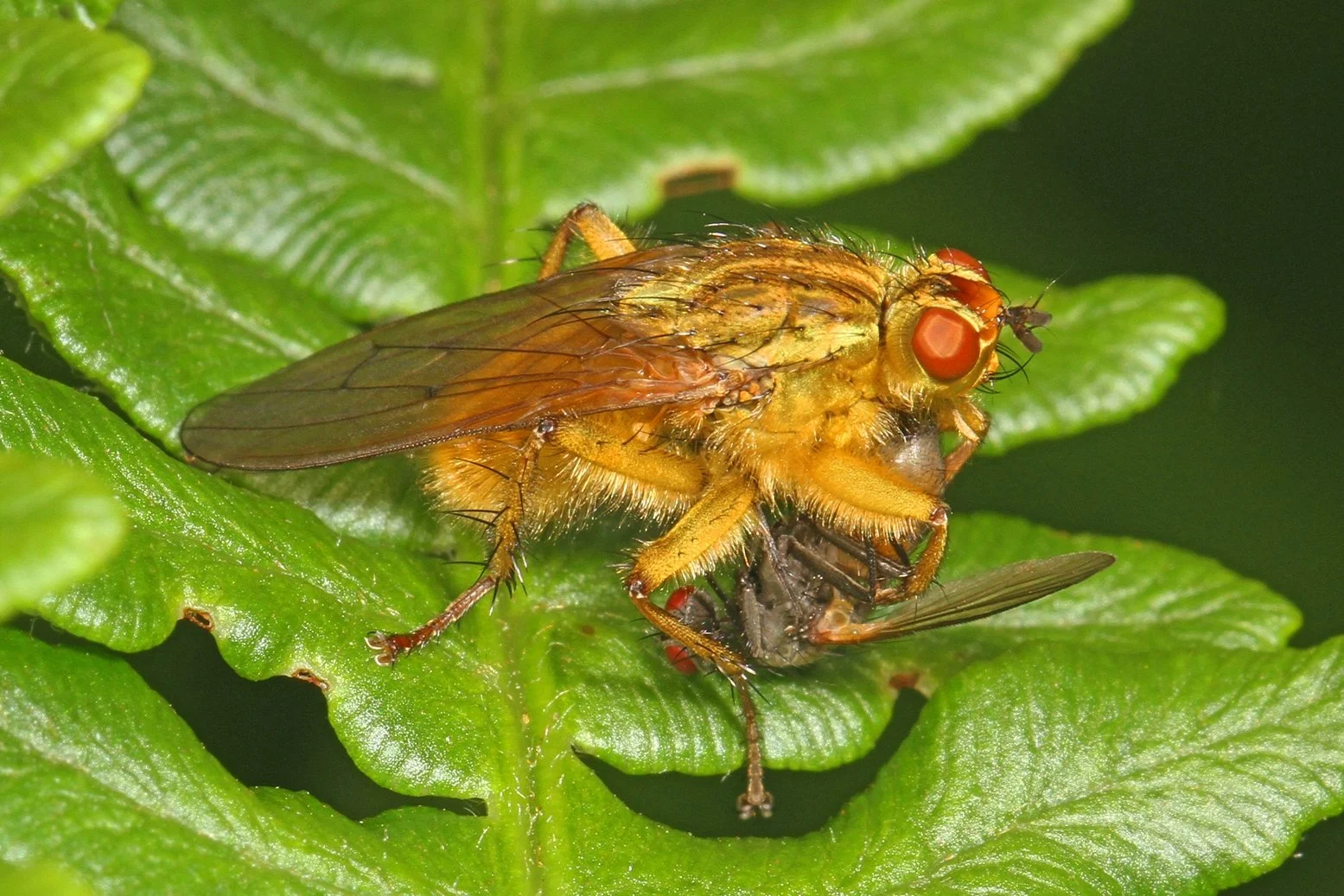
Golden Dung Fly with fly prey, Judy Gallagher
One would think that Dung Flies would eat dung. Larvae of some species do, but the adults mostly eat other insects, especially other flies, injecting them with digestive enzymes to liquefy them, and occasionally eating dung or nectar to get extra nutrition.
There is another fly family, Lesser Dung Flies, whose larvae also feed on dung and rotting seaweed. The larvae feed on other things too, as suggested by an alternate name, Lesser Corpse Fly. I was unable to find studies detailing what the adult flies eat.
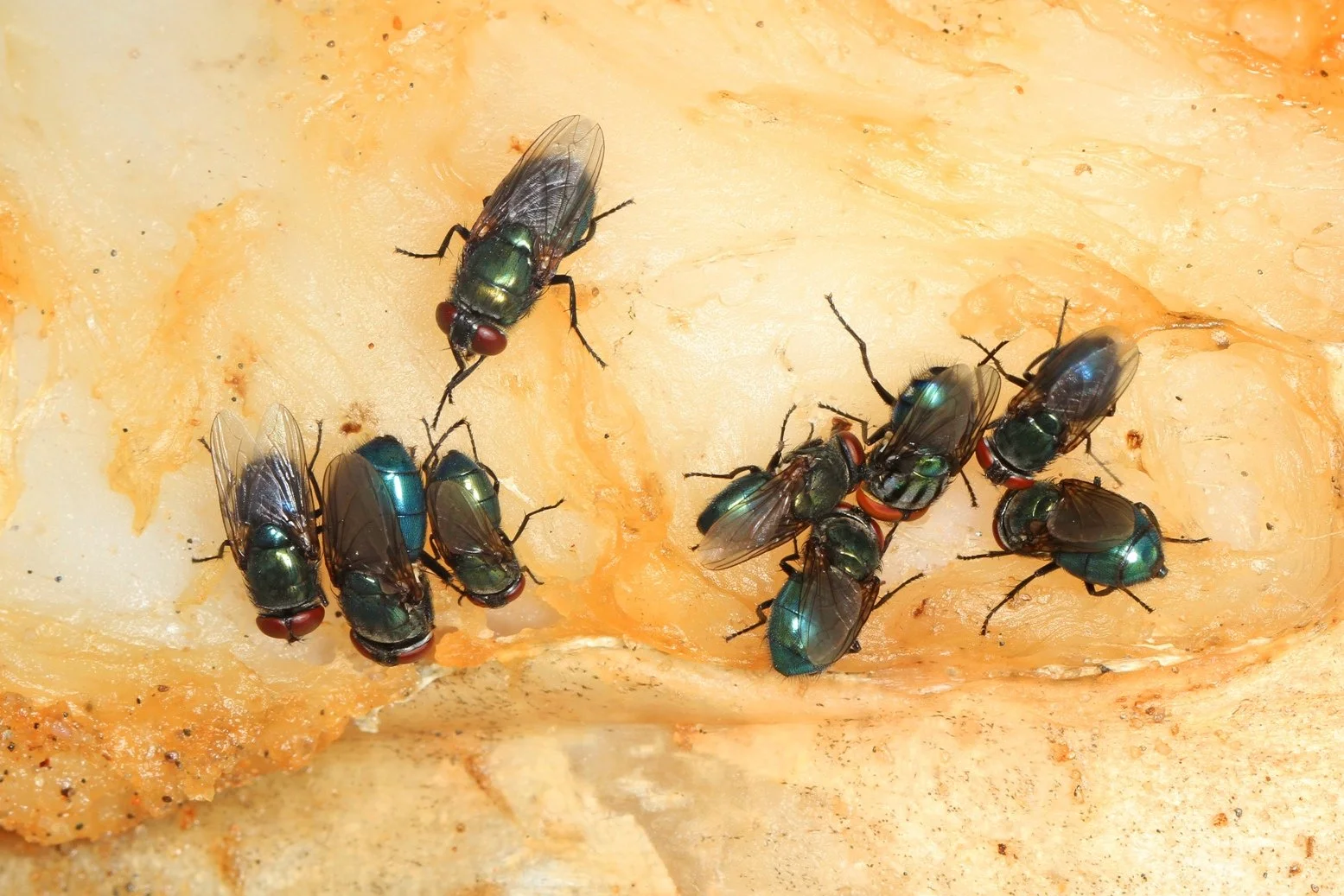
At least three different species of Blow Flies on dead catfish, Judy Gallagher
Adult Blow Flies like Bluebottle and Greenbottle Flies sometimes eat dung. They also dine on liquids from rotting garbage or carrion. It's easy to be disgusted by these flies' eating habits, but the flies play an important role in the ecosystem. They consume rotting organic matter and poop, which recycles nutrients back into the environment. They also help prevent the accumulation of rotting vegetation, dead bodies and waste.
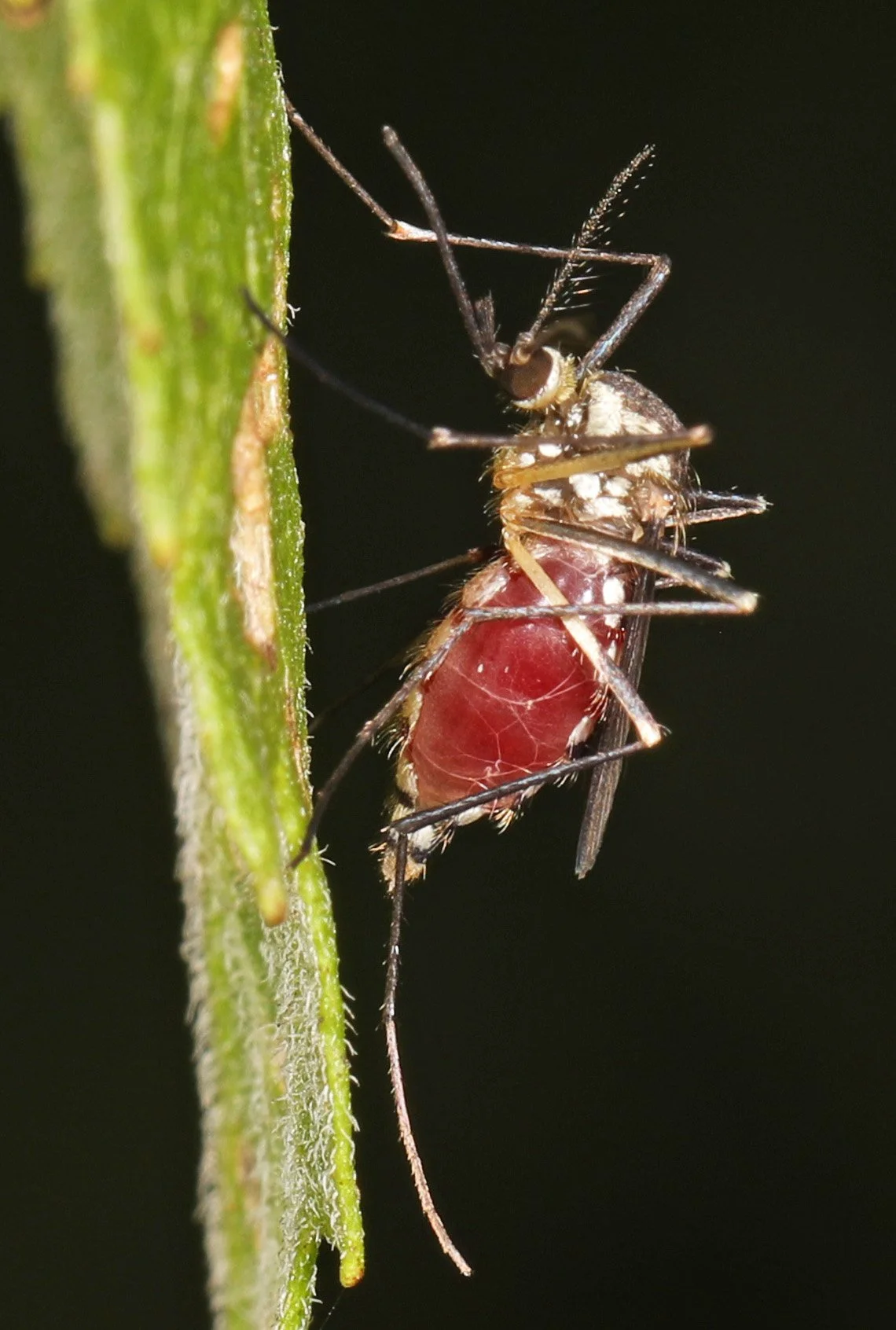
Eastern Treehole Mosquito showing signs of a recent blood meal, Judy Gallagher
As I'm sure you're all aware, some adult flies, especially mosquitoes, drink blood. In most cases, only the female bites, and she needs the proteins in blood to develop her eggs. But there are a few species, including the Stable Fly, where both males and females feed on blood. Scientists are studying anticoagulants secreted by blood-feeding flies, looking for medical applications in preventing blood clots, so some human good may come out of this annoying feeding strategy.
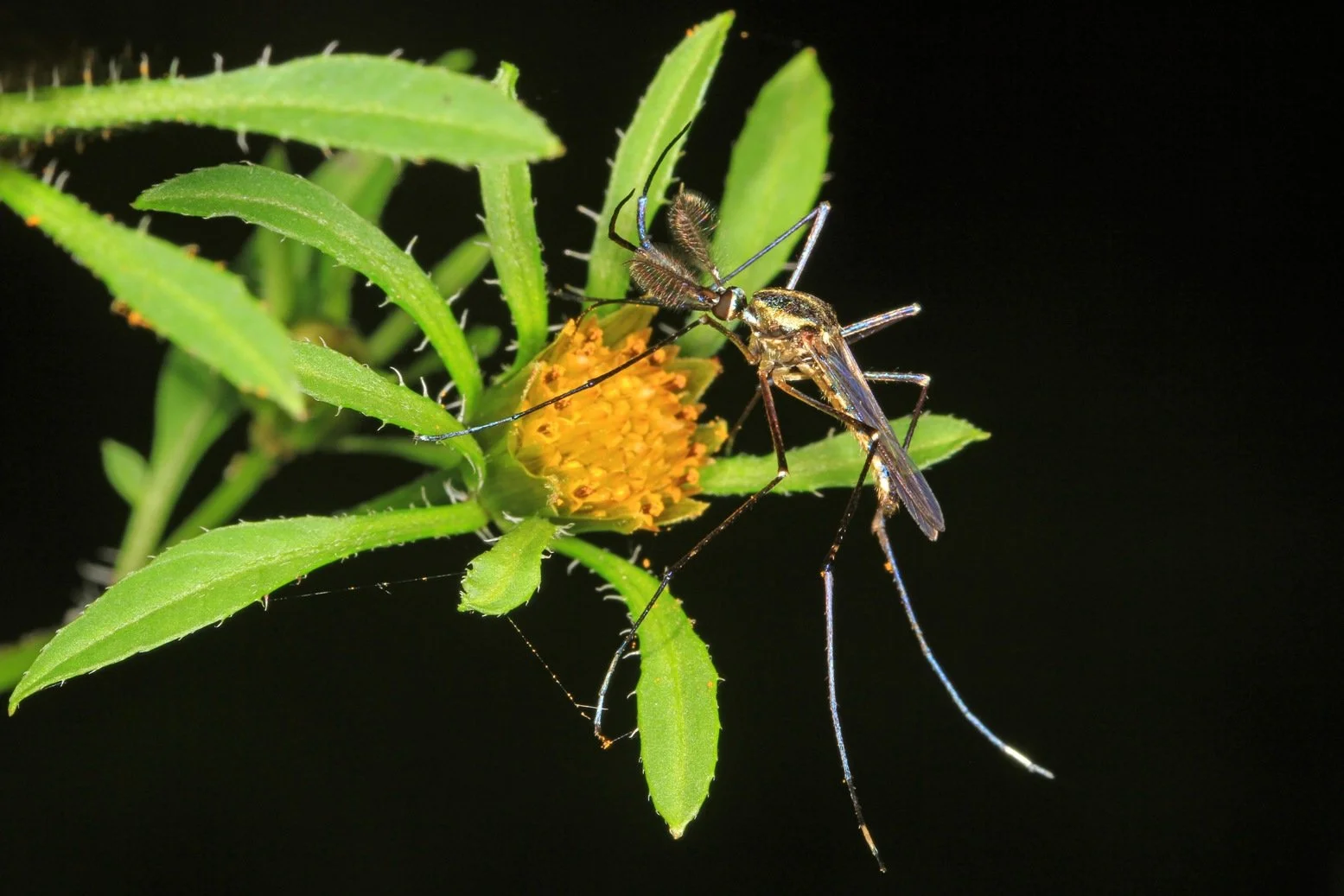
Elephant Mosquito male feeding on nectar, Judy Gallagher
Male mosquitoes mostly feed on nectar, and don't feed on blood. But a recent study on male mosquitoes preserved in amber suggests that male mosquitoes also may have fed on blood in the distant past. Hover Flies and many other adult flies feed on nectar, and often pollinate flowers while they're looking for a meal. Fruit Flies love the yeast and bacteria in overripe or fermenting fruits, and also feed on decaying vegetables and other sugary waste.
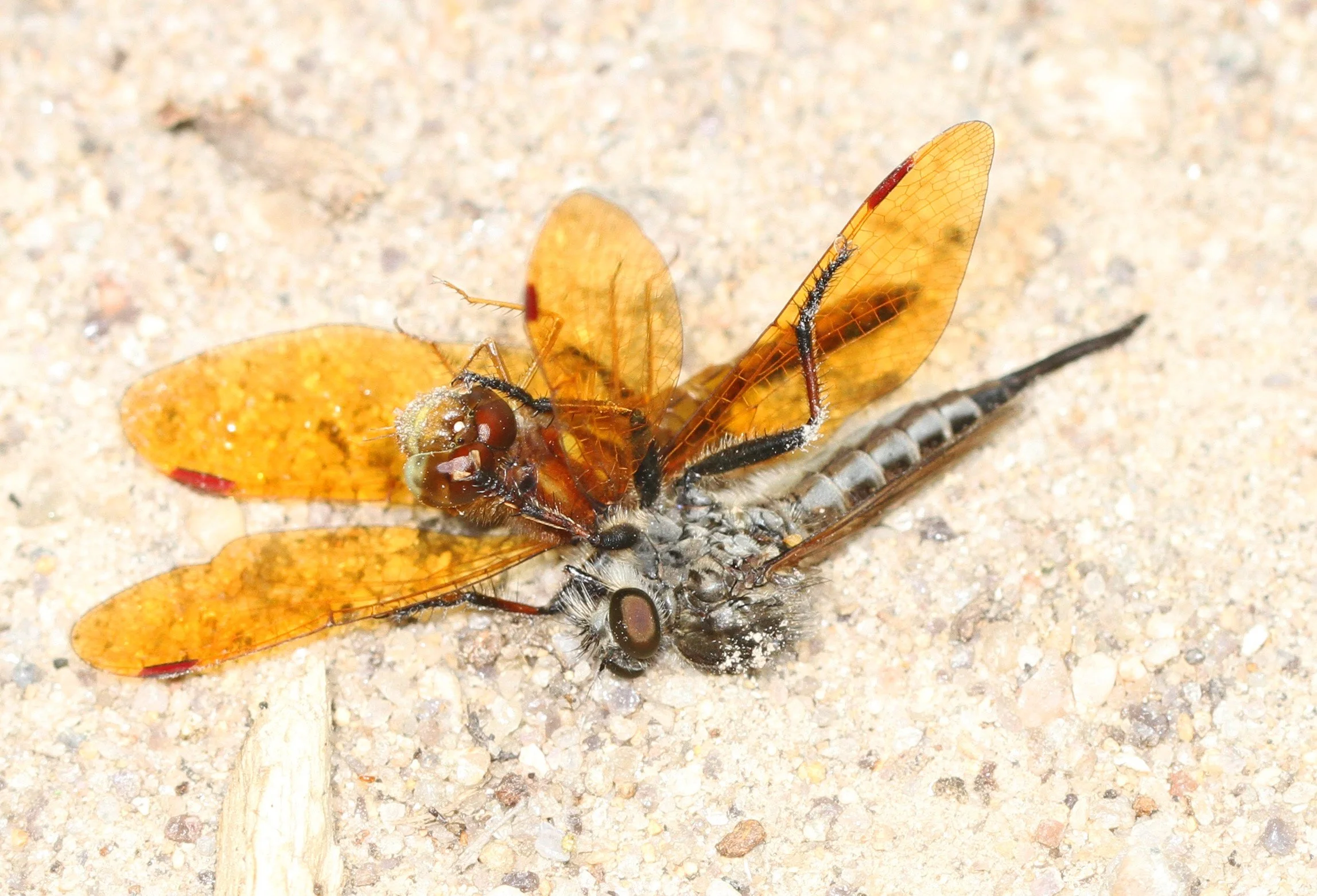
Robber Fly with Eastern Amberwing dragonfly, Judy Gallagher
I previously mentioned the Golden Dung Fly, a predator on other flies. There are several fly families that specialize in eating other invertebrates. The most famous are Robber Flies, who catch their prey in the air. They usually fly back to a perch with their prey, inject digestive enzymes to liquefy it, and eat while perched. This Robber Fly took down an Eastern Amberwing dragonfly, prey that was bigger and heavier than the Robber Fly, and the weight of the prey caused them to crash on the beach at Leesylvania State Park. After a short while, presumably sated, the Robber Fly extricated itself and flew off.
Long-legged Fly with prey, Judy Gallagher
Long-legged Flies also are predators. Some species in this family specialize in mosquito larvae and are useful as a control of pests.
Flies and their food choices play an important role in our environment. It's ironic that I was brought up to think of flies as being dirty, yet without flies, the world would be a much dirtier place. Let's hear it for the flies!
View more of Judy’s articles on A Closer Look: Nature All Around Us (formerly Observations from Meadowood).

Wildlife Sanctuary Almanac: It's Time for Goldenrods
One hallmark of autumn is the appearance of goldenrods along roadsides and in wild spaces; however, until recently, goldenrods have rarely been used deliberately in gardens.
Photo: Goldenrod blooming in Fairfax County, Famartin, CC BY-SA 4.0, via Wikimedia Commons
Alda Krinsman
One hallmark of autumn is the appearance of goldenrods along roadsides and in wild spaces; however, until recently, goldenrods have rarely been used deliberately in gardens. That omission is a shame, because goldenrods, along with asters, are not only attractive to human eyes but also, more importantly, support many pollinator and bird species with their nectar, pollen, and seeds.
There are over 138 species of goldenrod worldwide, the majority of which are found in North America. There are over 40 species of goldenrod native to Virginia alone. Most species of goldenrod belong to the genus Solidago, but some are also classified in the genera Euthamia and Oligoneuron. Perhaps one reason goldenrods have not been widely used in gardens is that many people believe goldenrods cause hay fever and are responsible for their sneezing and watery eyes every autumn. However, the goldenrod pollen is too heavy and sticky to be dispersed by wind. It is usually moved from plant to plant by bees and other pollinators. The true cause of hay fever is ragweed (Ambrosia species), which blooms around the same time of year as many goldenrods and is relatively inconspicuous. Ragweed produces abundant pollen, which is very light and dispersed by the wind. So next time you sneeze, blame the ragweed, not the goldenrod.
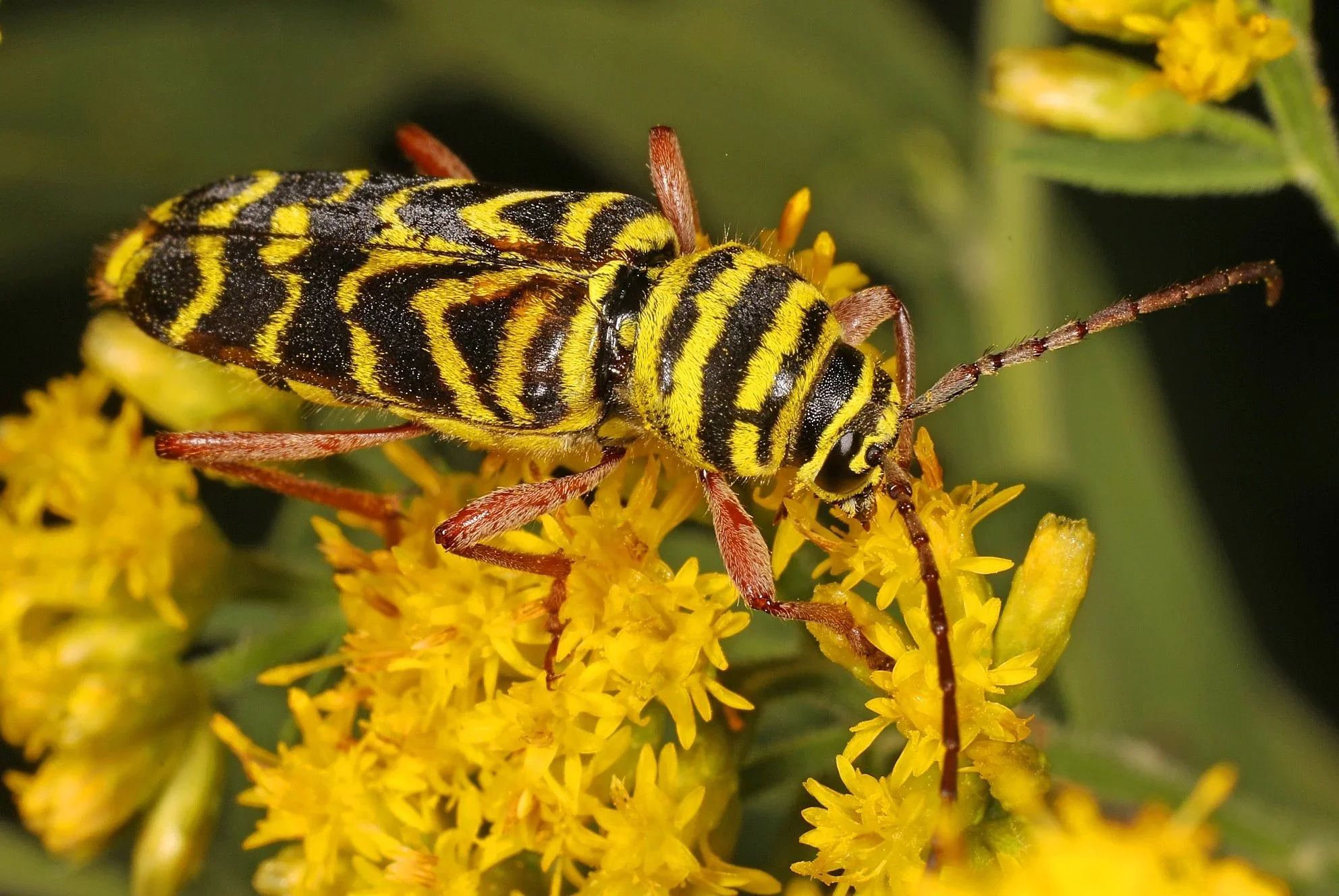
Locust Borer on Goldenrod, Judy Gallagher
In late summer and autumn, many bees such as bumblebees, sweat bees, and mining bees seek out the pollen provided by goldenrods to provision their nests. Male bees, butterflies and moths will seek out the nectar. Monarch butterflies will seek out goldenrod nectar on their migration south. The seeds of the plants are favored snacks by birds such as Goldfinch and Chickadees. Earlier in the growing season goldenrods also play an important role as larval hosts to up to 114 species of caterpillars, including Brown-Hooded Owlets and Goldenrod Hooded Owlets.

Goldenrod Crab Spider, Judy Gallagher, CC BY 2.0, via Wikimedia Commons
Goldenrod species tolerate or even thrive in a range of environmental conditions. Some do well in part shade, and some prefer full sun. Some do well in dry soils, and others prefer moist soils. So, when selecting a goldenrod, take those factors into consideration. Although goldenrods provide valuable ecoservices, not every species is right for every situation. Some goldenrod species such as Canadian goldenrod (Solidago canadensis) can spread aggressively and are best used in large areas such as meadows and restoration projects. However, there are quite a few species that are good choices for garden situations. Blue-stemmed goldenrod (Solidago caesia) is a good choice for shady woodland gardens. Showy goldenrod (Solidago speciosa) would be a good choice for sunny dry areas, and wrinkleleaf goldenrod (Solidago rugosa) is recommended for poorly draining areas, although it also does well in garden soil with average moisture. Early goldenrod (Solidago juncea), which is one of the first goldenrods to bloom in summer, and anise scented goldenrod (Solidago odora) also are good candidates for average garden situations.
Even well-behaved goldenrods may naturalize quickly. If you find you have too much of a good thing, control the spread by dividing your plant every few years and give some to your friends!
Catch up on past Wildlife Sanctuary Almanac articles here.

Wildlife Sanctuary Almanac: Growing Virginia Native Plants from Seed
Fall is coming and gardeners’ thoughts may turn to collecting seeds for planting next spring.
Photo: Milkweed seeds, Larry D. Moore, CC BY 4.0, via Wikimedia Commons
Laura Beaty and Donna Murphy
Fall is coming and gardeners’ thoughts may turn to collecting seeds for planting next spring. It’s best to remember that seed collecting begins with a knowledge and understanding of protocols and ethics of collecting seed outside of your own garden. Most people are aware they need the owner’s permission before gathering seeds from friends’ and neighbors’ gardens. It’s doubly important to get permission from land managing agencies before gathering any seeds from parks, forests and wilderness areas—even utility rights-of-way. You don’t want to impair the agencies’ conservation efforts.
A prominent native plant grower in our area, Earth Sangha, recommends that hobbyists not gather seeds from wild populations at risk of over-collection, as it also reduces food sources for wildlife. In addition to obtaining permission from the relevant land management agencies, it’s a good idea to seek guidance from local conservation organizations, like NVBA’s Wildlife Sanctuary Program, the Virginia Native Plant Society and local Master Naturalists if you are collecting outside your own garden and those of friends and neighbors.
Milkweed seeds. Photo: Larry D. Moore, CC BY 4.0, via Wikimedia Commons
Seed collecting begins after flowering is completed and ideally late in the bloom season, giving the plant an opportunity to complete seed maturation. When collecting, use clearly marked bags with the plant’s name, date and location (site). You can custom-design envelopes to provide the information you’ll want to have on the seeds you collect for future use. Too often we have all assumed we’d remember what seed we’ve collected--Wrong! Keep good records. Brown bags (not plastic) help the seeds to dry out slowly. It’s fine to delay cleaning the seeds (separating seeds from dried flowers) for a rainy day when you have indoor time.
Always look for fully ripened seeds, which ensures a mature embryo. Keep in mind that when seeds turn from green or yellow to tan, brown or black, and mature fruits turn red, orange or blue, they are ready to collect. When the fruits are ready the game is on for who will get to them first. Don’t wait! Many of us have missed collecting them on time and lost out to the birds and other wildlife.
When pulp, a germination inhibitor, is cleaned from fruit seeds, the seed is ready to grow when time and temperature are right. Timing is important. Once a seed is separated from the parent plant, its viability for producing a new plant is limited. It either germinates successfully or fails to germinate before it uses up the energy reserves it stores. Nature has provided a longer “viability” period to some seeds, but following regular protocols of processing is best practice. Most seeds require a cold period to ensure a viable embryo. Therefore, over-wintering the collected seeds in a safe/secure un-heated outdoor room, shed, or garage will prepare them for spring germination.
You can prepare seed trays ahead of planting time in mid-March. Just cut coco-rolls to fit into the bottom of the trays for good drainage. There are a number of prepared seed-planting mixtures, or you can develop your own. Planting directly into the ground is iffy: Many birds will be watching, not to mention the squirrels. As the seedlings grow you can transfer them to individual small pots for better root development; in time, larger pots will accommodate their expanding roots—that’s a success!
Catch up on past Wildlife Sanctuary Almanac articles here.
Letter to Our Members
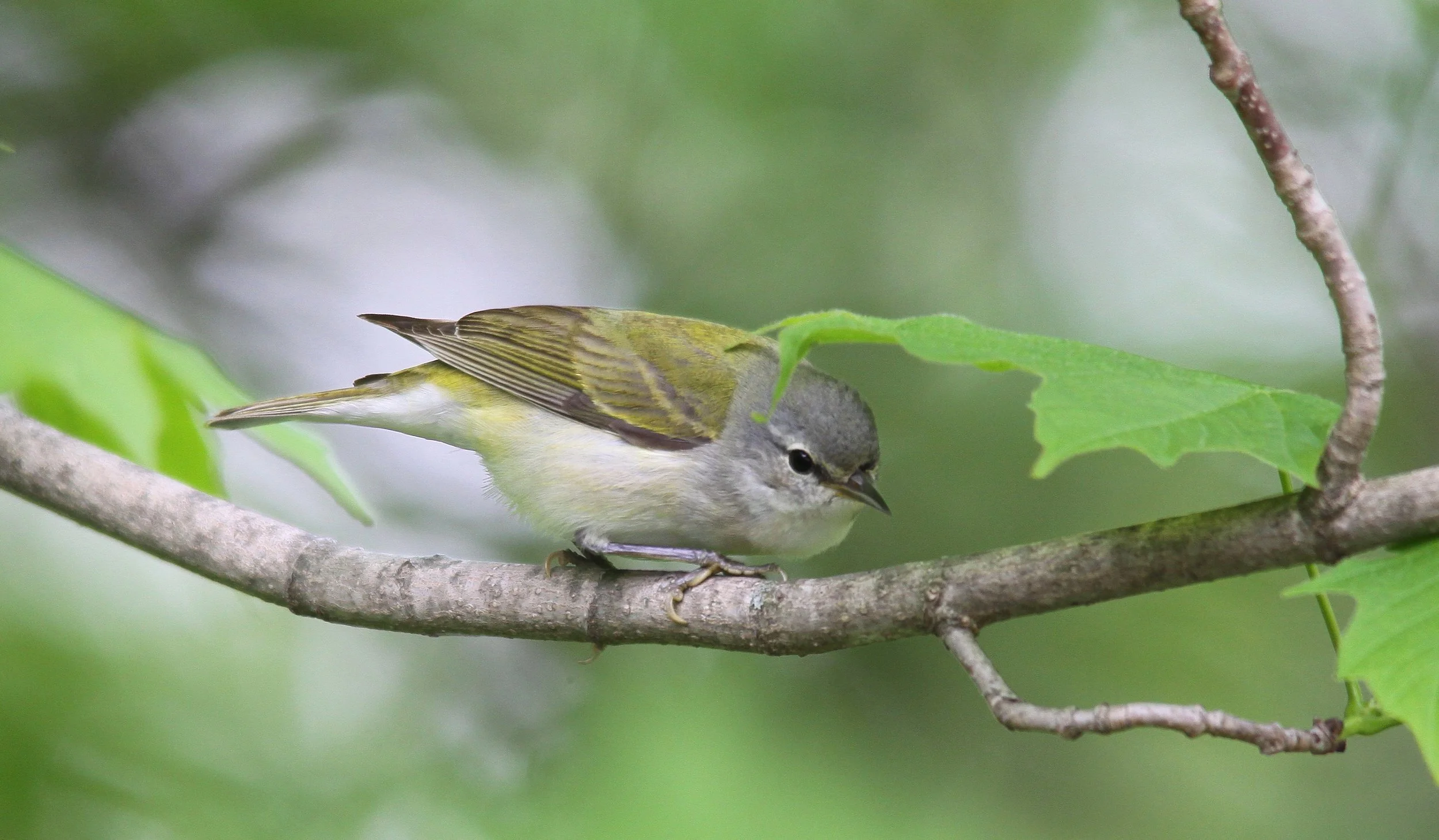
Fall migration is starting! I saw that someone had reported a Tennessee Warbler in northern Virginia just the other day, which got me musing about this migration season -- the challenges the birds face, how to make it safer for migrating birds and how to enjoy the spectacle of migration.
Photo: Tennessee Warbler, Ben Cvengros/Audubon Photography Awards
Libby Lyons, President
Fall migration is starting! I saw that someone had reported a Tennessee Warbler in northern Virginia just the other day, which got me musing about this migration season -- the challenges the birds face, how to make it safer for migrating birds and how to enjoy the spectacle of migration.
Although Spring’s northward-migrating birds usually get more attention because of their bright colors and breeding season songs, many of the same birds pass through our region on their way south, though in much drabber garb. Joining the round-tripping adults are the young-of-the-year birds undertaking their first migration.
Migration can be one of nature’s most spectacular phenomena. Each year it presents us the opportunity to see these amazing creatures for just two brief periods. Alas, it is also one of the most physiologically demanding times in a bird’s life. Several factors can make it even more taxing.
Many of the birds flying south over the U.S. faced another summer of severe Canadian wildfires, particularly in northern forests where many of them breed. The fire season is not yet over, but 2025 has already become the second worst year for Canadian wildfires, second only to 2023. Fire has long been a natural part of forested ecosystems, but the frequency, severity and size of the fires has been increasing recently. The smoke and fire can kill adults, nestlings and young birds if they are trapped in a rapidly moving fire, or they may be harmed by inhaling smoke-filled air. The fires also can kill their food sources and alter their habitats. For example, frequent fires can change the age structure of a forest and an area’s tree species – a particular hazard for species that nest in old-growth forests. Fires in their migration paths also can require long detours in an already arduous journey. So, even before they reach our area, having flown perhaps 1,000 miles, many migrants have had to overcome significant hazards. Learn more about the impact of Canada’s wildfires on Birds Canada’s 2024 post on how boreal birds respond to forest fires.
Young birds’ inexperience also can compound the long-distance challenge of migration. Many young birds, as well as experienced adults, can be distracted easily by human light sources, causing them to waste time and energy. While we can’t do anything about Canada’s wildfires, we can do something to make it safer for birds to migrate through our area. Please turn off your outdoor lights from now through November 30, especially any uplighting! NVBA’s website provides valuable information about reducing risk for birds in its Lights Out for Birds campaign.
So how can you enjoy this fall migration? I will be birdwatching locally, but I also will head to Cape May, New Jersey in late September with birding friends. The geography of that area, with the Cape May peninsula protruding into the Delaware Bay, serves to concentrate and funnel the southbound birds. Not only can I see many songbirds in forests and fields there, but there also will be scores of raptors in the air. If you ever have the opportunity, a Fall visit to the Cape May Point State Park's Hawkwatch platform is a treat, with the local experts calling out the dozens to hundreds of raptors of more than a dozen species flying overhead.
Closer to home, our local parks once again will be filled with migrating songbirds, but they will be quieter and not so brightly colored. When I started birdwatching many decades ago, I found the section on warblers in my Peterson’s Field Guide to the Birds quite daunting, particularly the four pages of “Confusing Fall Warblers.” Now that I am better at identifying Spring warblers from their colors and plumage patterns, I relish the challenge of recognizing patterns without the color. Ironically, that Tennessee Warbler spotted this week is so drab that its plumage doesn’t much vary seasonally!

Connecticut Warbler at Upton Hill Regional Park, Matt Felperin
And I will be watching for one species we see only in the Fall. If I’m lucky, I might catch a glimpse of the rare, skulking Connecticut Warbler, which migrates up the Mississippi River valley in the Spring. And to witness raptor migration closer to home, I plan to visit Snicker’s Gap located between Loudoun and Clarke Counties, only 45 miles from my home in Arlington. The Virginia Department of Wildlife Resources has conducted a yearly count of migrants at Snicker's Gap Hawk Watch since 1990. Its website provides directions as well as useful information on the best times to visit and what you may see.
So join me in taking steps to protect our fall migrants and enjoying the spectacle.

Hispanic Heritage Month and the World of Birds
From September 15 to October 15, Hispanic Heritage Month celebrates the histories, cultures, and contributions of Hispanic and Latino communities in the United States.
Photo: Resplendent Quetzal, Charles Gangas/Audubon Photography Awards
Josefina (Jo) Doumbia
From September 15 to October 15, Hispanic Heritage Month celebrates the histories, cultures, and contributions of Hispanic and Latino communities in the United States. For bird enthusiasts, it’s also a chance to honor the deep connections between these cultures and the avian world, connections that stretch from ancient traditions to modern conservation efforts.
Hispanic cultures across the Americas long have recognized birds as symbols of beauty, resilience and freedom. In the Andean regions, the Andean Condor soars as a national emblem and a messenger in Indigenous lore. In Mexico, the Resplendent Quetzal has inspired art, mythology, and conservation movements. Along the Caribbean coasts, colorful species like the Cuban Tody or the Puerto Rican Parrot hold both ecological and cultural significance.
These birds, and countless others, rely on the same flyways and ecosystems that link the Americas. Many species that breed in the U.S. migrate south each year, passing through or wintering in Latin American countries. Protecting their habitats is a shared responsibility that transcends borders.
Nowhere is this richness more evident than in Colombia, home to over 1,900 bird species, making it the second most bird-diverse country on Earth. From tiny hummingbirds in cloud forests to flocks of Scarlet Ibises in coastal mangroves, Colombia’s landscapes are a living showcase of avian beauty and biodiversity. Its conservation challenges and successes are directly tied to the health of migratory bird populations that also grace North American skies.
Hispanic Heritage Month also is a time to recognize the many Hispanic scientists, educators and community leaders who advance bird conservation. From field researchers in the tropics to grassroots advocates restoring wetlands, their work strengthens global efforts to protect avian biodiversity.
By celebrating cultural heritage and natural heritage together, we deepen our shared commitment to ensuring that future generations, across all the Americas can continue to experience the wonder of birds in the wild.
Please take a few minutes to watch this video to learn more about the partnership between NVBA and Casa Chiralagua in Alexandria, and consider volunteering to help us strengthen links with our local Hispanic community.